Solids
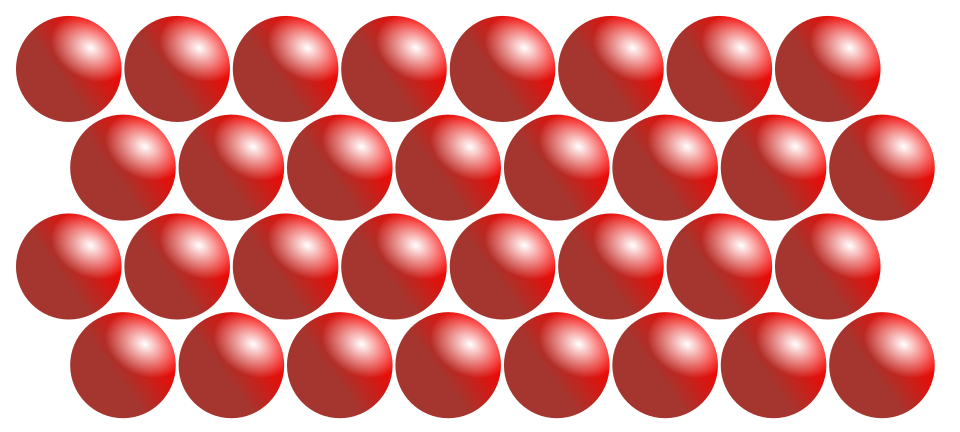

Solid is one of the four common states of matter. The molecules in solids are closely bound together, so they can only vibrate. This means solids have a definite shape that only changes when a force is applied. This is different to liquids and gases which move randomly, a process called flow.
Solids can resist forces applied to their surface.
When a solid becomes a liquid, this is called melting. Liquids become solid by freezing. Some solids, like dry ice, can turn into gas without turning liquid first. This is called sublimation.
Kinds of solids
The forces between the atoms in a solid can take many forms. For example, a crystal of sodium chloride (common salt) is made up of ionic sodium and chlorine, which are held together by ionic bonds. In diamond or silicon, the atoms share electrons and make covalent bonds. In metals, electrons are shared in metallic bonding. Some solids, like most organic compounds, are held together with “van der Waals forces” coming from the polarization of the electronic charge cloud on each molecule. The dissimilarities between the types of solid come from the differences between their bonding.
Metals
Most metals are strong, dense, and good conductors of electricity and heat. The mass of the elements in the periodic table, those to the left of a diagonal line drawn from boron to polonium, are metals. Mixtures of two or more elements in which the big component is a metal are known as alloys.
People have been using metals for many purposes since prehistoric times. The strength and relialbility of metals has led to their widespread use in making of buildings and other things, as well as in most vehicles, many tools, pipes, road signs and railroad tracks. Iron and aluminium are the two most commonly used metals. They are also the most common metals in the Earth’s crust. Iron is most commonly used in the form of an alloy, steel, which has up to 2.1% carbon, making it much harder than pure iron.
Since metals are good conductors of electricity, they are valuable in electrical tools and for carrying an electric current over long distances with little energy loss. Because of this, electrical power grids rely on metal cables to get electricity. Home electrical systems, for example, are wired with copper for its good conducting uses. The high thermal conductivity of most metals also makes them useful for stovetop cooking utensils.
Minerals
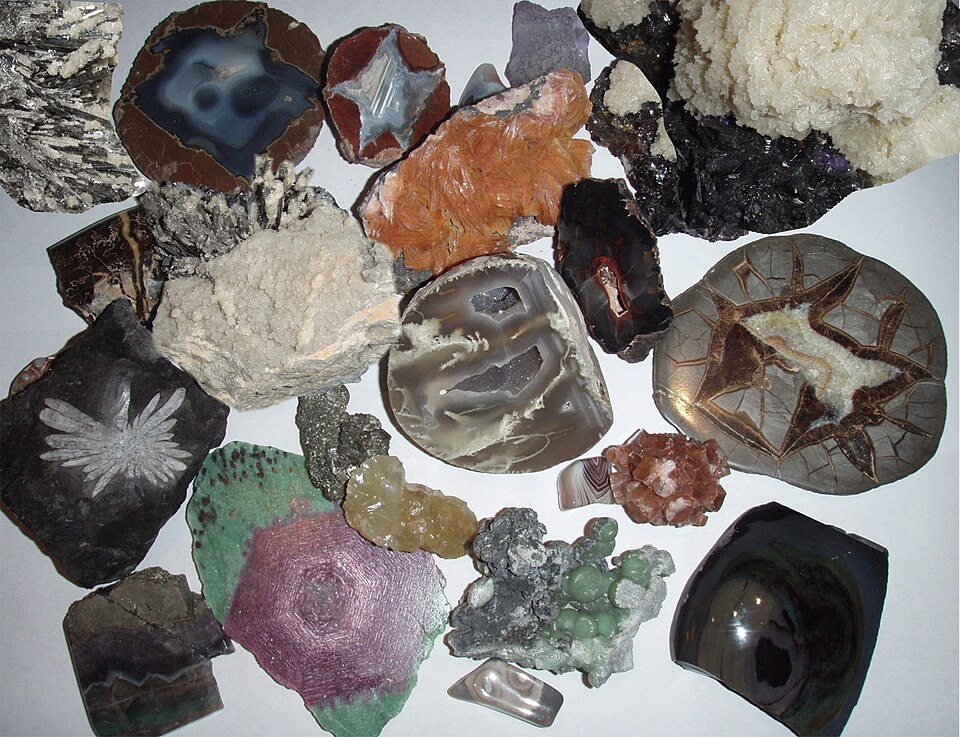
Minerals are natural solids formed through many geological processes and having a crystal structure with uniform physical things throughout..
Written for younger readers
Solids, in simpler words
This version comes from Wikijunior, a set of books written for children aged 8 to 11. It is shorter and uses plainer language than the article above.
From Wikijunior: The Elements
=Solids=
So what is a solid? Solids are usually hard because their molecules have been packed together. The closer your molecules are, the harder you are. Solids also can hold their own shape. A rock will always look like a rock unless something happens to it. The same goes for a diamond. Even when you grind up a solid into a powder, you will see tiny little pieces of that solid under a microscope. Liquids will move and fill up any container. Solids keep their shape.
In the same way that a solid holds its shape, the atoms inside of a solid are not allowed to move around too much. This is one of the physical characteristics of solids. Atoms and molecules in liquids and gases are bouncing and floating around, free to move where they want. The molecules in a solid are stuck in place. The atoms still spin and the electrons will still fly around, but the entire atom will not change position.
Solids can be made up of many things. They can have pure elements or a variety of compounds inside. When you get more than one type of compound in a solid it is called a mixture. Most rocks are mixtures of many different compounds. Concrete is a good example of a man-made mixture.
The opposite of a mixture is something called a crystal. When a solid is made up of a pure substance and forms slowly, it can become a crystal. Not all pure substances form crystals because it is a delicate process. The atoms are arranged in a regular repeating pattern called a crystal lattice. A crystal lattice is a very exact organization of atoms.
A good example is carbon. Carbon actually makes more than one kind of crystal lattice, although most elements only make one. A diamond is a perfect crystal lattice while the graphite arrangement is formed into microscopic sheets.

Where this page comes from
The article above is adapted from “Solids” on Simple English Wikipedia, by its contributors. We removed reference markers, navigation boxes and tables, expanded measurement templates into readable numbers, and kept the prose otherwise intact. The simpler version is adapted from Wikijunior on Wikibooks.
Both sources are published under CC BY-SA 4.0, so this page is published under the same licence. You may share and adapt it, including commercially, as long as you credit the original and keep the same licence.
Worksheets, answer keys and printable layouts elsewhere on K5Print are our own work and are not covered by this licence.