Spectrum

This article is about the visible spectrum. For all other uses see: Spectrum (disambiguation)
A spectrum, plural: spectra, is a band of several colours: violet, indigo, blue, green, yellow, orange and red. A spectrum can be seen if the Sun’s light is passed through a prism and allowed to gather on a white screen. This visible spectrum is part of the larger electromagnetic spectrum. Spectroscopy is the study of spectra.
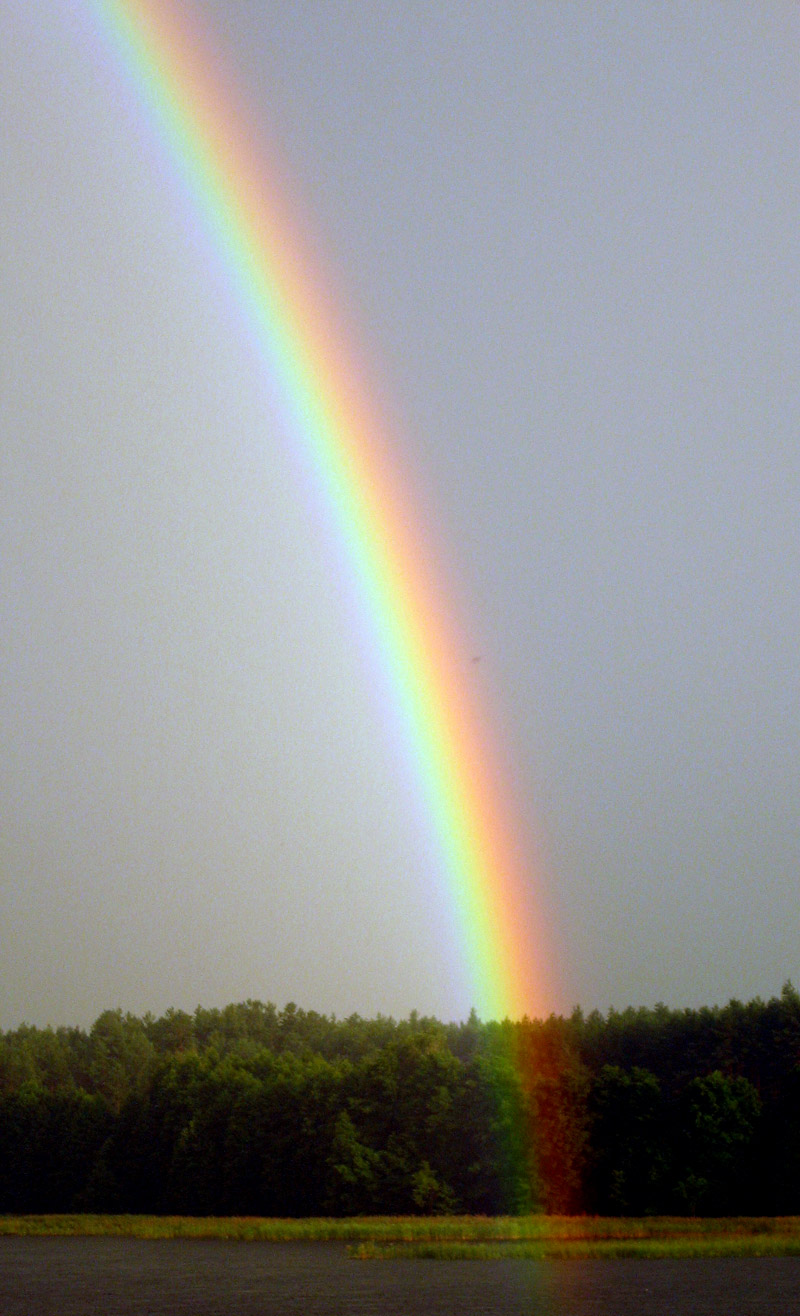
A natural example of a spectrum is a rainbow. The word spectrum was first used by scientists studying optics. They used the word to describe the rainbow of colors in visible light when separated using a prism. The spectrum seen when light passes through a prism is an example of the dispersion of light. The material from which the prism is made has a different refractive index n than air. Usually, n prism is greater than n air , and n air is taken to be approximately one. This implies that light travels a little slower in the material of the prism than in the space surrounding it. The angle of refraction can be determined from the angle of incidence and the refractive indexes using Snell’s law.
The reason why the white light separates into in its component colors instead of remaining white is because the shorter wavelengths are refracted, or bent, more than the longer wavelengths. Thus, red, having the longest visible wavelength, will appear closest to the line perpendicular to the surface of the material (the normal), that is, it will be bent the least. Violet light, with the smallest wavelength in the visible spectrum, will be bent the most. The rainbow produced will always be in the same order: red, orange, yellow, green, blue, indigo, violet.
Where this page comes from
The article above is adapted from “Spectrum” on Simple English Wikipedia, by its contributors. We removed reference markers, navigation boxes and tables, expanded measurement templates into readable numbers, and kept the prose otherwise intact.
Both sources are published under CC BY-SA 4.0, so this page is published under the same licence. You may share and adapt it, including commercially, as long as you credit the original and keep the same licence.
Worksheets, answer keys and printable layouts elsewhere on K5Print are our own work and are not covered by this licence.