Sulfur
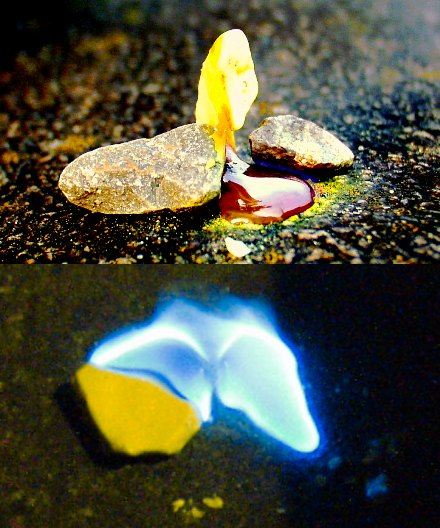

Sulfur (American English) or sulphur (British English) is a chemical element. The symbol for sulfur is S, and its atomic number is 16. Old English name, appearing in the Bible, is brimstone.
Properties
Sulfur is a yellow solid that is a nonmetal. It is fragile (easily broken) and crystalline. It burns easily, releasing toxic fumes of sulfur dioxide. It has a very faint odor. If it is melted and cooled very quickly, it makes a rubbery form of sulfur that is called “plastic sulfur”. It gradually turns back into the yellow brittle form. It does not dissolve in water. The smell normally known as “sulfur” comes from hydrogen sulfide and similar chemicals. These sulfides are produced when things decay without air.
Chemical compounds
Sulfur compounds are chemical compounds containing sulfur ions. Sulfur comes in several forms: oxidation states of -2 (hydrogen sulfide), +4 (sulfur dioxide, sulfites) and +6 (sulfuric acid, sulfates) are most common, although there are other oxidation states.
Sulfur oxides
- Sulfur dioxide, colorless toxic heavy gas, used to preserve dried foods
- Sulfur trioxide, various forms, sometimes liquid, irritating and toxic
- Oleum, sulfur trioxide dissolved in sulfuric acid
Sulfur acids
Mixture of sulfur oxides and water
- Sulfurous acid, unstable, weak
- Sulfuric acid, stable, strong acid, most used chemical after water
- Hydrogen sulfate, an ion produced when sulfuric acid only loses one acidic proton
- Hydrogen sulfide, weak smelly gas, becomes acidic when dissolved in water
Sulfides
Salts of hydrogen sulfide
- Ammonium sulfide, used in stink bombs
- Antimony trisulfide, used in match heads
- Arsenic trisulfide, less toxic arsenic compound
- Barium sulfide, used to make barium from barium sulfate
- Bismuth(III) sulfide, bismuth ore
- Iron sulfide, found as pyrite naturally
- Lead(II) sulfide, found as galena naturally
- Selenium disulfide, used in hair treatment creams
- Potassium sulfide, reacts with water
- Silver sulfide, tarnish on silver objects
- Thallium(I) sulfide, infrared detector
- Tin(II) sulfide, dark brown solid
- Tin(IV) sulfide, gold solid, “mosaic gold”
- Zinc sulfide, used in fluorescent bulbs
Sulfites
Salts of sulfurous acid
- Sodium sulfite, used to preserve dried foods
- Potassium sulfite, used to preserve foods
Sulfates and bisulfates
Salts of sulfuric acid
- Alums, all of them
- Aluminium sulfate
- Ammonium sulfate, used in fertilizers
- Barium sulfate, used to take X-rays of digestive system
- Cobalt(II) sulfate, used in pigments
- Copper(II) sulfate, used to kill algae
- Chromium sulfate, used to make chrome alum
- Iron(II) sulfate, used for reduction
- Iron(III) sulfate, rare
- Lead(II) sulfate, white solid in lead acid batteries
- Manganese(II) sulfate, used to add manganese to soil
- Nickel(II) sulfate, used to make nickel compounds
- Sodium bisulfate, used in lowering pH
- Sodium sulfate, used in detergents and paper making
- Thallium(I) sulfate, colorless odorless tasteless highly toxic
- Tin(II) sulfate, used to make other tin compounds
- Zinc sulfate, used in pigments
Other sulfur compounds
Sulfur(I) chloride, yellow liquid
Sulfur(II) chloride, red odorous liquid
Disulfur dinitride, colorless solid
Tetrasulfur tetranitride, orange solid
Sulfur tetrafluoride, colorless toxic gas
Disulfur decafluoride, colorless toxic liquid
Sulfur hexafluoride, colorless heavy gas
Occurrence and preparation
Sulfur can be found in the earth near volcanoes. Many minerals contain sulfur ions. Coal contains sulfur ions which are released when it burns. Hydrogen sulfide and sulfur dioxide are some sulfur compounds that are released when coal burns. They are reacted to make sulfur. Sulfur in the ground in melted, then forced up through pipes by compressed (squeezed) air.
Uses
Sulfur is commonly used in gunpowder, medicine, and matches. Matches release sulfur dioxide when they burn, giving them their smell. Sulfur is an essential component to living cells. Many proteins contain sulfur. It is also used as a pesticide on organic farms.
Etymology
Powder sulfur is said to be left after an occurrence of a supernatural being.
Toxicity and safety
Sulfur is not toxic, but the chemical compounds formed when sulfur burns can be very toxic. Sulfuric acid, for example, can make paper turn black.
History
The ancient name for sulfur is brimstone. Sulfur was used in fumigation (making fumes) and medicine in ancient Greece. In 1777, Antoine Lavosier convinced the scientific community that sulfur was an element.
In July 2024, NASA’s Curiosity rover found pure sulfur on the planet Mars.
Written for younger readers
Sulfur, in simpler words
This version comes from Wikijunior, a set of books written for children aged 8 to 11. It is shorter and uses plainer language than the article above.
From Wikijunior: The Elements
NOTOC
Sulfur is a common non metallic element with the chemical symbol S and atomic number 16.
It is bright yellow and forms large crystals. In its native (pure) form it is both odorless and tasteless, but many substances containing sulfur have a distinct odor. The scent of rotten eggs, burnt matches, and skunks are all caused by sulfurous compounds.
Sulfur was discovered early in human history. References in the Bible associated the element with the devil and hell. The Bible refers to it as brimstone.
The word sulfur has old roots. It comes from the ancient Latin word for sulfur, sulpur, which later changed to sulphur, perhaps under the influence of the Arabic word for yellow, sufra.
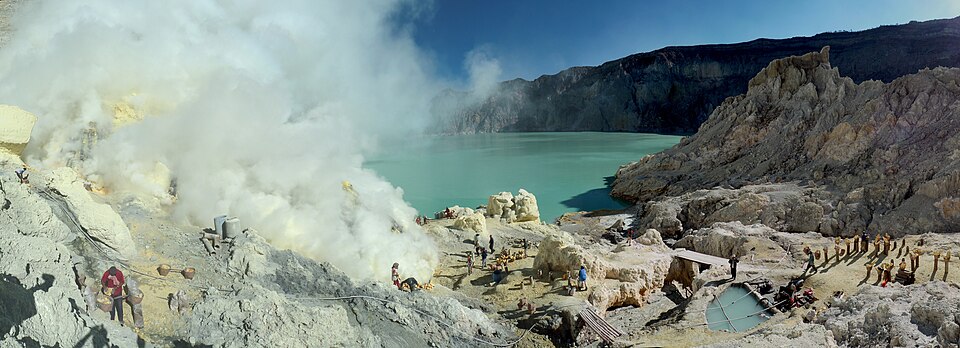
In nature, it can be found as the pure element or combined with other elements as different minerals. Sulfur can be found in areas where there are volcanoes. It is also found in meteorites and hot springs. Sulfur is mined from the ground and can be found throughout the world. A compound of sulfur (hydrogen sulfide or H 2 S, in which sulfur is combined with hydrogen) is also a common component of oil and natural gas, especially now that most sulfur-free oil and gas has been used up. A large amount of the element is made from H 2 S by oil refineries.
Did You Know?
- Sulfur burns with a blue flame.
- The name sulfur is also sometimes spelled sulphur.
- Sulfur boils at 832°F and melts at 239°F.
- Although solid sulfur is bright yellow, molten sulfur is blood red.
Sulfur is used to make matches and gunpowder. It is also used to make fertilizers to help plants grow, and to make sulfur dioxide (SO 2 ), which is used to keep dried fruit from discoloring. It is an essential element for life.
When mixed together with other elements, like hydrogen or oxygen, it can cause lung scarring and breathing problems. Sulfuric acid is a strong acid that can cause burns on unprotected skin. Hydrogen sulfide, called “stinkdamp” by miners due to its offensive smell, is a very dangerous gas. Sulfur is an important part of gunpowder. Gunpowder is explosive and is very dangerous if handled incorrectly.

Where this page comes from
The article above is adapted from “Sulfur” on Simple English Wikipedia, by its contributors. We removed reference markers, navigation boxes and tables, expanded measurement templates into readable numbers, and kept the prose otherwise intact. The simpler version is adapted from Wikijunior on Wikibooks.
Both sources are published under CC BY-SA 4.0, so this page is published under the same licence. You may share and adapt it, including commercially, as long as you credit the original and keep the same licence.
Worksheets, answer keys and printable layouts elsewhere on K5Print are our own work and are not covered by this licence.