Superconductor
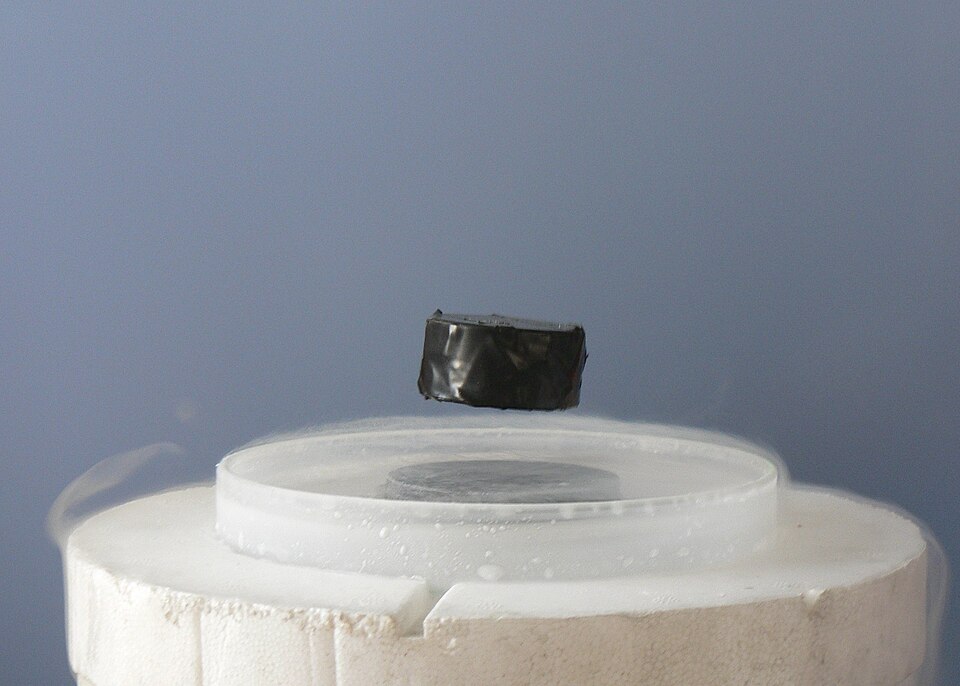

A superconductor is a substance that conducts electricity without resistance when it becomes colder than a “critical temperature.” At this temperature, electrons can move freely through the material. Superconductors are different from ordinary conductors, such as copper. Ordinary conductors lose their resistance (get more conductive) slowly as they get colder. In contrast, superconductors lose their resistance all at once. This is an example of a phase transition. High magnetic fields destroy superconductivity and restore the normal conducting state. Some examples of superconductors are the metals mercury and lead, ceramics and organic carbon nanotubes.
Normally, a magnet moving by a conductor produces currents in the conductor by electromagnetic induction. But a superconductor actually pushes out magnetic fields entirely by inducing surface currents. Instead of letting the magnetic field pass through, the superconductor acts like a magnet pointing the opposite way, which repels the real magnet. This is called the Meissner effect, and it can be demonstrated by levitating a superconductor over magnets or vice versa.
Explanation
Physicists explain superconductivity by describing what happens when temperatures get cold. The thermal energy in a solid or liquid shakes the atoms so they randomly vibrate, but this gets less as the temperature drops. Electrons carry the same negative electric charge which makes them repel each other. At higher temperatures each electron behaves as if it were a free particle. There is also however a very weak attraction between electrons when they are in a solid or liquid. At rather large distances ( many hundreds of nanometers apart) and low temperatures (near absolute zero), the attractive effect and lack of thermal energy allows pairs of electrons to hang together. This is called a cooper pair and it is a quasiparticle, that is it acts as if it were a new kind of particle in its own right even though it is made up of two fundamental electrons.
Many overlapping cooper pairs can exist in the same nanometer sized space. Since paired electrons constitute a boson the motions of all of the cooper pairs within a single superconductor synchronize and they function as if they are a single entity. Small disturbances such as scattering of electrons are forbidden in this state, and it moves as one, showing no resistance to its motion. Thus, it is now a superconductor.
Applications
- Superconducting quantum interference device (SQUID)
- Powerful magnets
- Particle accelerators
- Small particle accelerators in health
- Levitating trains
- Nuclear fusion
- MRI Scanner
Where this page comes from
The article above is adapted from “Superconductor” on Simple English Wikipedia, by its contributors. We removed reference markers, navigation boxes and tables, expanded measurement templates into readable numbers, and kept the prose otherwise intact.
Both sources are published under CC BY-SA 4.0, so this page is published under the same licence. You may share and adapt it, including commercially, as long as you credit the original and keep the same licence.
Worksheets, answer keys and printable layouts elsewhere on K5Print are our own work and are not covered by this licence.