Tin
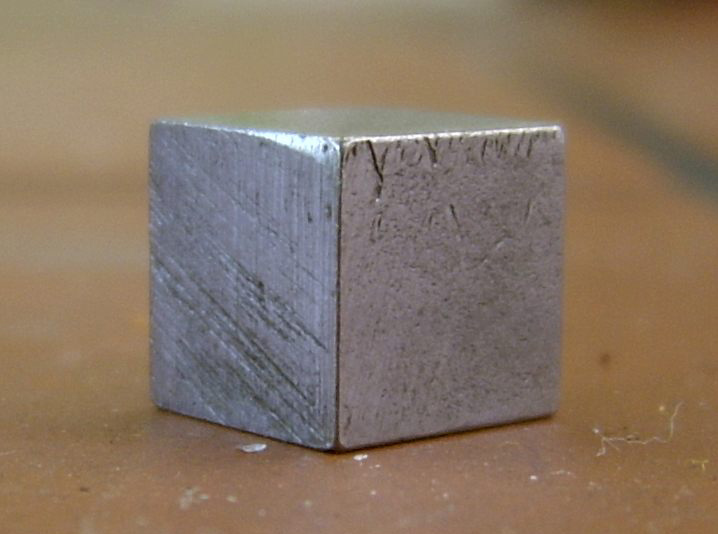

Tin is a chemical element with symbol Sn (for ) and atomic number 50. It is in Group 14 on the periodic table. It has ten isotopes that are not radioactive, which is more than any other element.
Physical properties
Tin is a silver, somewhat soft metal. It is a post-transition metal. Its melting point is 231.93°C and its boiling point is 2602 °C. It can melt easily in a flame. It is malleable. It makes a crackling sound called tin cry when a piece of it is bent. Tin has more non-radioactive isotopes than any other element.
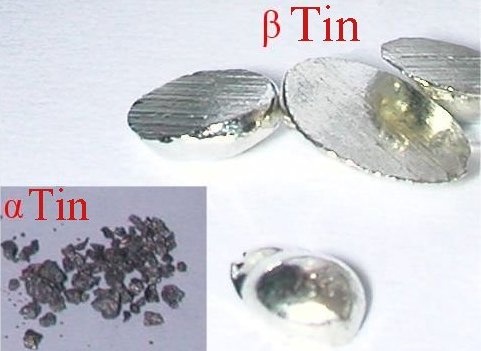
Tin is found in two allotropes: alpha-tin and beta-tin. Alpha-tin is a brittle, dull, powdery, semimetallic form of tin. It is made when very pure tin is cooled. Beta-tin is the normal shiny, soft, conductive, metallic form. It is made at higher temperatures. The decay of tin by turning from beta-tin to alpha-tin is called tin pest. Alpha-tin is not wanted in many places. When small amounts of other elements like antimony are added, the tin cannot change into alpha-tin. When alpha-tin is heated, it changes into beta-tin.
Tin can be hardened by adding antimony or copper, as well as some other elements. These also make it resistant to tin pest. Tin can also be made very shiny. Tin can make an alloy with copper called bronze.
Chemical properties
Tin resists many corrosive substance s and is often used to protect other metals. Salt water and fresh water do not affect tin. It dissolves in strong acids to make tin salts. It reacts with some strong bases.
Chemical compounds
Tin forms chemical compounds in two oxidation states: +2 and +4. +2 compounds are reducing agents. Some of them are colorless while others are colored. +4 compounds are more unreactive and act more covalent.
Tin burns in air to make tin(IV) oxide, which is white. Tin(IV) oxide dissolves in acids to make other tin(IV) compounds. Tin(IV) chloride is a colorless fuming liquid when anhydrous and a white solid when hydrated. It easily reacts with water to make tin(IV) oxide and an acid again.
Tin reacts with hydrohalic acids to make tin(II) halides. For example, tin(II) chloride is made when tin dissolves in hydrochloric acid. Tin(IV) halides are made when tin reacts with the halogens. Tin(IV) chloride is made when tin reacts with chlorine. Tin(II) sulfate is different as it does not oxidize to tin(IV) sulfate. Tin(II) oxide is a blue-black solid that burns in air to make tin(IV) oxide.
+2 compounds are reducing agents. They are about as common as +4 compounds. Some are colorless, while others are colored.
- Tin(II) bromide, yellowish solid
- Tin(II) chloride, white solid
- Tin(II) fluoride, white solid
- Tin(II) iodide, orange solid
- Tin(II) oxide, blue-black solid
- Tin(II) sulfate, white solid
- Tin(II) sulfide, dark brown solid
+4 compounds are unreactive. Some are colorless.
- Tin(IV) bromide, colorless solid
- Tin(IV) chloride, colorless liquid or solid
- Tin(IV) fluoride, colorless solid
- Tin(IV) iodide, orange solid
- Tin(IV) oxide, colorless solid
- Tin(IV) sulfide, gold-colored solid
File:Tin(II) chloride.jpg|Tin(II) chloride File:Tin(IV) chloride pentahydrate.jpg|Hydrated tin(IV) chloride File:Tin(IV) chloride.jpg|Anhydrous tin(IV) chloride File:Tin(IV)-iodide-sample.jpg|Tin(IV) iodide File:SnO2powder.jpg|Tin(IV) oxide File:Tin(II) oxide.jpg|Tin(II) oxide
Occurrence
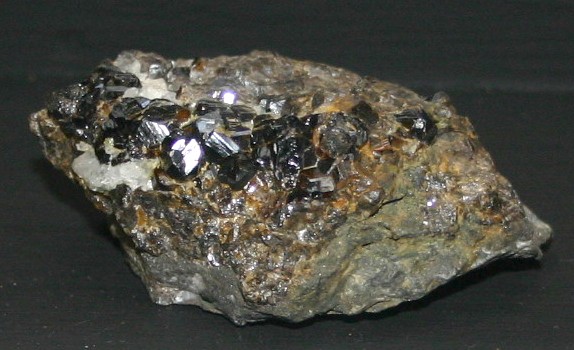
Tin is not found as a metal in the ground. It is normally in the form of cassiterite. Cassiterite is a mineral containg tin(IV) oxide. The cassiterite is normally found downstream of the cassiterite deposit when it is by a stream or river. Tin is also found in some complicated sulfide minerals.
Tin does not have any major job in the human body.
Preparation
Tin is made by heating cassiterite with carbon in a furnace. China is the biggest maker of tin.
History
People discovered tin long ago and used it with other metals. When copper and tin are mixed together, bronze is made. Bronze was important in the past, because it was one of the strongest metals available, which meant it was useful in weapons and tools. Bronze changed the world when it was first invented, starting the Bronze Age. People organized themselves more, because making tools from bronze was harder than making them from rock and wood like they did before.
Uses
Tin is used in solder. Solder used to contain a mixture of lead and tin. Now the lead is removed because of its toxicity.
Tin is also used to make pewter, which is mainly tin mixed with a small amount of copper and other metals. Babbitt metal also has tin in it. Tin is used to coat several metals, like lead and steel. Tin plated steel containers are used to store foods. The pipes on a pipe organ are made of tin. Tin foil was used before aluminium foil. Tin was one of the first superconductors to be found. Organotin compounds are more common than almost any other organometal compound. They are used in some PVC pipes to stop them from decaying. Organotin compounds are toxic, though.
Safety
Tin is not toxic, but tin compounds are very toxic to marine life. They are a little toxic to humans.
Written for younger readers
Tin, in simpler words
This version comes from Wikijunior, a set of books written for children aged 8 to 11. It is shorter and uses plainer language than the article above.
From Wikijunior: The Elements
General: Tin is a chemical element. Tin belongs to the carbon family of elements on the periodic table. The Periodic Pable arranges the chemical elements into rows (periods) and columns (groups). Chemical elements are represented by symbols. The symbol for tin is Sn, an abbreviation for the Latin word stannum.
Tin is silvery-white in color. It has a slightly bluish tinge. Since it is a metal, tin can be polished and made shiny. Tin contains clear particles called crystals.
Tin feels cool to the touch. It is flexible and bends easily. It is soft and can be cut with little effort. Tin is ductile, meaning it can be drawn out into fine strands. Tin is malleable, meaning it can be molded into various shapes. It can be extruded (pulled) into long tubes. It can be hammered or pressed flat by rollers.
Tin has a metallic taste and is odorless.
Other properties.
Solid tin will melt at about 450 degrees Fahrenheit. This is called the melting point.
Tin easily adheres (sticks) to iron, steel, and copper.
When tin is bent or twisted, the crystals inside crush together to make a cracking sound. This is called a “tin cry”.
Tin has two different forms, white and grey. These different forms are called allotropes. The familiar form is white tin (beta). The less familiar form is
gray tin (alpha). Gray Tin is powdery and of little use. Gray tin changes to white tin when the temperature is above 55.76 degrees Fahrenheit.
Exposure to harmful tin compounds can cause eye and skin irritations, dizziness, and sickness. Such compounds are used for making paint, plastic, fungicides, and pesticides. Some tin compounds are toxic (poisonous).
Pure tin is nontoxic and safe to handle. Food packaged in tin-plated containers has small, harmless amounts of dissolved tin. Metallic Tin and fumes from tin refining are not toxic.
The English word tin comes from the Anglo-Saxon language. The German word for tin is tin-om. The Latin word for tin is stannum, which means alloy (mixture) of silver and lead. The earlier Latin word for tin was plumbum candidum, which means “white lead”.
How tin was discovered in ancient times is unknown. Some areas of southwest Britain were not covered by ice during the Ice Age. Tin ore was on the surface in regions that were free of ice. In Brittany, France, and the Iberian Peninsula, tin mines date back 4000 years. Tin played a key role in shaping ancient civilizations.
There is evidence that the Inca and Aztec people mined tin in South and Central America.
Tin mining took place in the Ore Mountains in Europe about 4500 years ago. These ancient mines were located on the border between modern day Germany and the Czech Republic. There were tin mines in Brittany, Devon, Cornwell, and the Iberian Peninsula around 2000 BC.
Much of the tin used by early Mediterranean peoples likely came from the English Isles of Scilly and the Cornish Peninsula.
Tin mines in Yunnan began around 2700 years ago. They eventually became China’s main source of tin.
Later, tin mining developed in other regions of the world. Including Africa, Australia, and the Americas.
Important areas where tin is mined in modern times include:
The SE Asian tin belt (Myanmar, Thailand, Malaysia, Indonesia).
The South China tin belt.
The Central Andean tin belt (Bolivia and southernmost Peru).
The Cornwall tin province in southwestern England.
Tin is found in Alaska and other areas in the United States, but there are no more active tin mines. The United States has not produced tin since 1993. As of 2017, tin has become a “critical strategic metal”. This means it is needed for technology and industry but is in short supply. There are no known alternatives. The United States receives much of its tin supply from South America. Recycling plays an important role in maintaining the tin supply. Several processes have been developed for reclaiming tin from scrap tin or tin-plated articles.
Tin and tin compounds are widely used for:
Reducing friction in moving parts of machines, such as bearings.
Making toothpaste, perfume, polymers and dyes, and lithium batteries.
Plating (coating) steel cans used as food containers.
Soldering (joining) 2 pieces of metal together, mainly for electrical and plumbing work.
Grey tin is sometimes used in semi-conductor applications.
Making alloys such as bronze, pewter, and solder. Because pure tin is relatively weak, it must be mixed with other metals to form alloys. The world’s
first alloy was discovered more than 5,000 years ago. People found that mixing tin and copper produced a hard and durable metal. It could be shaped
into blades which would keep a sharp edge.
Where this page comes from
The article above is adapted from “Tin” on Simple English Wikipedia, by its contributors. We removed reference markers, navigation boxes and tables, expanded measurement templates into readable numbers, and kept the prose otherwise intact. The simpler version is adapted from Wikijunior on Wikibooks.
Both sources are published under CC BY-SA 4.0, so this page is published under the same licence. You may share and adapt it, including commercially, as long as you credit the original and keep the same licence.
Worksheets, answer keys and printable layouts elsewhere on K5Print are our own work and are not covered by this licence.