Titanium
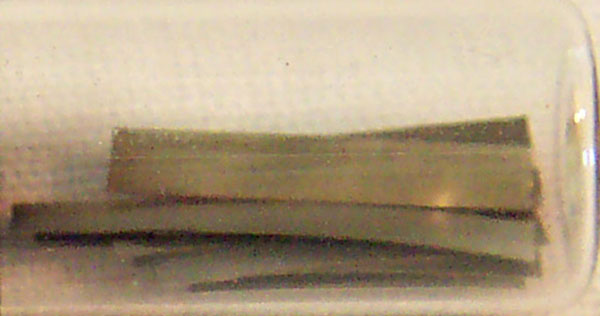

Titanium is a very strong metal that is used in special applications. The most common isotope has 26 neutrons. Titanium was discovered in 1791 by William Gregor. It is chemical element number 22 on the periodic table. Its symbol is Ti. It has 22 electrons and 22 protons. Its name comes from the name of the strong Greek gods called Titans.
Titanium can combine with other chemicals to make different materials. When titanium mixes with oxygen from the air, it forms titanium dioxide (TiO 2 ) or titania, which forms a hard passivation layer around the metal that prevents corrosion. Titanium dioxide is a white pigment that is often used to make things less transparent, brighter, or rougher - because it does not react with chemicals inside the human body, it is safe to use in foods and other applications, like toothpaste.
Titanium alloys are used in aerospace engineering to make very strong and light parts of aeroplanes. These alloys can replace steel because they are almost as strong as steel but much lighter. They are also much stronger than aluminium alloys, but only a little heavier, meaning that titanium parts can be thinner and lighter, while still withstanding the same forces. It does not corrode in most conditions, even when exposed to sea water or chlorine. However, it can burn at high temperatures, and like many metal powders, titanium dust is extremely flammable.
More than a third of the world’s titanium in 2021 was produced by a Russian firm, VSMPO-AVISMA, which has factories in many countries including one in Redditch, England.
Written for younger readers
Titanium, in simpler words
This version comes from Wikijunior, a set of books written for children aged 8 to 11. It is shorter and uses plainer language than the article above.
From Wikijunior: The Elements
NOTOC
Titanium is a silvery, light, strong metal. It is odorless. Its texture is rough as well as sharp.
Titanium was discovered at Creed, Cornwall in England by amateur geologist Reverend William Gregor in 1791, though he first named it menachite. It was discovered later by German chemist Martin Heinrich Klaproth who called it titanium.
Titanium is named for the Titans of Greek mythology.
Did You Know?
- Titanium is one of the few metals that can fuse with bone.
- Titanium is the ninth most abundant element in the Earth’s crust.
Titanium is never found pure in nature; it is always bonded to other elements.
Titanium is also found in asteroids and on rocks from the moon.
Because titanium is a light and strong metal, it has a lot of uses. It is used in aircraft, ships, racing bikes, and spacecraft. It can also be found in some computers, golf clubs, and tennis rackets. The compound titanium dioxide is colored bright white, so it used very often in paint.
Titanium is harmless as a metal. However, if titanium is made into powder, or blowed with pure nitrogen gas, it can burn and/or explode.
Where this page comes from
The article above is adapted from “Titanium” on Simple English Wikipedia, by its contributors. We removed reference markers, navigation boxes and tables, expanded measurement templates into readable numbers, and kept the prose otherwise intact. The simpler version is adapted from Wikijunior on Wikibooks.
Both sources are published under CC BY-SA 4.0, so this page is published under the same licence. You may share and adapt it, including commercially, as long as you credit the original and keep the same licence.
Worksheets, answer keys and printable layouts elsewhere on K5Print are our own work and are not covered by this licence.