Tungsten
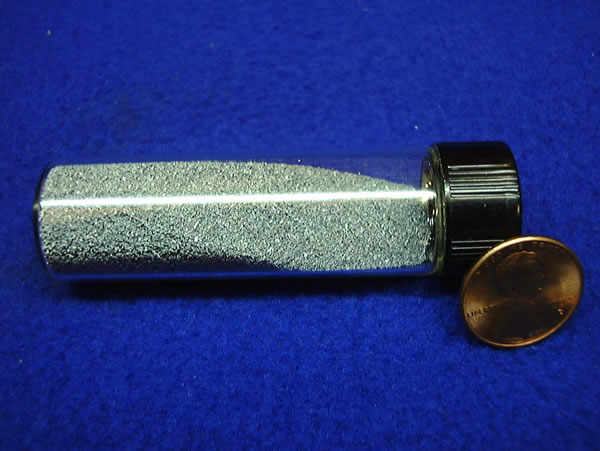

Tungsten (sometimes named wolfram) is a chemical element on the periodic table. It has the chemical symbol W and it has the atomic number 74. It is a steel-gray to white colored metal. Tungsten’s electron shell formula is: 2, 8, 18, 32, 12, 2. In chemistry, it is placed in a group of metal elements named the transition metals. Tungsten is found in several ores, including wolframite and scheelite.
Tungsten has a higher melting point than any other non-alloy that exists. The pure form (only tungsten) is mainly used in electrical equipment. Its compounds and alloys are used for many things, the most well known being its use in electrical filament s for light bulbs. It is also used in the filament and target in most X-ray tubes, superalloys, and in glass-to-metal seals.
Tungsten’s density and hardness have many uses. In the military, for example, tungsten has been used in armor-piercing artillery. It is also used in machine tools.
Tungsten’s density is almost the same as gold. Gold-plated tungsten ingots have been fraudulently passed off as solid gold.
Written for younger readers
Tungsten, in simpler words
This version comes from Wikijunior, a set of books written for children aged 8 to 11. It is shorter and uses plainer language than the article above.
From Wikijunior: The Elements
NOTOC
Tungsten is a heavy metal that can be from grey to white. Tungsten in its pure form is soft enough to cut with a hacksaw. Tungsten carbide is extremely hard and it is very difficult to cut.
In 1783, two Spanish chemists, the de Elhujar brothers, were the first to isolate pure tungsten metal. Tungsten was originally found in the mineral wolframite. “Wolframite” means “the devourer of tin.”
Tungsten gets its name from the Swedish word tung sten which means “heavy stone.” The “W” in its symbol stands for wolfram, tungsten’s German name.
Did You Know?
- Tungsten has the highest melting point of all metals at 3422 °C.
Tungsten is found in certain minerals including wolframite ((Fe, Mn)WO 4 ) and scheelite (CaWO 4 ). Most of the world’s tungsten, about 75%, comes from China. Other major deposits of tungsten can be found in California, Colorado, South Korea, Bolivia, Russia and Portugal.
Tungsten is used in incandescent light bulb filaments as the source of light (although, since they are very inefficient, they are less commonly seen nowadays). It is also used in fluorescent light bulbs, television tubes, and x-ray production.
Tungsten is combined with carbon to make tungsten carbide (WC) which is used to make the tips of drill bits, high-speed cutting instruments and mining machinery.
When electric current is passing through it, tungsten can get very hot and could cause a burn.
Where this page comes from
The article above is adapted from “Tungsten” on Simple English Wikipedia, by its contributors. We removed reference markers, navigation boxes and tables, expanded measurement templates into readable numbers, and kept the prose otherwise intact. The simpler version is adapted from Wikijunior on Wikibooks.
Both sources are published under CC BY-SA 4.0, so this page is published under the same licence. You may share and adapt it, including commercially, as long as you credit the original and keep the same licence.
Worksheets, answer keys and printable layouts elsewhere on K5Print are our own work and are not covered by this licence.