Uranium
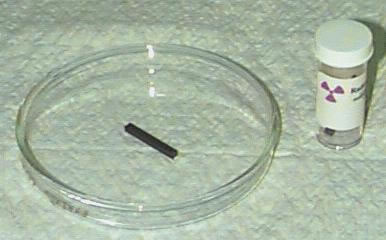

Uranium is a chemical element (a metal) on the periodic table. It has an atomic number of 92, which means that a uranium atom has 92 protons in its center, the nucleus.
The Uranium dug out of the ground is made from three different isotopes. The isotopes are different types of uranium with different numbers of neutrons in their nuclei. Most of it is uranium-238; uranium-235 is less common; uranium-234 is the rarest. Pitchblende is the main ore that is mined for uranium.
Uranium-235 can be used in nuclear reactors and nuclear weapons by making a nuclear chain reaction. This turns the uranium-235 into uranium-236 and splits the nucleus into two smaller nuclei. This makes two completely different elements with smaller atomic numbers. The process is called nuclear fission and creates lots of heat. This heat makes it very useful for making steam in nuclear reactors, or for making explosions with nuclear weapons. Most such weapons use plutonium made from uranium-238. Uranium is slightly radioactive.
Uranium without its uranium-235 is called depleted uranium. It is less radioactive than natural uranium. It is used in anti-tank weapons. Uranium can also be used as a dye for stained glass or pottery.
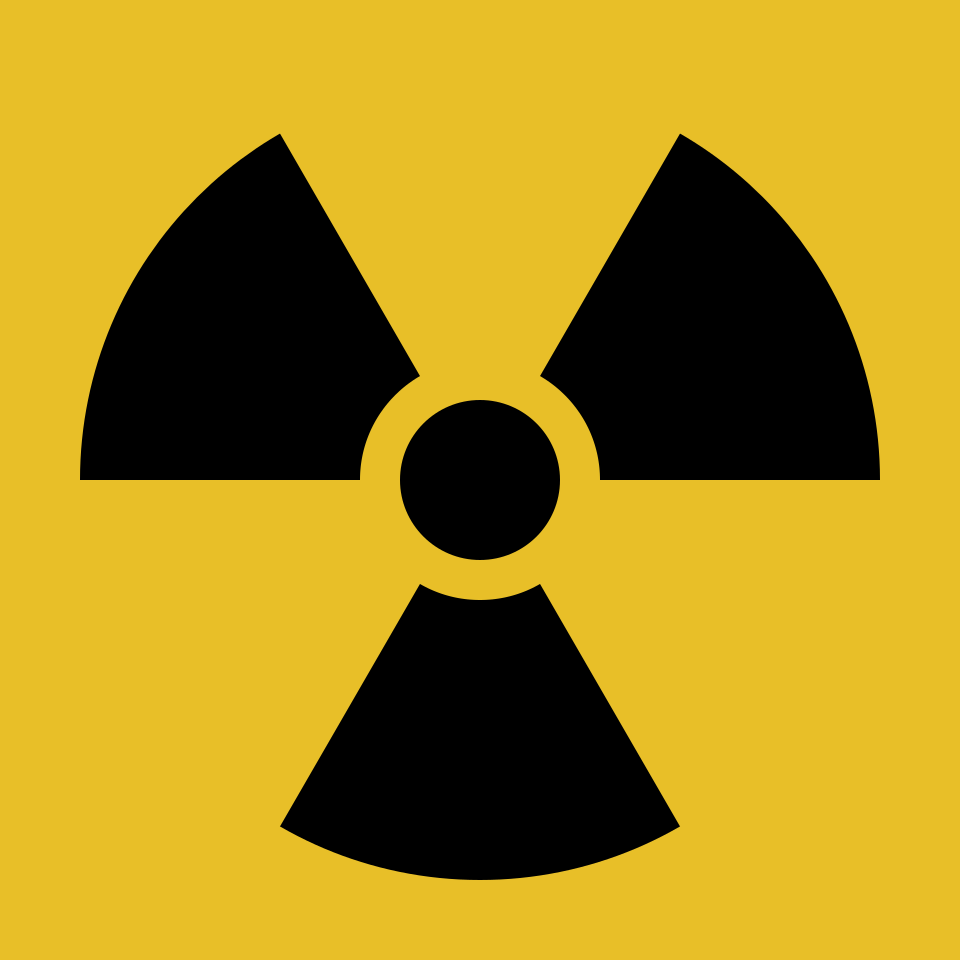
Uranium is a dangerous substance. Because uranium is radioactive it is often seen with the hazard sign for radioactive elements, a group of three triangles with curved outer edges pointing in towards the middle (as you can see on the left). Uranium is a shiny white metal, but is usually seen in its oxide form which is black. Spent or partially spent uranium fuel rods are kept underwater, inside a nuclear reactor or in a spent fuel pool. Uranium can glow blue due to Cherenkov radiation. In addition to being radioactive, uranium is a heavy metal and is chemically toxic.
Characteristics
Uranium is a silvery white, weakly radioactive metal. It has a Mohs hardness of 6. It is malleable, ductile and slightly paramagnetic. It is strongly electropositive. It is a poor electrical conductor. Uranium metal has a very high density of 19.1 g/cm 3 .
Uranium metal reacts with almost all non-metal elements and their compounds. Hydrochloric and nitric acids dissolve uranium, but non-oxidizing acids other than hydrochloric acid dissolve the element very slowly.
Uranium-235 was the first isotope that was found to be fissile: when it splits, it produces enough neutrons to split other atoms, supporting a nuclear chain-reaction. Other naturally occurring isotopes are fissionable (can be caused to split), but are not fissile.
As little as 15 lb (7 kg) of uranium-235 can be used to make an atomic bomb. The nuclear weapon detonated over Hiroshima, called Little Boy, relied on uranium fission.
Pre-discovery use
The use of uranium in its natural oxide form dates back to the year 79 AD. It was used in the Roman Empire to make ceramic glazes yellow. Yellow glass with 1% uranium oxide was found in a Roman villa on Cape Posillipo in the Bay of Naples, Italy. It was found by R.T. Gunther of the University of Oxford in 1912. In the late Middle Ages, pitchblende was extracted from the Habsburg silver mines in Joachimsthal, Bohemia (now Jáchymov in the Czech Republic). In the early 19th century, the world’s only known sources of uranium ore were these mines.
Origin
Uranium is only naturally formed by the rapid neutron capture in supernovae and neutron star mergers.
Radioactive heat production is present on Earth in quantities. It may be a widespread component of Solar System planets, and possible other planetary systems. That might help to explain the high internal temperatures of planets.
Mining
The world’s largest producer of uranium is Kazakhstan, which in 2019 produced 43% of the world’s mining output. Canada was the next largest producer with a 13% share, followed by Australia with 12%. Uranium has been mined in every continent except Antarctica.
Written for younger readers
Uranium, in simpler words
This version comes from Wikijunior, a set of books written for children aged 8 to 11. It is shorter and uses plainer language than the article above.
From Wikijunior: The Elements
NOTOC
Uranium is silvery-white and metallic. Uranium can appear to be slightly blue.
Uranium was discovered in 1789 by Martin Klaproth, a German chemist. Klaproth found uranium while he was analyzing samples of pitchblende, a variety of the mineral uranite, from the Joachimsal silver mines in the Kingdom of Bohemia (now located in the present-day Czech Republic). It was discovered to be radioactive by Henri Becquerel in 1896, and until the discovery that thorium was radioactive two years later, in 1898, it was thought to be the only radioactive element.
Uranium is named after the planet Uranus, which had been discovered some years before, in 1781, by William Herschel.
Did You Know?
- Uranium is the highest-numbered element, with a number of 92, to be found naturally in significant quantities on Earth.
- One ton of natural uranium can create over 40 million kilowatt hours of electricity. This is the same amount of energy that would be created by burning 16,000 tons of coal or the contents of 80,000 barrels of oil.
- Native Americans living on the Colorado Plateau used the uranium-bearing mineral carnotite to make bright yellow war paint.
Uranium is found worldwide in soil and rocks. Australia has the largest known reserves, while the most has been mined in recent years from Kazakhstan, which produced about 23,400 tonnes in 2017.
Uranium is commonly used in nuclear reactors to make electricity, as well as in nuclear weapons.
Uranium is also used to test the age of very old rocks.
Uranium was used to color paints and glazes, although such use is rare today.
Uranium can also be used to color glass yellow; such uranium glass, or “vaseline glass,” glows green under ultraviolet light (also known as a black light.)
Because it is so heavy, uranium is used in armor-piercing artillery bullets.
Pure uranium can burst into flames.
Compounds with uranium in them are toxic.
Uranium is radioactive, and can lead to cancer.
Where this page comes from
The article above is adapted from “Uranium” on Simple English Wikipedia, by its contributors. We removed reference markers, navigation boxes and tables, expanded measurement templates into readable numbers, and kept the prose otherwise intact. The simpler version is adapted from Wikijunior on Wikibooks.
Both sources are published under CC BY-SA 4.0, so this page is published under the same licence. You may share and adapt it, including commercially, as long as you credit the original and keep the same licence.
Worksheets, answer keys and printable layouts elsewhere on K5Print are our own work and are not covered by this licence.