Vanadium
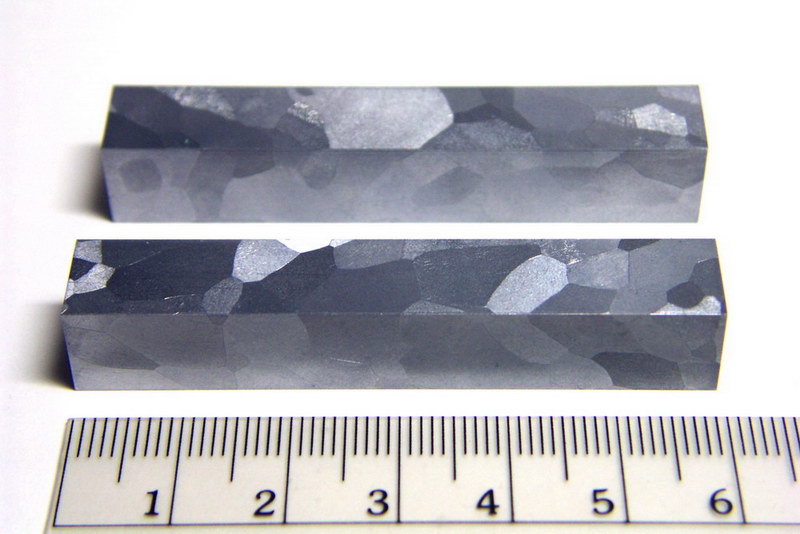

Vanadium is chemical element 23 on the periodic table. Its symbol is V. It is a metal and is part of the group known as the transition metals. It is gray-blue colored. It is mostly used in steel where it helps strengthen the steel metal. It is named after Vanadis, another name of Freyja.
Vanadium is often found in aquatic forms of life. The human body may need a little bit of vanadium, but scientists are not sure.
Vanadium can react with many other elements, and the chemical compounds it forms often have beautiful colors.
History
Vanadium was found for the first time in 1801 in Mexico by the Spanish mineralogist Andrés Manuel del Río in an ore called “brown lead”. He named it panchromium because of the beautiful colors in its chemical compounds. He was told by other people that it was chromium and so he stopped researching it.
In 1831 Swedish chemist Nils Gabriel Sefström found the element in iron ores. The German chemist Friedrich Wöhler said it was the same element that del Río found in 1801. The element was then named vanadium.
Occurrence
The amount of vanadium in the Universe is 0.0001%, making the element almost as common as copper or zinc. Vanadium is detected by spectroscopy in light from the Sun, and sometimes in light from other stars.
Vanadium is the 22nd most common element in the Earth’s crust. Metallic vanadium is rare in nature. Vanadium compounds occur naturally in about 65 different minerals. Most of the world’s vanadium production comes from vanadium-bearing magnetite found in ultramafic gabbro rocks. Vanadium is mined mostly in South Africa, north-western China, and Eastern Russia. In 2013 these three countries mined more than 97% of the 79,000 tonnes of produced vanadium.
Vanadium is also in bauxite and in deposits of crude oil, coal, oil shale and tar sands.
Properties
Vanadium is soft compared to other metals. It is a good conductor of electricity and heat. It can be pulled out into wires (ductile). Pure vanadium will form a layer of vanadium oxide corrosion very fast.
Uses
A lot of vanadium (85%) is used to make different types of steel. Steel made with vanadium is stronger. It is also mixed with titanium to make metal alloys that are used in jet engines and tooth implants.
Vanadium is also used to make batteries.
In nature
Vanadium is used by several marine organisms. Some algae and bacteria (like Azotobacter) use it for nitrogen fixation.
Written for younger readers
Vanadium, in simpler words
This version comes from Wikijunior, a set of books written for children aged 8 to 11. It is shorter and uses plainer language than the article above.
From Wikijunior: The Elements
NOTOC
Pure vanadium is a shiny, silvery-gray metal. In its pure form, vanadium is ductile and malleable. It can be shaped or stretched without breaking. When impurities are present—especially carbon—vanadium becomes hard and brittle. It will snap or crack instead of bending. Vanadium and its compounds are sometimes toxic. They should never be tasted. Vanadium does not have a distinct smell. Some of its compounds release harmful vapors that should not be inhaled. Vanadium is not safe to handle directly. Scientists always use gloves, goggles, and special tools, such as a fume hood, tongs, and masks.
Vanadium was first discovered in 1801, by Andrés Manuel del Río. He noticed a mineral that turned different colors when heated. He believed he had found a new element and named it erythronium.
His discovery was dismissed by other scientists. They believed he had simply found impure chromium. Del Río gave up his idea, and vanadium was forgotten for nearly 30 years.
Del Rio’s element was discovered again in 1830, by Swedish chemist Nils Gabriel Sefström. He was analyzing iron ore and noticed the same colorful compounds seen by Del Reo.
Vanadium was first isolated by English chemist Sir Henry E. Roscoe in 1867.
Vanadium was named in 1830, by Nils Gabriel Sefström. It was named after Vanadis, the Norse goddess of beauty and fertility. The name was chosen because vanadium compounds display beautiful colors when heated. Did You Know?
- A higher amount of vanadium can be found in oceanic animals than those living on land.
- Firstly, it was introduced as “rionium" but this name was rejected.
- Most of the vanadium in the world is mined in three countries: South Africa, China, and Russia.
Vanadium is a naturally occurring element found in Earth’s crust. It is found in iron ore, crude oil, and coal. Small amounts of vanadium are released when fossil fuels are burned. Vanadium is found in areas with volcanic activity. It is also found in sedimentary rocks on ancient ocean seafloors.
There are vanadium deposits in Colorado, Utah, and Nevada, but most mining has stopped in these areas. Vanadium is still mined in China, Russia, and South Africa.
Vanadium alloys are strong and resist wear. They are used for making tools, cars, and jet engines. They are used in armor plating, spacecraft, and large batteries.
Manufacturers use vanadium compounds as catalysts to speed up chemical reactions. Vanadium pentoxide is used to color glass and ceramics.
Small amounts of vanadium occur naturally in food, water, and air. The tiny amounts that most people are exposed to every day are usually safe.
Vanadium dust or fumes can be toxic. Inhaling it can damage lungs. Ingesting it can cause nausea and stomach pain. Gloves, masks, and goggles should be worn for safe handling of vanadium.
Where this page comes from
The article above is adapted from “Vanadium” on Simple English Wikipedia, by its contributors. We removed reference markers, navigation boxes and tables, expanded measurement templates into readable numbers, and kept the prose otherwise intact. The simpler version is adapted from Wikijunior on Wikibooks.
Both sources are published under CC BY-SA 4.0, so this page is published under the same licence. You may share and adapt it, including commercially, as long as you credit the original and keep the same licence.
Worksheets, answer keys and printable layouts elsewhere on K5Print are our own work and are not covered by this licence.