Amalthea

Fast facts
- Discovered
- September 9, 1892
- Period
- 0.49817943 ± 0.00000007 d (11 h 57 min 23 s)
- Mass
- 2.08 ± 0.15 kg
- Density
- 0.857 ± 0.099 g/cm³
Amalthea is the third closest moon to Jupiter. It was found on September 9, 1892, by Edward Emerson Barnard and named after Amalthea, a nymph in Greek mythology. It is also known as Jupiter V.
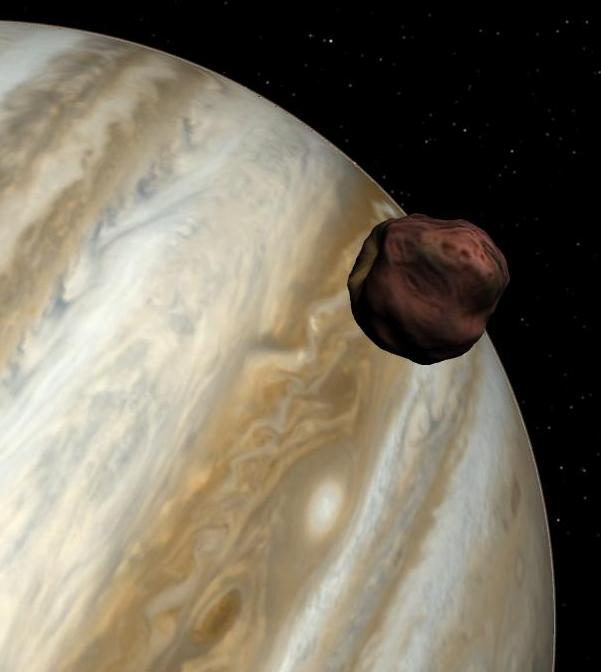
On Amalthea, Jupiter would be an amazing sight in its sky, looking 92 times bigger than the Full Moon. Amalthea is the biggest of the closer moons of Jupiter. Non-spherical and reddish in colour, it is thought to have of water ice with unknown amounts of other materials. Its surface has big craters and high mountains.
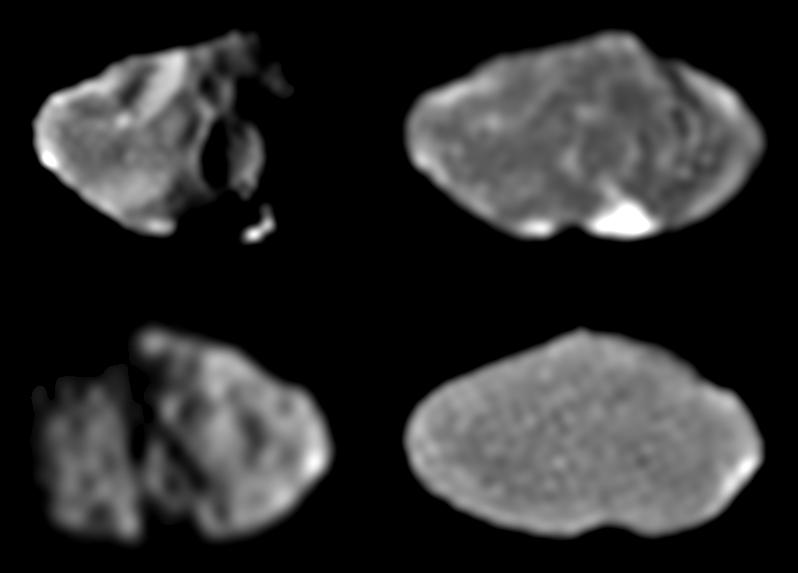
Pictures of Amalthea were taken in 1979 and 1980 by the Voyager 1 and 2 spacecraft, and later, in more detail, by the Galileo orbiter in the 1990s.
Discovery and naming
Amalthea was found on September 9, 1892 by Edward Emerson Barnard using the 36 inch (91 cm) telescope at Lick Observatory. It was the first new moon of Jupiter since Galileo Galilei’s discovery of the Galilean moons in 1610.
The moon is named after the nymph Amalthea from Greek mythology who nursed the infant Zeus (the Greek equivalent of Jupiter) with goat’s milk. Its Roman numeral designation is Jupiter V. The name “Amalthea” was not adopted by the IAU until 1975, although it had been in use for many decades. The name was suggested by Camille Flammarion. Before 1975, Amalthea was most commonly known simply as Jupiter V. The adjectival form of the name is Amalthean.
Orbit
Amalthea circles Jupiter at a distance of 181,000 km (2.54 Jupiter radii). The orbit of Amalthea has an eccentricity of 0.003 and an inclination of 0.37° relative to the equator of Jupiter.
Physical characteristics
The surface of Amalthea is very red The reddish color may be due to sulfur coming from Io or some other non ice material. Bright patches of green appear on the major slopes of Amalthea, but the nature of this color is currently unknown. The surface of Amalthea is a bit brighter than surfaces of other closer moons of Jupiter.
How Amalthea looks from Jupiter
From Jupiter’s surface —or rather, from just above its cloudtops— Amalthea would appear very bright, shining with a magnitude of −4.7, similar to that of Venus from Earth.
How Jupiter looks from Amalthea
From the surface of Amalthea, Jupiter would look enormous: it would look 92 times bigger than the Full Moon.
Exploration
In 1979-1980, the Voyager 1 and 2 spacecraft made the first images of Amalthea, which resolved its surface. They also measured the moon’s surface temperature. Later, the Galileo orbiter completed taking pictures of Amalthea’s surface and a close flyby enabled it to constrain the moon’s internal structure and composition.
Written for younger readers
Amalthea, in simpler words
This version comes from Wikijunior, a set of books written for children aged 8 to 11. It is shorter and uses plainer language than the article above.
From Wikijunior: Solar System
Amalthea Facts:
- Amalthea is the reddest object in the Solar System, even redder than Mars.
- Before 1975, Amalthea was not considered the official name (though it had extensive informal use) of the moon. Prior to the current name, it was called Jupiter V.
Amalthea is the third moon of Jupiter. Amalthea’s oribt is very close to the Amalthea gossamer ring.
Amalthea is not spherical like a ball, instead it looks like an asteroid. In fact, there is an asteroid in the asteroid belt named 113 Amalthea. However, the asteroid is completely unrelated to the moon. This moon of Jupiter has an average diameter of 172 km. The entire moon is actually a bit smaller than Ireland.
The surface of Amalthea is bright crimson. The reddish colour may be from sulfur or some other non-ice material. Amalthea has multiple craters, but only two are named: Pan, named after the Greek god of the wild; and Gaia, goddess of the Earth. Amalthea also has two named mountains, both named after places in Crete, the largest island of Greece: Lyctos Facula, named after Lyctos; and Ida Facula, named after Mount Ida. Facula, in Latin, means a small torch.
One day on Amalthea is equal to about half of an Earth day. One day is 11 hours, 57 minutes, and 23 seconds, barely more time than Jupiter takes to rotate.
One orbit around Jupiter also takes the same time as a day on Amalthea — about half of an Earth day. Since these two times are the same, the same side of Amalthea always faces Jupiter. Earth’s moon is the same way, which is why you can always see the Man in the Moon.
If you stood on the surface of Amalthea, you would weigh only 1/555 of what you do on Earth. A one hundred pound person would weigh only 0.18 pounds on Amalthea, which is a little more than ten 50p, or 14 quarters! This means that if you could lift ten kilograms on earth, you could hold three cars on Amalthea. The strongest weightlifter would be able to lift a blue whale, the heaviest animal on Earth.
Amalthea (Greek Ἀμάλθεια) is named after a nymph in Greek myths who nursed Zeus, which is the Greek counterpart of the god Jupiter, with goat’s milk.
Amalthea was discovered on September 22, 1892 by Edward Emerson Barnard, using the 36 inch (91 cm) refractor telescope at Lick Observatory, in California. He was the first to discover a new moon of Jupiter since Galileo discovered Io and Europa in 1610.
de:Wikijunior Sonnensystem/ Jupiter/ Amalthea it:Wikijunior Il sistema solare/Giove/Amaltea
Where this page comes from
The article above is adapted from “Amalthea” on Simple English Wikipedia, by its contributors. We removed reference markers, navigation boxes and tables, expanded measurement templates into readable numbers, and kept the prose otherwise intact. The simpler version is adapted from Wikijunior on Wikibooks.
Both sources are published under CC BY-SA 4.0, so this page is published under the same licence. You may share and adapt it, including commercially, as long as you credit the original and keep the same licence.
Worksheets, answer keys and printable layouts elsewhere on K5Print are our own work and are not covered by this licence.