Asteroid belt
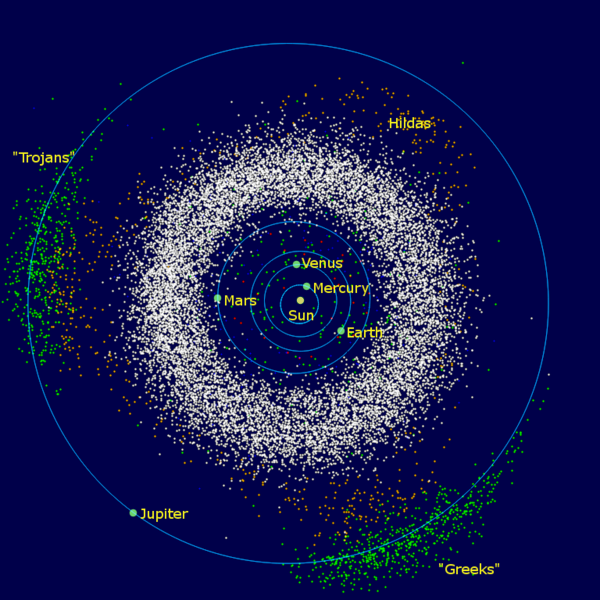

The asteroid belt or main belt is a ring of small and large rocks and dust between the orbits of Mars and Jupiter. The biggest object in the asteroid belt is Ceres, a dwarf planet. The Kirkwood gaps separate the asteroid belt into several groups. The belt is toroidal in shape.
Most asteroids orbit at 2 to 3 times the distance between Earth and the Sun. Planets that are “inside” - or before - the asteroid belt (which means they are closer to the sun) are called inner planets. Planets that are “outside” - that is, after - the asteroid belt are called outer planets: so Mercury, Venus, Earth, and Mars are inner planets, while Jupiter, Saturn, Uranus and Neptune are the outer planets.
Origin
In 1802, shortly after discovering 2 Pallas, Heinrich Olbers suggested to William Herschel that Ceres and Pallas were fragments of a much larger planet that once occupied the Mars–Jupiter region, this planet having suffered an internal explosion or a cometary impact many million years before. This hypothesis has fallen from favor. The large amount of energy needed to destroy a planet, and with the belt’s low combined mass (only about 4% of the mass of the Moon) do not support the hypothesis. Also, the significant chemical differences among the various asteroid spectral types are difficult to explain if they come from the same planet. Today, most scientists accept that the asteroids never formed a planet at all.
The Solar System formed when a cloud of interstellar dust and gas collapsed under the influence of gravity to form the Sun and planetesimals, and eventually the planets. This gravitational accretion led to the formation of the rocky planets and the gas giants.
Planetesimals in the region which would become the asteroid belt were too strongly disturbed by Jupiter’s gravity to form a planet. Instead they continued to orbit the Sun as before, while occasionally colliding. In regions where the velocity of the collisions was too high, the shattering of planetesimals was more common than accretion, preventing the formation of planet-sized bodies.
Main Belt asteroids
Written for younger readers
Asteroid belt, in simpler words
This version comes from Wikijunior, a set of books written for children aged 8 to 11. It is shorter and uses plainer language than the article above.
From Wikijunior: Solar System
The asteroid belt lies between the planets Mars and Jupiter. It contains lumps of rock and metal much smaller than planets. These lumps are called asteroids or minor planets. They are not visible from Earth with the naked eye, but many may be seen through binoculars or small telescopes.
In the asteroid belt, the four largest bodies are Ceres (a dwarf planet named after the Roman goddess of agriculture), Vesta (the Roman goddess of the home), Pallas (the granddaughter of Poseidon), and Hygiea (the Greek goddess of health). These four bodies make up about half of the asteroid belt.
Some asteroids are less than a kilometer across. Unofficially the limit has been set at 50 meters, and anything smaller than that is going to be simply called a meteoroid. With advances in telescopes and particularly for objects that travel close to the Earth, some objects smaller than 50 metres have indeed been seen passing nearby the Earth.
There are probably several million asteroids in the solar system. Over 96,000 asteroids have been given numbers. Almost 12,000 of them have names. But even though there are a lot of asteroids, the asteroid belt is mostly empty space. Traveling through the asteroid belt in a space ship would not be very much like what you see in a science fiction film. This would not be the same in the first 100 million years of the solar system’s history (had humans evolved and discovered film). The asteroid belt lost 99.99% of its mass in the first 100 million years of the solar system.
The first asteroids were named after mythical heroes and gods much like the major planets. The first to be discovered was named Ceres after the Roman goddess of growing plants (particularly grain) and of motherly love. The second asteroid discovered was called Pallas and was named after one of the Greek gods of wisdom. Asteroids are also given a number in the order of their discovery, so Ceres is 1, Pallas is 2, and so forth.
As the number of known asteroids increased, they ran out of mythical names so other names were used instead. Some asteroids were named after countries. For example asteroid number 136 is named Austria. Others were named after plants, for example 978 Petunia. 1620 Geographos was named after the National Geographic Society, in recognition to their efforts at sharing knowledge about the Solar System. Many are named after people, both alive and dead. In a couple of cases, like 2309 Mr. Spock, asteroids were named after the discoverer’s pet cat. This last type of naming is discouraged, but it still happens from time to time. Even fictional characters have been used.
Today, names for asteroids can be suggested by the people who discover them. The names become official after a group of people reviews them to make sure they are not offensive or too much like another name. Because so many asteroids are now being found, most new asteroid discoveries are not even getting a name at all, but rather a numbered code. It is not likely that they will ever be given a formal name, at least in this century.
The actual word Asteroid can refer to any member of the family of Asteroidea; in other words, a starfish. The etymology of the word comes from Ancient Greek ἀστεροειδής, literally meaning star form. The Ancient Greeks probably must have mistook the asteroids for stars.
Most of the asteroids have symbols representing them; for example, Ceres has ⚳, representing Ceres’s scythe, and Pallas has ⚴, reperesenting Athena’s spear.
Asteroid Belt Facts:
- The total mass of all the asteroids in the asteroid belt is about 1/35th of that of our moon.
- The largest object in the asteroid belt, Ceres, makes about 1/3 of the total weight of all the asteroids.
- Ceres is the only dwarf planet in the asteroid belt.
- Vesta is the only asteroid that can ever be seen with the naked eye. Its magnitude can reach +5.1, about the same as Uranus.
- Although people probably saw Vesta and Uranus thousands of years ago, they were not recognised to orbit the Sun until 200 years ago.
The first asteroid to be discovered was Ceres, on 1 January 1801, by Giuseppe Piazzi accidentally. At first he thought this was a comet, then later a planet! When it was realised it was too small Sir William Herschel (the astronomer who discovered Uranus) made up the word “asteroid” to describe it, using the Ancient Greek word aster, meaning star, and the -oid, meaning form or shape. In other words a star-like planet, because he couldn’t see any details due to the small size of the object.
By 1807 another 3 asteroids were discovered, but no more were found until 1845 when a persistent asteroid hunter named Karl Ludwig Hencke found a fifth, and sixth asteroid in 1847. Ever since then at least one new asteroid has been found each year.
In 1891, the first pictures of the night sky were taken to find more asteroids. This led to the discovery of many more asteroids. A picture of the same part of the sky is taken on two different nights. When the two pictures are lined up, the stars will be in the same places but an asteroid will have moved.
In our modern times, over 280,000 asteroids have been discovered. Many more are being found all the time. Some of these asteroids pass near the earth and astronomers want to find any that come close to our planet. Large numbers of asteroids are now being discovered by machines.
Three out of four asteroids are made of rock that is rich in carbon. The rest are made of the metals iron and nickel. About half of these are pure iron and nickel; the rest are mixed with compounds of silica, the element that makes up rocks. Each of the larger metal asteroids contains huge amounts of iron: much more than is mined every year on Earth. Vesta, the brightest asteroid, has a very unusual composition - being made of high-density volcanic rocks.
Scientists are very interested in what asteroids are made of because it can help them learn how the solar system was formed. Several spacecraft have visited asteroids to learn more about them.
Most asteroids are found in the asteroid belt, but not all. Some asteroids orbit closer to the Sun, and many asteroids orbit beyond Neptune. Asteroids that closely approach Earth are called Near-Earth Asteroids. Sometimes pieces of asteroids strike the Earth, burning in the atmosphere as a meteor. If they are large enough, they might actually hit the surface and become meteorites.
A centaur is a mythical beast having a horse’s body with a man’s head and torso in place of the head and neck of the horse. There are some asteroids in the outer solar system that are called Centaurs. It is hard to tell whether any one Centaur is an asteroid, comet, or Kuiper Belt object. For example, the first Centaur to be discovered was Chiron(In Greek Mythology, an important centaur). But some scientists think it is a comet, not an asteroid. Officially it is called both the asteroid 2060 Chiron and the comet 95P/Chiron!
In most cases when an asteroid’s orbit crosses the path of a planet such as Jupiter, at some point the asteroid will either hit the planet or else be hurled into another orbit. Many of the small moons of some planets may have once been asteroids that were captured by the planet’s gravity when they came too close. However there are two points along the orbit of a planet were an asteroid can safely linger. These are found at a point one-sixth (or 60°) of an orbit ahead of the planet, and the same distance behind the planet. These sites are called Lagrange points, and they are found where the force of gravity from the Sun and the planet balance out with the motion of the asteroid’s orbit. The asteroids found in these spots are called Trojans, and they move around the Sun at the same velocity as the planet.
Ceres is a large Dwarf Planet like Pluto located in the asteroid field. The difference between Ceres and most other dwarf planets is that it is also an asteroid. Ceres is one of the few asteroids that are shaped like a sphere, and it may have some ice just underneath its dusty surface. It was discovered in 1801 by Giuseppe Piazzi, who was an Italian astronomer.
Ceres the first discovered and biggest asteroid in the solar system.
The asteroid Ida has its own moon named Dactyl. A number of asteroid moons have now been found.
Next Topic: Jupiter
Where this page comes from
The article above is adapted from “Asteroid belt” on Simple English Wikipedia, by its contributors. We removed reference markers, navigation boxes and tables, expanded measurement templates into readable numbers, and kept the prose otherwise intact. The simpler version is adapted from Wikijunior on Wikibooks.
Both sources are published under CC BY-SA 4.0, so this page is published under the same licence. You may share and adapt it, including commercially, as long as you credit the original and keep the same licence.
Worksheets, answer keys and printable layouts elsewhere on K5Print are our own work and are not covered by this licence.