Betelgeuse
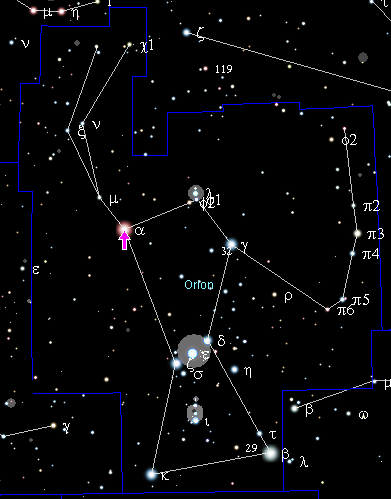

Betelgeuse (from Arabic: إبط الجوزاء Ibṭ al-Jauzā’, meaning “the armpit of Orion”) is a large red supergiant star in the Orion constellation. It is usually the ninth-brightest star in the night sky, and the second-brightest in Orion.
Betelgeuse is a semiregular variable star whose apparent magnitude varies between 0.2 and 1.2. This is the widest range of any first-magnitude star.
It is also one of the largest and most luminous observable stars. It has a radius between around 640 times wider than the Sun’s radius. This means it is around 900 million kilometers in diameter. Betelgeuse was the first star other than the Sun whose size was known. The star’s distance from Earth is between 400 and 500 light-years. Its average absolute magnitude is about −6.02.
Betelgeuse is less than 10 million years old. It evolves rapidly because of its high mass. It is moving through the interstellar medium at a speed of 30 km/s, creating a shock wave over 4 light-years wide.
Betelgeuse is now in a later stage of stellar evolution. It will rapidly go through its life cycle before exploding as a type II supernova sometime in the next million years. Betelgeuse was once a yellow supergiant, which was observed by humans thousands of years ago.
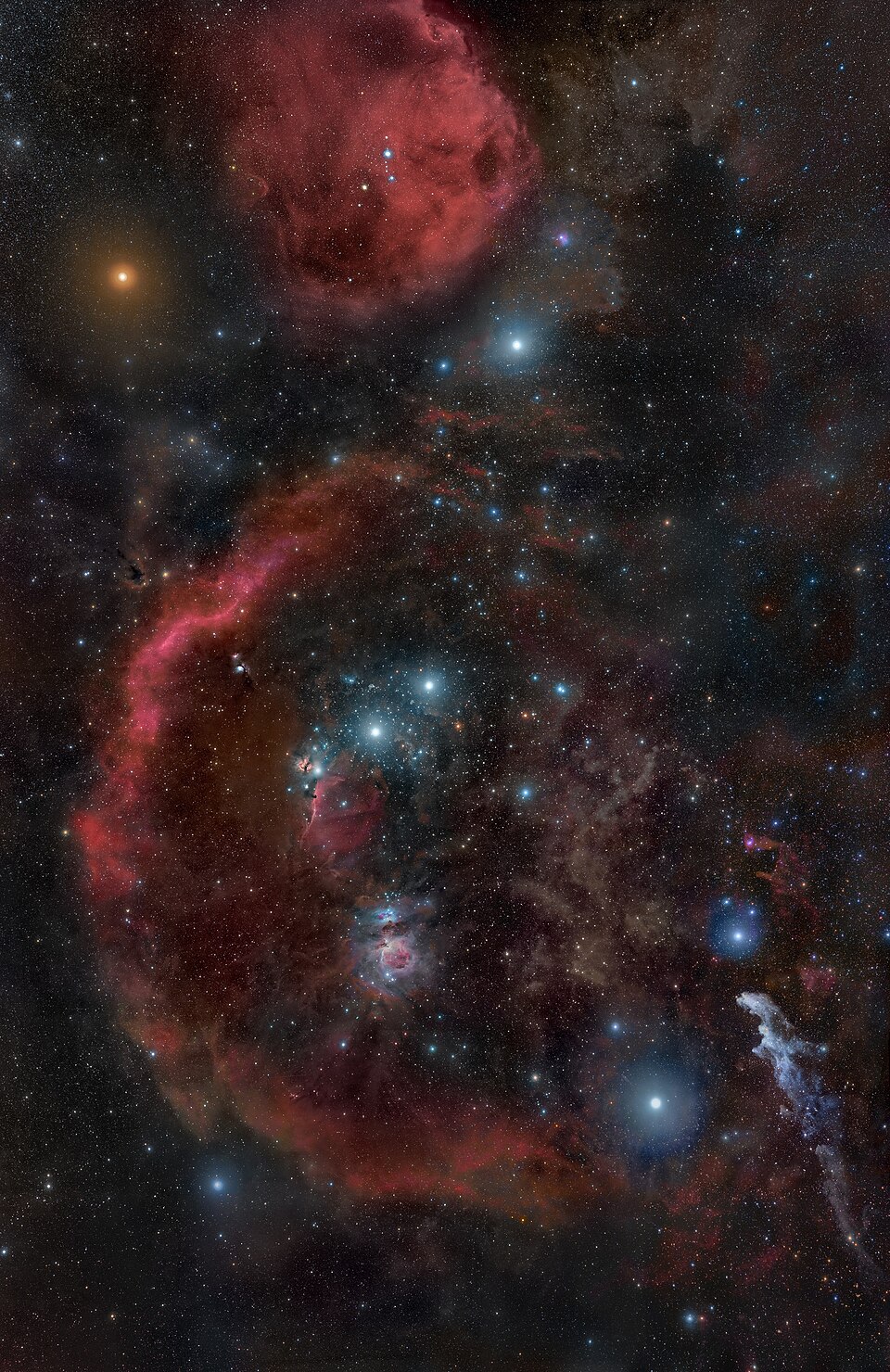
An observation by the Herschel Space Observatory in January 2013 showed that the star’s winds are crashing against the surrounding interstellar medium. Betelgeuse is one of the red supergiant stars to have a bow shock: others are Mu Cephei and IRC-10414. Betelgeuse can be seen at the upper left in Orion.
Alternate names
Betelgeuse is also called Alpha Orionis (α Orionis, abbreviated Alpha Ori, α Ori).
Where this page comes from
The article above is adapted from “Betelgeuse” on Simple English Wikipedia, by its contributors. We removed reference markers, navigation boxes and tables, expanded measurement templates into readable numbers, and kept the prose otherwise intact.
Both sources are published under CC BY-SA 4.0, so this page is published under the same licence. You may share and adapt it, including commercially, as long as you credit the original and keep the same licence.
Worksheets, answer keys and printable layouts elsewhere on K5Print are our own work and are not covered by this licence.