Callisto
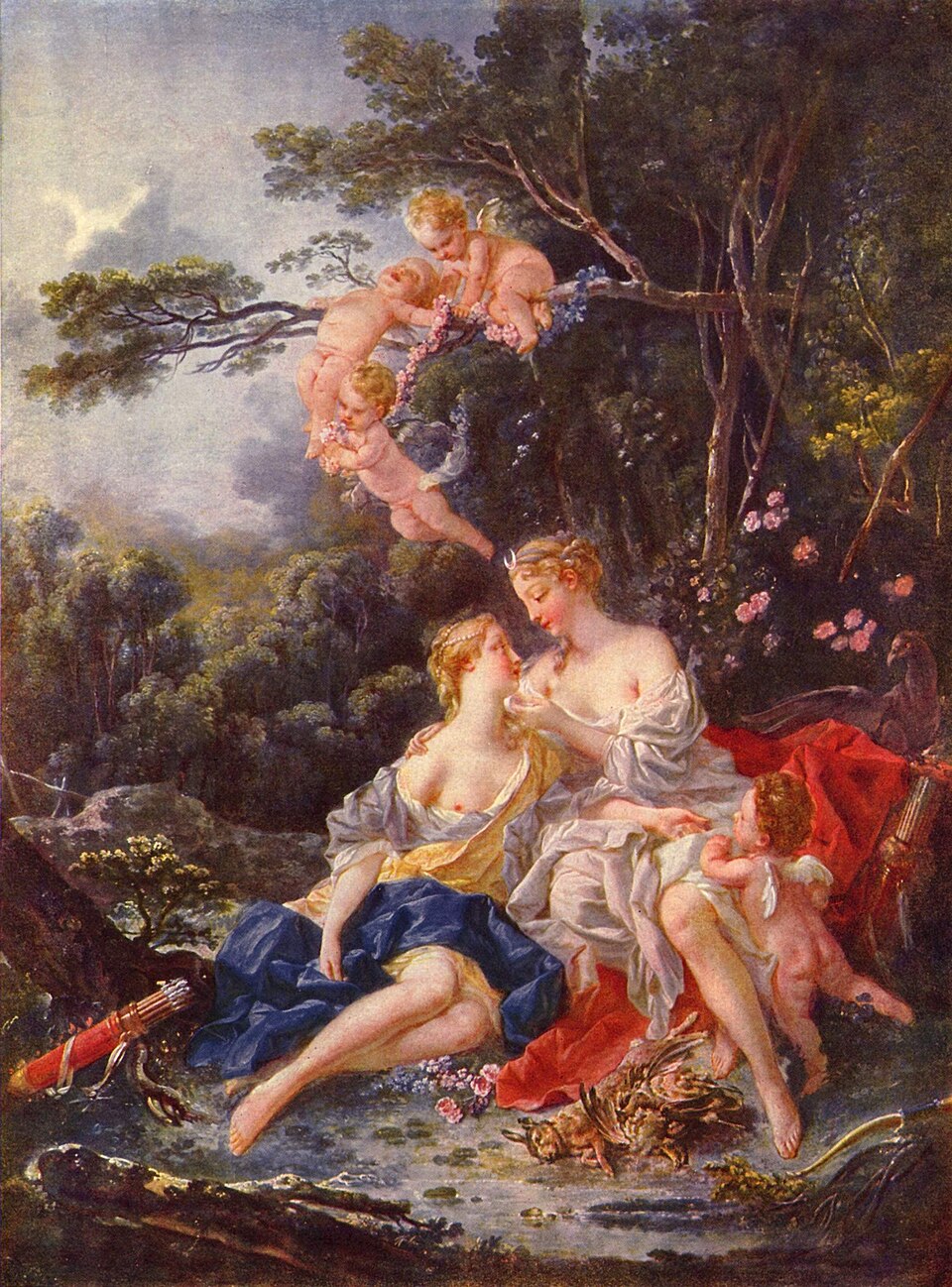

Kallisto or Callisto was a nymph in Greek mythology, a companion of Artemis. Zeus came to her looking like Artemis, and with him she was the mother of Arkas. Hera in her jealousy made Kallisto a bear. Then her son was looked after by Maia, a nymph.
Written for younger readers
Callisto, in simpler words
This version comes from Wikijunior, a set of books written for children aged 8 to 11. It is shorter and uses plainer language than the article above.
From Wikijunior: Solar System
It is Jupiter’s second largest moon, after Ganymede, and the third largest moon in the solar system. It is a little more than one third the size of the earth.
The surface of Callisto is one of the most cratered in the Solar System. In fact, impact craters are the only features found on the surface. Because Callisto’s surface is icy, large craters and mountains are slowly erased. Callisto’s crust is about 4 billion years old, dating back to the formation of the Solar System.
The largest crater on the surface is Valhalla. It measures 3000 km across. The second largest crater, Asgard, measures 1600 km across. Gipul Catena, a series of craters in a straight line, was probably caused by an object that was tidally disrupted as it passed close to Jupiter.
There is no oxygen in the atmosphere. Under the rocky crust of the surface there is a salty underground sea.
One day on Callisto is equal to approximately 16.7 days on Earth. Callisto Facts:
- Callisto’s crust dates back to the formation of the Solar System.
- A salty ocean may lay beneath the crust.
- It is the second largest of Jupiter’s moons.
One orbit around Jupiter is also equal to 16.7 days on Earth.
Callisto (Greek Καλλιστώ) is named after the Greek Mythological nymph named Kallisto, which meant “most beautiful” in Greek. Kallisto was one of Zeus’ many lovers.
Callisto was discovered by Galileo Galilei and Simon Marius. Galileo discovered it on January 7, 1610, and Marius observed it around the same time.
de:Wikijunior Sonnensystem/ Jupiter/ Kallisto
Where this page comes from
The article above is adapted from “Callisto” on Simple English Wikipedia, by its contributors. We removed reference markers, navigation boxes and tables, expanded measurement templates into readable numbers, and kept the prose otherwise intact. The simpler version is adapted from Wikijunior on Wikibooks.
Both sources are published under CC BY-SA 4.0, so this page is published under the same licence. You may share and adapt it, including commercially, as long as you credit the original and keep the same licence.
Worksheets, answer keys and printable layouts elsewhere on K5Print are our own work and are not covered by this licence.