Comets
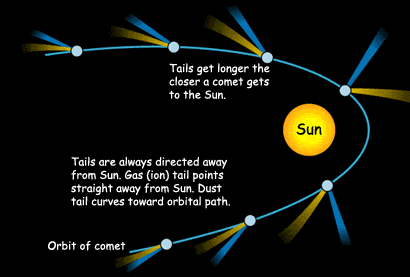

A comet is a ball of mostly ice that moves around in outer space. Comets are often described as “dirty snowballs”. They are very different from asteroids.
The orbital inclinations of comets are usually high and not near the ecliptic where most solar system objects are found. Most of them are long-period comets and come from the Kuiper belt. That is very far away from the Sun, but some of them also come near enough to Earth for us to see at night.
They have long “tails”, because the Sun melts the ice. A comet’s tail does not trail behind it, but points directly away from the Sun, because it is blown by the solar wind.
The hard centre of the comet is the nucleus. It is one of the blackest things (lowest albedo) in the solar system. When light shone on the nucleus of Halley’s Comet, the comet reflected only 4% of the light back to us.
Periodic comets visit again and again. Non-periodic or single-apparition comets visit only once.
Comets sometimes break up, as Comet Biela did in the 19th century. Comet Shoemaker-Levy 9 broke up, and the pieces hit Jupiter in 1994. Some comets orbit (go around) together in groups. Astronomers think these comets are broken pieces that used to be one object.
Famous comets
- Halley’s
- Hale-Bopp
- Shoemaker-Levy 9
- Ikeya Seki
History of comets
For thousands of years, people feared comets. They did not know what they were, or where they came from. Some thought that they were fireballs sent from demons or gods to destroy the earth. They said that each time a comet appeared, it would bring bad luck with it. Whenever a comet appeared, a king would die. For example, the Bayeux Tapestry shows the return of Halley’s Comet and the death of a king. Comets were also known to end wars and thought to bring famine. During the Renaissance, astronomers started to look at comets with less superstition and to base their science on observations. Tycho Brahe reasoned that comets did not come from the earth, and his measurements and calculations showed that comets must be six times farther than the earth is from the moon.
Edmond Halley reasoned that some comets are periodic, that is, they appear again after a certain number of years, and again and again. This led to the first prediction of a comet’s return, Halley’s Comet, named after him.
Isaac Newton also studied comets. He realised that comets make U-turns around the sun. He asked his friend Edmond Halley to publish this in his book Philosophiae Naturalis Principia Mathematica. Before Newton said this, people believed that comets go in to the sun, then another comes out from behind the sun.
In later years, some astronomers thought comets were spit out by planets, especially Jupiter.
All this new information and research gave people confidence, but some still thought that comets were messengers from the gods. One 18th century vision said that comets were the places that hell was, where souls would ride, being burned up by the heat of the sun and frozen by the cold of space.
In modern times, space probes have visited comets to learn more about them.
Written for younger readers
Comets, in simpler words
This version comes from Wikijunior, a set of books written for children aged 8 to 11. It is shorter and uses plainer language than the article above.
From Wikijunior: Solar System
Think of a comet as a big, dirty, gassy snowball. Comets are formed in the ring of rocks, dust, and ice that orbits the Sun beyond Pluto called the Kuiper Belt. Comets form when rocks, dust, and ice condense – that is, join together. As a comet grows larger, it starts to be pulled towards and around the Sun. Comets in our Solar System usually take many years to go around the Sun – from a few dozen years to many thousands of years. This is because they start to orbit the sun from very far away. They make long, egg-shaped orbits around the Sun instead of almost circular ones like the planets.
The comets that can be seen in the sky without telescopes are unusual because they are the biggest and brightest comets of all. You might have the chance to see one once or twice during your life. Most comets can only be seen with a telescope. The few that can be seen with human eyes are usually just hazy streaks or faint smudges in the night sky.
When comets are very far away from the Sun, they are covered in a coating of icy, black rocks and dust. As a comet approaches the Sun, however, the ice starts to melt. This creates large amounts of water and gas that break through the coating, freeing some of the dust and rocks. Sometimes this water, gas, rocks, and dust can be seen from the Earth as one or two tails streaming away from the comet. Even when only one tail can be seen, there are two, one made from the lighter gas and water, and the other from the rocks, dust, and chunks of ice.
Comets themselves are usually between a few kilometres and several hundred kilometres in size, but their tails can be several million kilometres long.
The “great comets” that produce particularly spectacular tails are some of the rarest objects in our solar system. Usually they can only be seen about once every hundred years, so it is very rare to see one of these comets. The last great comet appeared in 1910, but it may still be another hundred years before another one comes near the Earth. Astronomers can’t predict exactly how or when they will appear as there are still things about our Solar System that they don’t understand. If you hear about a comet coming into the sky soon, follow the instructions below to watch it!
- Find out if the comet is going to be in your area of the sky.
- Get a telescope or binoculars and some chairs to view it. Many of the largest comets have never even needed a telescope to see them.
- Ask your parents to take you to a park, the woods or another dark place away from city lights.
- Look up into the sky and enjoy this amazing sight.
Usually the dust making up the comet’s tail is so faint you can’t see it. However, when the Earth’s orbit takes it through one of these tails, the dust hits the Earth’s atmosphere and burns up.
These are the recurring meteor showers that happen from time to time, and most major meteor showers have now been identified either with an existing comet or the remains of a comet that was observed earlier, usually in previous centuries. When the Earth travels through this “swarm” of dust left behind, you can see shooting stars or meteors at night.
No one really knows. All comets spend most of their orbit so far away from the sun that they can’t be seen – even with a telescope. However, every year amateur astronomersdiscover over 100 never-seen-before comets that have come close enough to be discovered[http://comethunter.de/. As of November 2005, astronomers have discovered 2 857 comets. Most of the comets we see either crash into the Sun, or leave the Solar System entirely. There might be millions of these comets that sooner or later will come within range of our telescopes.
Of all the comets that have ever been seen, astronomers only expect 253 comets to ever return.
A comet is usually named after the astronomer who first discovered it. When several people are involved in its discovery, sometimes you will see multiple names on a comet, like Comet Hale-Bopp, or Comet Shoemaker-Levy. It is generally considered to be a great honor to have a comet named after you.
- Halley’s Comet - Perhaps the most famous of all comets, and this was the first comet to be identified as a recurring comet.
- Comet Encke - The second comet to be identified as a recurring comet.
- Comet Shoemaker-Levy 9 - This was the first comet to have been observed hitting another body in the Solar System. In this case, it smashed into the planet Jupiter in what was possibly the most studied astronomical event in history.
In ancient times people didn’t have a very good understanding of what comets really were or where they came from. They were seen as very unusual objects in the sky, and very temporary in nature as well. In some societies it was often a sign of bad events in the future when a comet arrived, associated with the death of a king or a significant military defeat. In other countries comets were considered to bring good luck, bringing increased fertility and more food. The ancient Chinese astronomers seem to have done the best job of actually recording when comets appeared in the sky, and left detailed descriptions of what they looked like and approximately where in the sky each comet was seen.
Even as recently as the 1910 appearance of Halley’s Comet there was widespread panic when it was discovered that the Earth might pass through the tail of that comet. The panic was over the possibility of gases from the comet flooding the atmosphere of the Earth with poison. The reality was that there is so little gas in a comet tail that there is no measurable effect in the content of the Earth’s atmosphere when an event like this occurs. Next Topic: Kuiper Belt
Where this page comes from
The article above is adapted from “Comets” on Simple English Wikipedia, by its contributors. We removed reference markers, navigation boxes and tables, expanded measurement templates into readable numbers, and kept the prose otherwise intact. The simpler version is adapted from Wikijunior on Wikibooks.
Both sources are published under CC BY-SA 4.0, so this page is published under the same licence. You may share and adapt it, including commercially, as long as you credit the original and keep the same licence.
Worksheets, answer keys and printable layouts elsewhere on K5Print are our own work and are not covered by this licence.