Dione
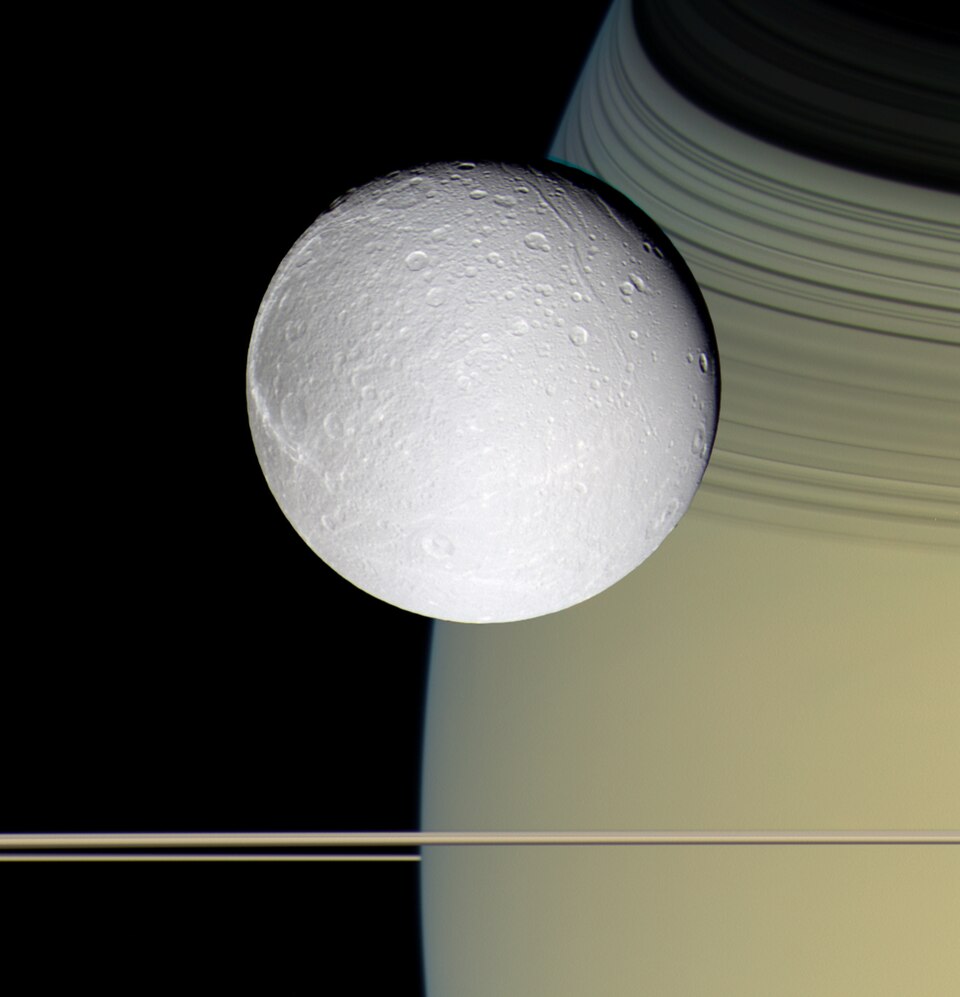

Dione is the fourth largest moon of Saturn. It has a diameter of 1,123 km (698 miles). It was discovered in 1684 by Giovanni Domenico Cassini. It is named after the titan Dione in Greek mythology. The moon has many craters and ice cliffs. It is tidally locked with Saturn, meaning the same face of Dione always faces Saturn.
Written for younger readers
Dione, in simpler words
This version comes from Wikijunior, a set of books written for children aged 8 to 11. It is shorter and uses plainer language than the article above.
From Wikijunior: Solar System
Dione is a moon of the planet Saturn. It was first photographed in some detail when the Voyager 1 mission passed by Saturn in 1980. The Cassini spacecraft started taking more closeup pictures in 2004, and we now know much more about this moon.
Dione is 1118 km across. This is much smaller than our Moon, which is almost 3,500 km across. It is one-fifth as large as Titan, the largest moon in orbit around Saturn.
This is a cold, icy world with a thin layer of oxygen for its atmosphere. The side of the moon that faces toward the direction of its orbit is covered from craters that were made by collisions with asteroids. On the back side are bright, wispy streaks across the surface. These are cliffs in the ice that were caused when the surface shifted about.
It takes 2.74 days to complete an orbit around Saturn. This is just under 2 days and 18 hours. It also takes the same amount of time for the moon to rotate around the axis. This means that the same side of Dione is always facing toward Saturn, in much the same was as our Moon always keeps the same face toward us.
Dione has a covering of ice surrounding a rocky interior. It has a higher portion of rock inside than any other moon of Saturn except Titan.
A person standing on the surface would weigh less than one-thirtieth as much as they would on Earth.
This moon is named for one of the titans from Greek mythology. She was an addition to the original twelve titans mentioned by the Greek poet Hesiod.
It was discovered by the Italian astronomer Giovanni Cassini in the year 1684. At the time he was the director of the Paris Observatory in France.
de:Wikijunior Sonnensystem/ Saturn/ Dione
Where this page comes from
The article above is adapted from “Dione” on Simple English Wikipedia, by its contributors. We removed reference markers, navigation boxes and tables, expanded measurement templates into readable numbers, and kept the prose otherwise intact. The simpler version is adapted from Wikijunior on Wikibooks.
Both sources are published under CC BY-SA 4.0, so this page is published under the same licence. You may share and adapt it, including commercially, as long as you credit the original and keep the same licence.
Worksheets, answer keys and printable layouts elsewhere on K5Print are our own work and are not covered by this licence.