Jupiter
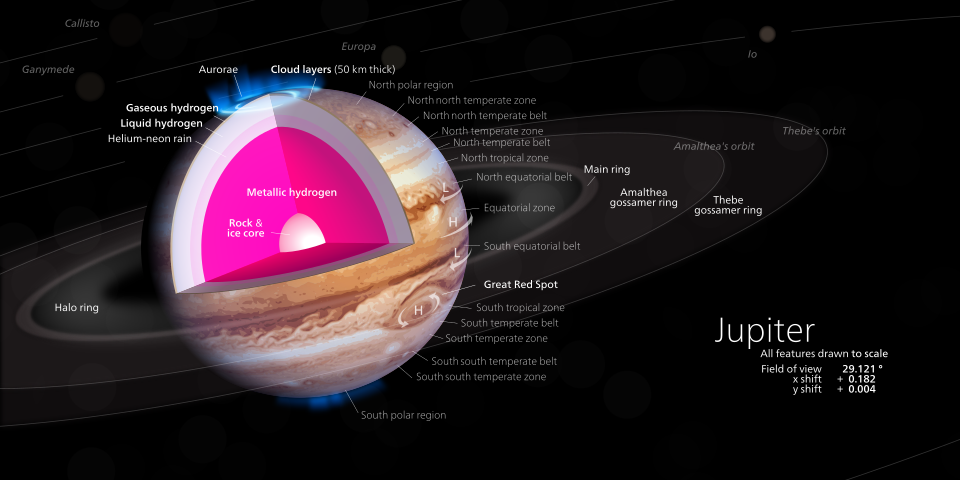

Jupiter is the largest planet in the Solar System. It is the fifth planet from the Sun. Jupiter is a gas giant because it is large and made mostly of gas. Gas giants are a subtype of giant planets. The other gas giant planets in the Solar System are Saturn, Uranus and Neptune.
Jupiter was discovered by Galileo Galilei in 1610 with a small telescope. The planet has a Great Red Spot which is located at 22 degrees south of Jupiter’s equator. The great red spot produces wind-speeds up to 432 km/h (268 mph).
By mass, Jupiter’s atmosphere is around 76% hydrogen and 24% helium. However, since helium atoms are larger than hydrogen molecules, Jupiter’s upper atmosphere is about 90% hydrogen and 10% helium by volume. The atmosphere also contains small amounts of methane, water vapour, ammonia, and silicon-based compounds as well as trace amounts of carbon, ethane, hydrogen sulfide, neon, oxygen, phosphine, and sulfur. The outermost layer of the atmosphere contains crystals of frozen ammonia. Through infrared and ultraviolet measurements, small amounts of benzene and other hydrocarbons have also been found. The interior of Jupiter contains denser materials—by mass it is roughly 71% hydrogen, 24% helium, and 5% other elements.
Jupiter was the first planet to form. It moved towards the center during the early times of the Solar System. This affected how other planets were formed. Hydrogen makes up most of Jupiter (90% by volume). Helium is the second and makes up a quarter of the mass and a tenth of the volume. Jupiter’s interior is getting smaller. This process makes more heat than the planet receives from the Sun. It is believed that there is an outer mantle and a diffuse inner core of denser material inside Jupiter. Liquid metallic hydrogen would make up the outer mantle. Jupiter rotates very fast at 1 rotation per 10 hours. This creates a slight but noticeable bulge around the equator, therefore Jupiter’s shape is an oblate spheroid. The outer atmosphere has many bands across the latitude. Interactions between the bands create turbulence and storms. The Great Red Spot is the most obvious example. It is a giant storm which has been seen since 1831, and possibly earlier.
Name and symbol
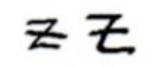
Jupiter was named for the king of the gods. The Greeks called him Zeus. The Romans called him Jupiter. The symbol for Jupiter, ♃, is from the Greek zeta. It has a horizontal stroke . This stands as an abbreviation for Zeus.
Structure
Jupiter is the biggest planet in the Solar System. Its diameter is 142,984 km (88846 mi), eleven times larger than the diameter of Earth. Jupiter is twice as massive as all the other planets in the Solar System combined. Jupiter is 318 times as massive as Earth. The volume of Jupiter is 1,317 times the volume of Earth. In other words, 1,317 Earth-sized objects could fit inside it. The planet gives off more heat than it gets from the Sun.
Atmosphere
The atmosphere near the surface of Jupiter is about 90% hydrogen, 10% helium, and less than 1% other gases.
The lower atmosphere is so heated and the pressure so high that helium changes to liquid, which then rains down onto the planet. Based on spectroscopy, Jupiter seems to be made up of the same gases as Saturn. It is different from Neptune or Uranus. Those two planets have much less hydrogen and helium gas.
Core
It is not possible to say exactly what metals are in the core of Jupiter. However, by measuring the gravity around Jupiter, one can estimate its size. The inner core is dense. It has a lot of heavy elements, likely in the form of rock and ice. The heavy elements in the core have a total mass of 7–25 times that of Earth.
Round the unknown inner core is an outer core. The outer core of Jupiter is thick, liquid hydrogen.
Jupiter is mainly made of the same elements (hydrogen and helium) as the Sun, but it is not large enough to have the internal pressure and temperature necessary to cause hydrogen to fuse to helium, the energy source that powers the Sun and most other stars. If Jupiter had 75 times its mass, it could fuse hydrogen to helium.
Cloud layers
Jupiter has many bands of clouds going horizontally across its surface. The lighter areas are zones and the darker ones are belts. The zones and belts often interact with each other. This causes huge storms. Wind speeds of 360 kilometres per hour (km/h) are common on Jupiter. To show the difference, the strongest tropical storms on Earth are about 100 km/h.
Most of the clouds on Jupiter are made of ammonia. There may also be clouds of water vapor, like the clouds on Earth. Multiple spacecraft such as Voyager 1 have seen lightning on the surface of the planet. Scientists think it was water vapor because lightning needs water vapor. These lightning bolts have been measured as up to 1,000 times as powerful as those on Earth.
Great Red Spot
One of the biggest features in Jupiter’s atmosphere is the Great Red Spot. It is a huge storm that is bigger than the entire Earth. It is on record since at least 1831, and as early as 1665. Images by the Hubble Space Telescope have shown as many as two smaller “red spots” next to the Great Red Spot. Storms can last for hours or as long as hundreds of years, as in the case of the Great Red Spot.
Magnetic field
Jupiter has a magnetic field like Earth’s but 10 times stronger. It also has a magnetosphere much bigger and stronger than Earth’s. The field traps radiation belts much stronger than Earth’s Van Allen radiation belts, strong enough to endanger any spacecraft travelling near. The magnetic field is probably caused by the large amounts of liquid metallic hydrogen in the core of Jupiter. The four largest moons of Jupiter and many of the smaller ones orbit or go around the planet within the magnetic field. This protects them from the solar wind. Jupiter’s magnetic field is so large, it reaches the orbit of Saturn 7.7 million miles (12 million km) away. The Earth’s magnetosphere does not even cover its moon, less than a quarter of a million miles (400,000 km) away. Jupiter also experiences large aurorae, which happen when charged particles from the volcanic moon Io land in its atmosphere.
Ring system
Rings of Jupiter Jupiter also has a thin planetary ring system. These rings are difficult to see and were not discovered until 1979 by NASA’s Voyager 1 probe. There are four parts to Jupiter’s rings. The closest ring to Jupiter is called the Halo Ring. The next ring is called the Main Ring. It is about 6,440 kilometres (4,002 mi) wide and only 30 kilometres (19 mi) thick. The Main and Halo rings of Jupiter are made of small, dark particles. The third and fourth rings, called the Gossamer rings, are transparent and are made from microscopic debris and dust. This dust probably comes from small meteors striking the surface of Jupiter’s moons. The third ring is called the Amalthea Gossamer Ring, named after the moon Amalthea. The outer ring, the Thebe Gossamer Ring, is named after the moon Thebe. The outer edge of this ring is about 220,000 kilometres (136,702 mi) from Jupiter.
Formation
Jupiter and other gas giants probably started as rocky planets, similar to Earth. This theory is called the core accretion model. The rocky core would have formed in the early Solar System, within a disk of gases around the Sun. When the planet reached a critical mass, its gravity started to quickly capture lots of gas. In this way, Jupiter became a giant planet. In order for Jupiter to reach this critical mass before the gas disk disappeared, there must have been lots of ice in the area. Jupiter must have formed outside the snow line, the area that is cold enough for water to freeze.
The disk instability model is another theory. It says that Jupiter was formed by gas clumping together in the disk around the Sun. In this case, a rocky core would not need to form. However, this process would probably create planets that are bigger than Jupiter, so most scientists think Jupiter was formed by core accretion.
Orbit
The orbit of a planet is the time and path it takes to go around the Sun. In the time it takes for Jupiter to orbit the Sun once, the Earth orbits the Sun 11.86 times. One year on Jupiter is equal to 11.86 years on Earth.
The average distance between Jupiter and the Sun is 778 million kilometres. This is five times the distance between Earth and the Sun. Jupiter is not tilted on its axis as much as Earth or Mars. This causes it to have no seasons, for example summer or winter. Jupiter rotates, or spins around very quickly. This causes the planet to bulge in the middle. Jupiter is the fastest spinning planet in the Solar System. It completes one rotation or spin in 10 hours. Because of the bulge, the length of the equator of Jupiter is longer than the length from pole to pole.
Grand tack hypothesis
The orbit of Jupiter is unusual compared to planets in other star systems. It is usual for giant planets to be much nearer to their stars. Because Jupiter is not, this suggests an unusual explanation is needed for the arrangement of the planets in the Solar System. Astronomers have an idea on why this happened. It is called the grand tack hypothesis.
It is suggested that Jupiter formed about 3.5 astronomical units from the Sun. It started migrating inward and scattered the rocky planet-forming materials out beyond its orbit. Saturn formed later than Jupiter and started its own inward migration. When Jupiter reached 1.5 astronomical units, it became locked into an orbital resonance with Saturn. Both planets turned around and moved outward until Jupiter arrived at its current position, 5.2 astronomical units from the Sun. Saturn arrived at about 7 astronomical units.
The grand tack hypothesis explains another mystery of the Solar System. Mars should have been larger than Earth but is instead only of this size. On Jupiter’s grand tack, it cleared the area where Mars orbits today. After it left, the material remaining was only enough to form a small planet and a low-mass asteroid belt. Although the hypothesis has not been absolutely proven, there is no other competing explanation why the Solar System’s giant should be so far from its star, and Mars so small.
Asteroids and comets
Jupiter’s large gravity has had an effect on the Solar System. Jupiter protects the inner planets from comets by pulling them towards itself. Because of this, Jupiter has the most comet impacts in the Solar System. Jupiter has 95 known natural satellites.
Two groups of asteroids, called Trojan asteroids, have settled into Jupiter’s orbit around the Sun. One group is called the Trojans and the other group is called the Greeks. They go around the Sun at the same time as Jupiter.
From Earth
Jupiter is the third brightest object in the night sky, after the Moon and Venus. The first person known to really study the planet was Galileo Galilei in 1610. He was the first person to see Jupiter’s moons Io, Europa, Ganymede and Callisto. This was because he used a telescope, unlike anyone before him.
No new moons were discovered for more than two hundred years. In 1892, astronomer E.E. Barnard found a new moon using his observatory in California. He called the moon Amalthea. It was the last of Jupiter’s 67 moons to be discovered by human observation through a telescope. In 1994, bits of the comet Shoemaker Levy-9 hit Jupiter. It was the first time a collision between two Solar System objects was seen.
From spacecraft
Seven spacecrafts have flown past Jupiter since 1973. These were Pioneer 10 (1973), Pioneer 11 (1974), Voyagers 1 and 2 (1979), Ulysses (1992 and 2004), Cassini (2000) and New Horizons (2007). Two spacecraft have been brought into orbit around Jupiter. These were Galileo (1995) and Juno (2011).
The Pioneer missions were the first spacecraft to take close-up pictures of Jupiter and its moons. Five years later, the two Voyager spacecraft discovered three new moons. They captured photo evidence of lightning on the night side of Jupiter.
The Ulysses probe was sent to study the Sun. It only went to Jupiter after it had finished its main mission. Ulysses had no cameras so it took no photographs. In 2006, the Cassini spacecraft, on its way to Saturn, took some very good, very clear pictures of the planet. Cassini also found a moon and took a picture of it but it was too far away to show the details.
The Galileo mission in 1995 was the first spacecraft to go into orbit around Jupiter. It flew around the planet for seven years and studied the four biggest moons. It launched a probe into the planet to get information about Jupiter’s atmosphere. The probe travelled to a depth of about 150 km before it was crushed by the pressure of all the gas above it. The Galileo spacecraft was also crushed in 2003 when NASA steered the craft into the planet. They did this so that the craft could not crash into Europa, a moon that scientists think might have life.
NASA has sent another spacecraft to Jupiter called Juno. It was launched on August 5, 2011 and arrived at Jupiter on July 4, 2016. NASA published some results from the Juno mission in March 2018.
Several other missions have been planned to send spacecraft to Jupiter’s moons, Europa, Callisto, and Ganymede. One called JIMO (Jupiter Icy Moons Orbiter) was cancelled in 2006 because it cost too much money. The European Space Agency launched JUICE (Jupiter Icy Moons Explorer) on April 14, 2023. It will enter orbit around Jupiter in July 2031.
Moons
Jupiter has 95 known moons, as of February 23, 2023. The four largest were seen by Galileo with his primitive telescope, and thus are known as the Galilean moons, and nine more can be seen with modern telescopes. Three moons were identified by the Voyager spacecraft. All other moons were first seen on Earth, using modern telescopes and advanced photography methods. The smallest moon (S/2003 J 12) is only one kilometre across. The largest, Ganymede, has a diameter of 5,262 kilometres. It is bigger than the planet Mercury. The other three Galilean moons are Io, Europa and Callisto. Due to the way they orbit Jupiter, gravity affects three of these moons greatly. The friction caused by the gravity of Europa and Ganymede pulling on Io makes it the most volcanic object in the Solar System. It has over 400 volcanoes, more than three times as many as Earth.
Written for younger readers
Jupiter, in simpler words
This version comes from Wikijunior, a set of books written for children aged 8 to 11. It is shorter and uses plainer language than the article above.
From Wikijunior: Solar System
Jupiter Facts:
- Due to its magnetic field trapping particles from the Sun, Jupiter is surrounded by very powerful radiation belts which would kill anyone who entered them.
- Jupiter’s moon Europa is thought to have a giant ocean below its surface.
- Jupiter’s moon Ganymede is the largest moon in the solar system.
- Jupiter is the third brightest object in the night sky, second being Venus and first being the Earth’s moon.
- Jupiter has more than twice the mass of all the other planets in the solar system combined.
- Jupiter is considered an almost-star. The smallest red dwarf star was only 30% bigger than Jupiter.
- Jupiter’s red spot and the Earth are close to the same size. That means that there is a storm going on in Jupiter that is as big as the Earth!
- Jovian in English means anything relating to Jupiter — the god or the planet. Sometimes the four outer planets are called the Jovian planets.
Jupiter is by far the largest planet in our Solar System: two and a half times larger than all of the other planets put together. It is the fifth planet from the Sun and one of the brightest planets as seen from Earth. Jupiter, along with Saturn, Uranus and Neptune, is sometimes called a “gas giant” because most of these planets are made up of liquid and gas.
Jupiter is 142,984 km or about 11 Earths in diameter at the equator. That makes it about one tenth as big in diameter as the Sun! You could fit about 1,400 Earths into the volume of Jupiter. It is 133,709 km or 10 Earths in diameter from pole to pole. Jupiter’s rapid rotation (it spins around in under ten hours compared with 24 hours for Earth) makes it bulge out at the equator.
Jupiter’s magnetic field is the largest single planetary thing in the Solar System. It is 26 million kilometers across, making it about 20 times bigger than the Sun. It has a tail that extends past Saturn’s orbit. If it could be seen from Earth, it would appear to be five times the size of the full moon.
The surface we see is not solid. This enormous planet has a relatively small solid and rocky core. Liquids and gases surround this core and blend with the atmosphere.
Jupiter is a cloudy, windy and stormy planet. It is always covered by a layer of clouds, and wind speeds of 600 km/h are not uncommon. The storms are visible as swirls, bands and spots. A particularly violent storm, about three times Earth’s diameter, is known as the Great Red Spot. This storm has been in existence since at least 1831, and maybe since 1665. If the storm has existed since 1665, that would make it more than 300 years old!
The layer of clouds is divided into several bands. The lighter colored bands are called zones and the darker bands are called belts. The colors are caused by small changes in the temperature and chemistry. Each band rotates in the opposite direction from its neighbors. Along the edges where the bands meet, these winds collide and create swirling patterns.
The stormy atmosphere of Jupiter has flashes of lightning just like on Earth. However, while Earth’s lightning strikes may be hotter than 50,000 °C, Jupiter’s lightning strikes may go over 5,000,000 °C, which is a hundred times more than Earth lightning, and is more than the temperature of the sun’s corona. The lightning is made by water near the tops of the clouds.
Jupiter’s rings are dark and hard to see. They are made of tiny particles that meteors knocked off Jupiter’s small inner moons and debris left over from comets and other objects that came close to the surface of Jupiter. In fact, until the Voyager spacecraft arrived near Jupiter and took closeup pictures of the rings of Jupiter, scientists didn’t even know that it even had rings at all. Two rings are clearly from material that can be associated with two sets of the inner moons of the planet.
These are the names of the rings and their sizes:
Gossamer means in English anything that is delicate, light, and flimsy.
In the outermost layer of Jupiter lie frozen Ammonia crystals. (Ammonia is a compound of hydrogen and nitrogen; its scientific designation is NH 3 .) crystals.
Jupiter’s atmosphere is mainly made of hydrogen(H 2 ). Near the surface, there is almost 90% hydrogen. Apart from this, the atmosphere has helium(He). Because of the high pressure, helium becomes a liquid further down in the planet. In addition, Jupiter has methane(CH 4 )(0.3%), hydrogen deuteride(HD)(0.003%), ethane(C 2 H 6 )(0.0006%), and least of all, water(H 2 O)(0.0004%).
Jupiter’s temperature is very high. Because of this, scientists cannot tell all the materials the planet is made of. The outer core of Jupiter has hydrogen. The pressure present can make the gas solid. However, because of the very high temperature, the gas melts, and becomes liquid.
Jupiter has 95 known moons. There are four major moons that were discovered by Galileo in 1610, the first moons ever discovered around another planet. Those moons are Io, Europa, Ganymede and Callisto; they are named from characters in mythology closely associated with Jupiter. They are called the Galilean moons. There are often eclipses on Jupiter’s cloud tops by the Galilean moons.
There are four small moons orbiting inside Io’s orbit. That group is called the Amalthea group because Amalthea is the largest one. They are all small and potato shaped. Amalthea is very red. The material of Jupiter’s rings came from meteors knocking it off of those moons. Amalthea(Greek:Ἀμάλθεια) in Greek mythology is a foster mother of Zeus.
Io (pronounced EYE-oh) is Jupiter’s closest major moon. It is 3643.2 km across, slightly larger than Earth’s Moon. It has the most spectacular volcanoes in the solar system and molten sulfur lakes. Any craters formed by asteroids hitting the surface are quickly covered up by the volcanic activity. Io’s core is made of molten iron and is surrounded by a rock shell. Unlike Jupiter’s other moons, there is very little water on Io. Scientists think that when Jupiter was forming, it was hot enough to dry out Io, but not the other major moons. In Roman mythology, Io(Ancient Greek:Ἰώ) was a beautiful young nymph(Nymphs are divine spirits that animate nature and generally portrayed as beautiful young women.) that Zeus loved.
Europa (pronounced Eurṓpē) is 3,121.6 km across, about 10% smaller than Earth’s Moon. It is made of silicates and has a layer of smooth water ice 10 to 30 km thick. The ice has long cracks in it and very few craters. It looks like the sea ice on Earth. The ice has slid around at the cracks. We believe there is liquid water under the ice as much as 100 km below the surface. There are also some large spots on the surface. In Roman mythology Europa was courted by Jupiter in the form of a bull. Europa (Ancient Greek:Ευρώπη) in Greek mythology was a Phoenician noblewoman who was abducted by Zeus to Crete (An island of Greece).
Ganymede is 5262.4 km across, making it 380 km wider than Mercury. It is Jupiter’s largest moon and the largest moon in the Solar System. It has plate tectonics like Earth. There are older, darker regions and newer areas with grooves where the plates have moved. Newer craters have bright rays around them from material thrown up by impacts. Older craters look flat and faded because the icy surface does not hold the shape of the crater as well as rock does over long periods of time. Ganymede may have an iron and sulfur core with a silicate mantle and an icy shell. It may be similar to Io except with a layer of ice on it. In Roman mythology Ganymede was a beautiful young man who Jupiter kidnapped and made cupbearer to the gods on Mt. Olympus.
Callisto is 4820.6 km across, about the same size as Mercury. It has many craters. Like craters on Ganymede, the older craters have faded. The largest crater is Valhalla. It has a bright center 600 km across with rings around it up to 3000 km across. Callisto is made of silicates and ice. There is a 200 km thick icy crust with a liquid water sea under it. In Roman mythology Callisto was turned into a bear by Jupiter’s jealous wife Juno. Later Jupiter placed her in the stars as The Great Bear.
The other moons are smaller in several groups outside the orbits of the major moons. There is also a small moon, Themisto and four groups of small moons that orbit very far from Jupiter.
One Jupiter day is about 10 Earth hours long. You have to say “about” because different parts of Jupiter rotate about its axis at different speeds. This is caused by the fact that Jupiter is mostly gases that are in constant motion and sometimes going in different directions. Some efforts have been made to try and measure the rotation speed of the inner rocky core of Jupiter, but that has proved to be quite difficult to accomplish due to the magnetic fields that surround Jupiter and the very active radio energy that is generated by the atmosphere of Jupiter, which interferes with measuring techniques like radar that has been used to measure the surface of Venus and Mars.
One year on Jupiter is 4,335 Earth days or 11.87 Earth years long.
A Jupiter year is about equal to four-tenths (or two-fifths) of a Saturn year. Thus after every two Saturn years, Jupiter has completed five full orbits about the Sun. So after 59 years, Saturn and Jupiter will be back in nearly the same position. When the orbits of two planets are simple ratios of each other like this, it is called a resonance.
If someone were floating close to the cloud tops of Jupiter, it would pull them down with a force about two and a half times as strong as the force of Earth’s gravity.
Jupiter’s rapid rotation causes the equator to bulge out. This would also cancel out about 10 percent of gravity’s force on them if they were at the equator. The amount of this counteraction becomes lower the closer they get to the poles.
Jupiter (Latin Iuppiter) is named after the king of the Roman gods, also called Zeus in ancient Greece. The god Jupiter was known for causing lightning strikes on Earth. He is associated with the eagle and the oak tree.
Next Topic: Saturn
ar:ويكي الأطفال:نظام شمسي/المشتري bs:Wiki_junior_Sunčev_sistem/Jupiter de:Wikijunior Sonnensystem/ Jupiter es:Wikichicos/Sistema_Solar/Júpiter nl:Wikijunior:Zonnestelsel/Jupiter pl:Wikijunior:Układ_Słoneczny/Jowisz fi:Wikijunior_Aurinkokunta/Jupiter zh:Wikijunior:太阳系/木星
Where this page comes from
The article above is adapted from “Jupiter” on Simple English Wikipedia, by its contributors. We removed reference markers, navigation boxes and tables, expanded measurement templates into readable numbers, and kept the prose otherwise intact. The simpler version is adapted from Wikijunior on Wikibooks.
Both sources are published under CC BY-SA 4.0, so this page is published under the same licence. You may share and adapt it, including commercially, as long as you credit the original and keep the same licence.
Worksheets, answer keys and printable layouts elsewhere on K5Print are our own work and are not covered by this licence.