Mars

Fast facts
- Mass
- (0.107 Earths)
Mars is the fourth planet from the Sun and the second-smallest planet in the Solar System, nicknamed The Red Planet.
Mars is a terrestrial planet with caps of water and carbon dioxide. It has the largest volcano in the Solar System, and some very large impact craters.
Mars is named after the mythological Roman god of war because it appears of red color. Anything that has to do with Mars is called “Martian”.
Space probes, such as the Viking program landers, are the main tools for the exploration of Mars.
Appearance
Mars is a terrestrial planet and made of rocks. The ground there is red because of iron oxide (rust) in the rocks and dust. The planet’s atmosphere is very thin. It is mostly carbon dioxide with some argon and nitrogen and tiny amounts of other gases including oxygen. The temperatures on Mars are colder than on Earth, because it is farther away from the Sun and has less air to keep heat in. There is water ice and frozen carbon dioxide at the north and south poles. Mars does not have any liquid water on the surface now, but signs of run-off on the surface were probably caused by water.
The average thickness of the planet’s crust is about 50 km (31 mi), with a maximum thickness of 125 km (78 mi).
Moons
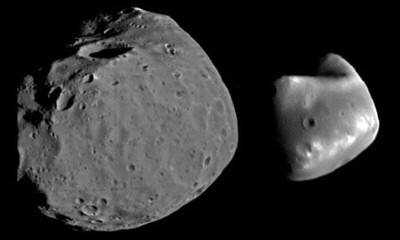
Mars has two small moons, called Phobos and Deimos.
The origin of Mars’ moons is unknown and controversial. One theory is that the moons are captured asteroids. However, the moons’ near circular orbits and low inclination relative to the Martian equator are not in agreement with the capture hypothesis.
Estimates of the mass ejected by a large Borealis-size impact vary. Simulations suggest that a body about 0.02 of Mars mass (~0.002 Earth mass) in size can produce a sizable debris disk in Martian orbit. Much of the material would stay close to Mars. There are several other large impact basins on Mars that could also have ejected enough debris to form the moons.
Lack of magnetic field
Mars does not have a global magnetic field. Despite this, observations show that parts of the planet’s crust have been magnetized. This suggests that polarity reversals have occurred in the past. This paleomagnetism is similar to the magnetic striping found on Earth’s ocean floors. One theory is that these bands suggest plate tectonic activity on Mars four billion years ago, before the planetary dynamo stopped working and the planet’s magnetic field faded.
Rotation and orbit
A Martian day is called a sol, and is a little longer than an Earth day. Mars rotates in 24 hours and 37 minutes. It rotates on a tilted axis, just like the Earth does, so it has four different seasons. Of all the planets in the Solar System, the seasons of Mars are the most Earth-like, due to their similar axial tilt. The lengths of the Martian seasons are almost twice those of Earth’s: Mars’s greater distance from the Sun causes the Martian year to be almost two Earth years long.
Martian surface temperatures vary from lows of about 130 kelvins (at the winter polar caps) to highs of up to 308 kelvins (in equatorial summer). The wide range in temperatures is due mostly to the thin atmosphere which cannot store much solar heat. The planet is also 1.52 times as far from the Sun as Earth, resulting in just 43% of the amount of sunlight.
Its orbit is more eccentric than the Earth’s (meaning less like a circle). Probably that is one reason why the Earth’s climate varies so much. In other words, its orbit affects the climate of the Earth. That is just a theory at present.
Water
‘‘See main article, Water on Mars
A 2015 report says Martian dark streaks on the surface were affected by water.
Liquid water cannot exist on the surface of Mars due to its low atmospheric pressure (there is not enough air to hold it in), except at the lowest elevations for short periods. The two polar ice caps appear to be made largely of frozen water. The amount of ice in the south polar ice cap, if melted, would be enough to cover the entire planet’s surface 11 meters deep. A permafrost mantle stretches from the pole to latitudes of about 60°.
Geological evidence gathered by unmanned missions suggest that Mars once had much liquid water on its surface. In 2005, radar data revealed the presence of large quantities of water ice at the poles, and at mid-latitudes. The Mars rover Spirit sampled chemical compounds containing water molecules in March 2007. The Phoenix lander found water ice in shallow Martian soil in July 2008. Landforms seen on Mars strongly suggest that liquid water at some time existed on the planet’s surface. Huge areas of ground have been scraped and eroded.
In August 2024, a reservoir of liquid water was discovered on Mars - deep in the rocky outer crust of the planet. The findings came from a new analysis of data from Nasa’s Mars Insight Lander, which recorded four years’ of vibrations - Mars quakes - from deep inside the Red Planet.
Polar caps
Mars has two permanent polar ice caps. During a pole’s winter, it lies in continuous darkness, chilling the surface and causing the deposition of 25–30% of the atmosphere into slabs of CO 2 ice (dry ice). When the poles are again exposed to sunlight, the frozen CO 2 sublimes (turns to vapor), creating enormous winds that sweep off the poles as fast as 400 km/h. Each season this moves large amounts of dust and water vapor, giving rise to Earth-like frost and large cirrus clouds and dust storms. Clouds of water-ice were photographed by the Opportunity rover in 2004.
The polar caps at both poles consist primarily of water ice.
Atmosphere
Mars has a very thin atmosphere with barely any oxygen (it is mostly carbon dioxide). Because there is an atmosphere, however thin it is, the sky changes colour when the sun rises and sets. The dust in the Martian atmosphere makes Martian sunsets somewhat blue. Mars’s atmosphere is too thin to protect Mars from meteors, which is part of the reason why Mars has so many craters.
Meteorite craters
After the formation of the planets, they all experienced the “Late Heavy Bombardment”. About 60% of the surface of Mars shows a record 67.
of impacts from that era. Much of the remaining surface is probably lying over the immense impact basins caused by those events. There is evidence of an enormous impact basin in the northern hemisphere of Mars, spanning , or roughly four times larger than the largest impact basin previously known. This suggests that Mars was struck by a Pluto-sized body about four billion years ago. The event is thought to be the cause of the difference between the Martian hemispheres. It made the smooth Borealis Basin that covers 40% of the planet.
Some meteorites hit Mars with so much force a few pieces of Mars went flying into space even to Earth. Rocks on Earth are sometimes found which have chemicals that are exactly like the ones in Martian rocks. These rocks also look like they fell really quickly through the atmosphere, so it is reasonable to think they came from Mars.
Recent hits
Spacecraft Insight detected seismic waves made by the biggest meteorite impacts ever seen on Mars.
Geography
Mars is home to the highest known mountain in the Solar System, Olympus Mons. Olympus Mons is about 17 miles (or 27 kilometers) high. This is more than three times the height of Earth’s tallest mountain, Mount Everest. It is also home to Valles Marineris, the third largest rift system (canyon) in the Solar System, 4,000 km long.
Observation of Mars
Our records of watching and recording Mars start with ancient Egyptian astronomers in the 2nd millennium BC.
Detailed observations of the location of Mars were made by Babylonian astronomers who developed methods using math to predict the future position of the planet. The ancient Greek philosophers and astronomers developed a model of the solar system with the Earth at the center (‘geocentric’), instead of the sun. They used this model to explain the planet’s motions. Vedic and Islamic astronomers estimated the size of Mars and its distance from Earth. Similar work was done by Chinese astronomers.
In the 16th century, Nicholas Copernicus proposed a model for the Solar System in which the planets follow circular orbits about the Sun. This ‘heliocentric’ model was the beginning of modern astronomy. It was revised by Johannes Kepler, who gave an elliptical orbit for Mars which better fit the data from our observations.
The first observations of Mars by telescope was by Galileo Galilei in 1610. Within a century, astronomers discovered distinct albedo features (changes in brightness) on the planet, including the dark patch and polar ice caps. They were able to find the planet’s day (rotation period) and axial tilt.
Better telescopes developed early in the 19th century allowed permanent Martian albedo features to be mapped in detail. The first crude map of Mars was published in 1840, followed by better maps from 1877 onward. Astronomers mistakenly thought they had detected the spectroscopic mark of water in the Martian atmosphere, and the idea of life on Mars became popular among the public.
Yellow clouds on Mars have been observed since the 1870s, which were windblown sand or dust. During the 1920s, the range of Martian surface temperature was measured; it ranged from 85 to 7 o C. The planetary atmosphere was found to be arid with only traces of oxygen and water. In 1947, Gerard Kuiper showed that the thin Martian atmosphere contained extensive carbon dioxide; roughly double the quantity found in Earth’s atmosphere. The first standard naming of Mars surface features was set in 1960 by the International Astronomical Union.
Since the 1960s, multiple robotic spacecraft and rovers have been sent to explore Mars from orbit and the surface. The planet has remained under observation by ground and space-based instruments across a broad range of the electromagnetic spectrum (visible light, infrared and others). The discovery of meteorites on Earth that came from Mars has allowed laboratory examination of the chemical conditions on the planet.
Martian ‘canals’
During the 1877 opposition, Italian astronomer Giovanni Schiaparelli in Milan used a 22 centimetres telescope to help produce the first detailed map of Mars. What caught people’s attention was that the maps had features he called canali. These were later shown to be an optical illusion (not real). These canali were supposedly long straight lines on the surface of Mars to which he gave names of famous rivers on Earth. His term canali was popularly mistranslated in English as canals, and thought to be made by intelligent beings.
Other astronomers thought they could see the canals too, especially the American astronomer Percival Lowell who drew maps of an artificial network of canals on Mars.
Although these results were widely accepted, they were contested. Greek astronomer Eugène M. Antoniadi and English naturalist Alfred Russel Wallace were against the idea; Wallace was extremely outspoken. As bigger and better telescopes were used, fewer long, straight canali were observed. During an observation in 1909 by Flammarion with a 84 centimetres (33 in) telescope, irregular patterns were observed, but no canali were seen.
Search for life
Because Mars is the one of the closest planets to Earth in the Solar System, many have wondered if there is any kind of life on Mars. Scientists have not found life on Mars (as of 2024). No sign of former life, has been found.
Today we know that this life, if any, would be simple organisms, like bacteria.
Meteorites
NASA maintains a catalog of 34 Mars meteorites, that is, meteorites which originally came from Mars. These assets are highly valuable since they are the only physical samples available of Mars.
Studies at NASA’s Johnson Space Center show that at least three of the meteorites contain possible evidence of past life on Mars, in the form of microscopic structures resembling fossilized bacteria (so-called biomorphs). Although the scientific evidence collected is reliable, and the rocks are correctly described, what made the rocks look like they do is not clear. To date, scientists are still trying to agree if it really is evidence of simple life on Mars.
Over the past few decades, scientists have agreed that when using meteorites from other planets found on Earth (or rocks brought back to Earth), various things are needed to be sure of life. Those things include:
- Whether the rock comes from the right time and place on the planet for life to exist.
- Whether samples contain evidence of bacterial cells (if they show fossils of some kind, even if very tiny).
- Whether there is any evidence of biominerals (minerals usually caused by living things).
- Whether there is any evidence of isotopes typical of life.
- Whether the features are part of the meteorite, and not contamination from Earth.
For people to agree on past life in a geologic sample, most or all of these things must be met. This has not happened yet, but investigations are still in progress. Reexaminations of the biomorphs found in the three Martian meteorites are underway.
The significance of water
Liquid water is necessary for life and metabolism, so if water was present on Mars, the chances of life evolving is improved. The Viking orbiters found evidence of possible river valleys in many areas, erosion and, in the southern hemisphere, branched streams. Since then, rovers and orbiters have also looked closely and eventually proved water was on the surface at one time, and is still found as ice in the polar ice caps and underground.
As of 2025
Several space probes have gone to Mars to study it. Some have orbited (gone around) the planet, and some have landed on it. There are pictures of the surface of Mars that were sent back to Earth by the probes.
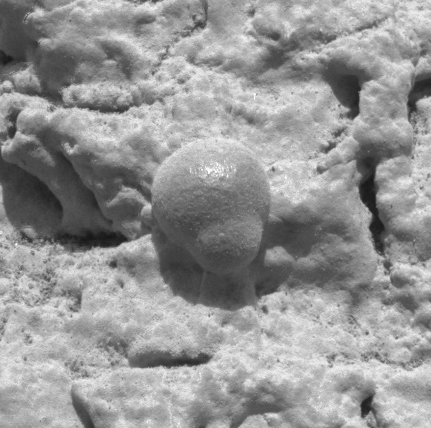
The Chevaya Falls rock was discovered on Mars in June 2024. The rock was core sampled by the Perseverance rover, so that the rock could get sent to Earth and further examination. Research has not shown (as of 2025’s third quarter) if the rock has a biological origin or abiotic origin; The rock has spots that look [similar to spots on a leopard, or] “poppyseed and leopard-esque spots.
NASA has said that the rock is maybe a biosignature. The rock is part of the samples from “Sapphire Canyon”.
Earlier (August 2012), the Mars Science Laboratory landed on Aeolis Palus in Gale Crater on Mars. It brought with it a mobile explorer called ‘Curiosity’. Curiosity has dug up Martian soil and studied it in its laboratory. It has found sulfur, chlorine, and water molecules.
Some people are interested in sending astronauts to visit Mars. They could do a better search, but getting astronauts there would be difficult and expensive. The astronauts would be in space for many years, and it could be very dangerous because of radiation from the Sun.
Popular culture
Some famous stories were written about the idea of life on Mars. The writers used the name “Martians” for intelligent beings from Mars. In 1898, H.G. Wells wrote The War of the Worlds, a famous novel about Martians attacking the Earth. In 1938, Orson Welles broadcast a radio version of this story in the United States, and many people thought it was really happening and were very scared. Beginning in 1912, Edgar Rice Burroughs wrote several novels about adventures on Mars.
Written for younger readers
Mars, in simpler words
This version comes from Wikijunior, a set of books written for children aged 8 to 11. It is shorter and uses plainer language than the article above.
From Wikijunior: Solar System
Mars Facts:
- Mars is red because of rust in the surface rocks
- A volcano on Mars called Olympus Mons is the highest mountain in our Solar System.
- Mars has polar ice caps that look like the ones on ../Earth/.
- Mars has ancient river beds where scientists think liquid water flowed millions or billions of years ago.
- The Tooting crater on Mars was named after a suburb in London because the discoverer “thought [his] mum and brother would get a kick out of having their home town paired with a land form on Mars”. Mars is the fourth planet from the Sun. It is called a terrestrial planet because its outer layers are made of rocky material like the Earth.
Mars is the second smallest of the eight major planets in the Solar System. Only Mercury is smaller. It is nearly 7,000 kilometres (km) wide; just over half the width of the Earth. Its volume is about 15% of the Earth. Since a lot of the Earth is covered by water, the total surface area of the Mars is nearly as large as all of the land on the Earth. It is possible that its size may eventually permit human colonies.
The surface of Mars is a lot like a desert on Earth; it is very dry and dusty, but it is also very cold. There are a lot of loose rocks and dunes of fine sand. Crater impacts mark the surface, but these are not as common as on the Moon. One of the craters is the huge Hellas Planitia. It is about half the size of the continental United States. The southern half of the planet has more craters than in the north. The south is also higher in elevation.
There is an area on Mars called the Tharsis Bulge, which has four huge volcanoes. These volcanoes have not erupted for millions of years. The largest volcano is called Olympus Mons. It is 27 km tall, making it the highest mountain in the Solar System; more than three times higher than Mount Everest on Earth. It is 625 km across and takes up an area as big as the US state of Arizona. Mars also has a huge canyon called the Valles Marineris. It is much bigger than the Grand Canyon on Earth. It is 4000 km long, up to 7 km deep and up to 200 km wide. Scientists think that when the Tharsis Bulge was created, the surface of Mars cracked to form the Valles Marineris.
Like the Earth, Mars has ice caps at its poles. However, they are made from frozen carbon dioxide as well as ice. During the Martian winter at each pole, the cap grows as carbon dioxide from the atmosphere freezes. The cap shrinks again during the Martian summer. As on Earth, when it is winter at one pole it is summer at the other.
In some places, there are dry channels that look like they were made by running water. So, a long time ago Mars may have had lakes and streams made of water. Now all of the water is frozen into ice under the surface.
There is an atmosphere on Mars, but it is very thin. There is also much more carbon dioxide in it than oxygen. (Oxygen is the gas we need when we breathe in; carbon dioxide the gas we get rid of when we breathe out.) So, we would need spacesuits to visit Mars. The atmosphere helps protect the surface from smaller meteorites.
When Mars comes closest to the Sun, the atmosphere can stir up storms of dust. Some of these storms are gigantic; they can cover the entire planet in clouds of dust. Dust storms on Mars can last for hundreds of days, with wind speeds of up to 200 kilometres per hour. Huge storms like these have been seen from the Earth through telescopes.
One day on Mars is only 39 minutes and 35 seconds longer than a day on Earth (1.026 Earth days). A year on Mars is almost two Earth years long (687 Earth days).
Much like the Earth, the axis of rotation of Mars is tilted at an angle. This tilt causes seasons on Mars as it travels around the Sun. Summer occurs on the half of the planet that is tilted toward the Sun, and winter on the other half. After half a Martian year has passed, the seasons are reversed. But these seasons are about twice as long as on Earth.
The outer, rocky surface of Mars is called the crust. Most of the crust is made from basalt, a type of rock made when lava grows cold.
Like the Earth, Mars has a thick layer of rock below the crust called the mantle. The mantle is much hotter than the crust, and the mantle rock is partly molten. But the crust on Mars has grown thick, so the lava from the mantle no longer reaches the surface. There are volcanoes on Mars, but they are no longer active.
At the center of Mars is a core made of the metals iron and nickel. If Mars were the same size as the Earth, the core of Mars would be smaller than the Earth’s core. So a larger amount of Mars is made out of rock. Because rock is lighter than the metals in the core, Mars has a lower density than the Earth.
If you were on Mars, you would be lighter, as Mars’ gravity only has a force about two fifths as strong as the that of Earth’s. You could lift objects that weigh almost three times as much compared to similar objects here on the Earth. You could jump up almost three times higher, and it would take much longer to fall to the ground from the same height.
Even though it looks as though you would be like a comic-book hero on Mars, there are some things you couldn’t do. Although a big rock would weigh less and you could pick it up, it would still have the same mass. If you tried to catch it, it would knock you over, and if it landed on you it would crush you. A car on the surface of Mars would need the same amount of power to speed up, although going uphill would be less of a problem. It may, however, need more room to stop. Because of the reduced gravity a vehicle would not “grip” the ground on Mars as strongly, but the constant mass would keep the vehicle moving just as strongly, making it easy to go into a skid.
In Roman mythology, Mars was the god of war and agriculture. The planet Mars was named this because the planet looks red like blood, from rust in its surface rocks.
Nobody knows, but the earliest records we know of were by Ancient Egyptians, more than 4000 years ago, noting Mars’ movement. On one pharaoh’s tomb, named Seti I, Mars is drawn on the ceiling. The Babylonians (in the Middle East), Chinese, and Greeks also studied Mars more than 3000 years ago. The Greeks learned about Mars from the Babylonians, and since the Babylonians called it their god of war, named Nergal, the Greeks called it their own god of war, Ares. Exploration of Mars was first attempted in 1960, with Mars 1. It failed, along with several other missions by the Soviet Union in the 1960s. The first successful mission to Mars was in 1964, by Mariner 4, by the U.S. Most of the other Mariner missions to Mars were successful. The last Mariner mission to Mars, Mariner 9, got there in the midst of a dust storm, and orbited the planet for several months before it could get a good look at the surface. So far, all these missions were flybys or orbiters. The first spacecraft to land on Mars was Viking 1 in 1976. Viking 2 landed 19 days later. Together, they took many good pictures of Mars’ surface. Next Topic: Asteroid belt
Where this page comes from
The article above is adapted from “Mars” on Simple English Wikipedia, by its contributors. We removed reference markers, navigation boxes and tables, expanded measurement templates into readable numbers, and kept the prose otherwise intact. The simpler version is adapted from Wikijunior on Wikibooks.
Both sources are published under CC BY-SA 4.0, so this page is published under the same licence. You may share and adapt it, including commercially, as long as you credit the original and keep the same licence.
Worksheets, answer keys and printable layouts elsewhere on K5Print are our own work and are not covered by this licence.