Mimas
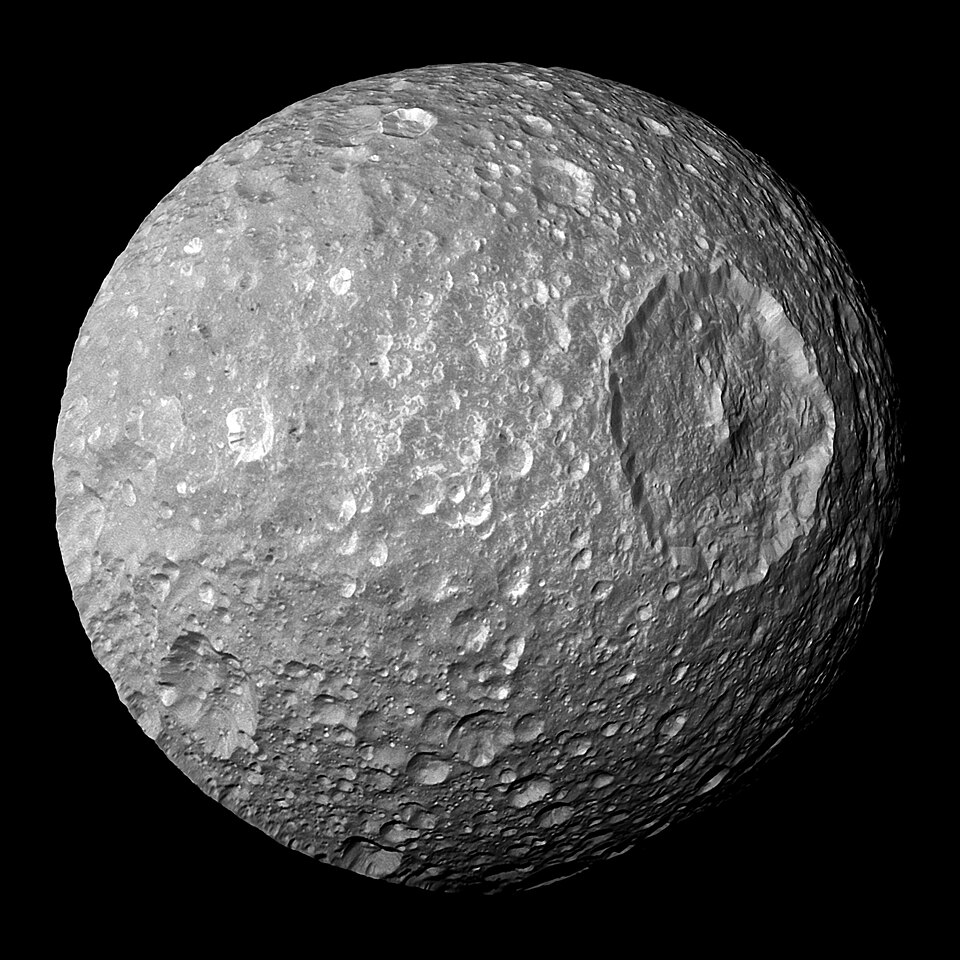

Quick facts
- Discovered by
- William Herschel
- Discovered
- 17 September 1789
- Goes around
- Saturn
- Radius
- 198 km (123 mi)
Facts from Wikipedia’s “Mimas” page (CC BY-SA 4.0).
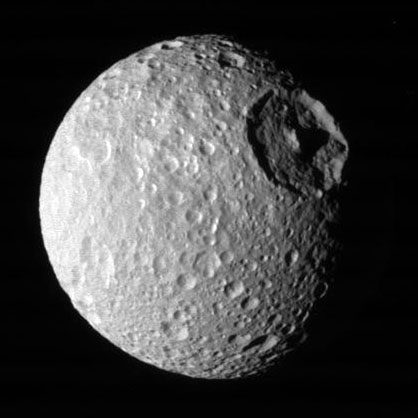
Mimas (from the Greek Μίμᾱς) is one of Saturn’s largest moons. It is also called Saturn I. Mimas is best known for its large crater, Herschel. In the centre of the crater is a very high mountain. Mimas was discovered by the English astronomer William Herschel on September 17, 1789. It resembles the Death Star from Star Wars. The moon is believed to have created the Cassini Division. This is a 4,800 km gap between Saturn’s A and B rings.
Discovery and naming
Mimas was discovered in 1789 by William Herschel. He discovered it on September 17. Herschel discovered it along with another Saturnian moon, Enceladus Mimas was named after one of the Titans in mythology. Mimas was the giant.
Surface
Mimas is full with craters like our Moon. But unlike the craters on the Moon, Mimas has icy craters like going through an icy object. Mimas has craters, but the most famous is the Herschel crater. It is 130 km (80 mi) in diameter. The diameter of Herschel is about 1/3 of Mimas. If a comet or asteroid that hit Mimas were to hit Earth, the crater would be seen from space with all the Earth shown in view. Mimas would evaporate away if it was too close to the Sun.
Exploration
Mimas has been visited by 4 or 5 spacecrafts.
- Pioneer 11
- Voyager 1
- Voyager 2
- Cassini
Written for younger readers
Mimas, in simpler words
This version comes from Wikijunior, a set of books written for children aged 8 to 11. It is shorter and uses plainer language than the article above.
From Wikijunior: Solar System
Mimas is one of the moons of Saturn.
Mimas is 397.2 km wide (246 miles). It is egg shaped because Saturn and the other moons stretch it with their gravity.
The surface of Mimas is covered with craters, the largest being Herschel, which was named after William Herschel, the person who discovered Mimas. This crater is about one-third of Mimas’ width. It is 5 km (3 miles) high, 10 km (6 miles) deep, and its peak is 6km (4 miles) above the crater floor. Mimas and Rhea, another of Saturn’s moons, have been called the most heavily cratered bodies in the Solar System.
Mimas also has many chasmata (chasms), which are long, narrow, steep-sided depressions on the moon’s surface.
One day on Mimas is equal to 23 hours.
Mimas takes 23 hours to make one orbit around Saturn. It has synchronous rotation, which means that it takes the same amount of time for Mimas to complete one orbit as it does for one rotation. The same side of Mimas is always facing toward Saturn.
Mimas is made mostly of ice, with some rock. Mimas appears to be frozen solid despite its location to Saturn. This location should have made Mimas more susceptible to tidal heating from Saturn, thus causing partial thaw of the frozen ice.
If you were on Mimas, the gravity would be 0.008 times as much as Earth’s gravity.
Mimas is named after Mimas, the son of the Greek goddess Gaia. The named was suggested by John Herschel, William Herschel’s son. Mimas is also called Saturn I.
Mimas was discovered in 1789 by William Herschel using a telescope. It was the second moon of Saturn to be discovered by Herschel
de:Wikijunior Sonnensystem/ Saturn/ Mimas
Where this page comes from
The article above is adapted from “Mimas” on Simple English Wikipedia, by its contributors. We removed reference markers, navigation boxes and tables, expanded measurement templates into readable numbers, and kept the prose otherwise intact. The simpler version is adapted from Wikijunior on Wikibooks.
Both sources are published under CC BY-SA 4.0, so this page is published under the same licence. You may share and adapt it, including commercially, as long as you credit the original and keep the same licence.
Worksheets, answer keys and printable layouts elsewhere on K5Print are our own work and are not covered by this licence.