Moon

Fast facts
- Period
- 27.321 582 d (27 d 7 h 43.1 min)
- Mass
- 7.347 7 kg
- Density
- 3,346.4 kg/m³
The Moon, also known as Luna, is Earth’s only natural satellite (the only object which orbits the Earth and is not man-made). It is usually visible in the night sky, but is sometimes seen during the day.
The Moon is about one-fourth of the width of Earth. Because it is so far away it looks small in the sky, about half a degree wide.
The gravity on the Moon is one-sixth of the Earth’s gravity. It means that an object will be one-sixth as heavy on the Moon compared to Earth.
The Moon is a rocky and dusty place. It moves slowly away from the Earth at a rate of 3.8 centimeters per year due to the effect of tidal dissipation.
Some other planets also have moons or natural satellites. The giant impact hypothesis is a common explanation for how the Moon formed.
Origin
The giant impact hypothesis is the most common theory among scientists to explain how the Moon formed. According to this hypothesis, Earth collided with a Mars-sized proto-planet around 4.5 billion years ago, and the debris from the collision created the Moon.
Recent research has challenged this hypothesis. According to one article: [N]ew findings suggest that the Moon was primarily created from material ejected from Earth’s mantle, with minimal contribution from [the proto-planet].
Gravity
Because it is smaller, the Moon has only 1/6 of the gravity on Earth. So if a person weighs 60 kilograms on Earth, the person would only weigh 10 kilograms on the Moon.
Even though the Moon’s gravity is weaker than the Earth’s gravity, it is still there. If a person dropped a ball while standing on the Moon, it would still fall down. However, it would fall much more slowly. A person who jumped as high as possible on the Moon would jump higher than on Earth, but still fall back to the ground.
Because the Moon has no atmosphere, there is no air resistance, so a feather will fall as fast as a hammer.
Heat & cold
Without an atmosphere, the Moon’s environment is not protected from heat or cold. Astronauts wore spacesuits to survive and carried oxygen to breathe. These suits weighed about as much as the astronauts (though they were not as heavy as on Earth because of the Moon’s weak gravity). The astronauts never took their gloves or spacesuits off on the Moon.
Light
On the Earth, the sky is blue because the Sun’s blue rays bounce off the gases in the atmosphere. This makes it look like blue light is coming from the sky. On the Moon, there is no atmosphere for light to bounce off. This means the sky looks black, even in the daytime.
Craters
Earth’s atmosphere causes most meteorites (space rocks) to burn up. The Moon does not have this protection. Meteorites crash into it and create wide, shallow holes called craters. The Moon has thousands of them. Newer craters overlie older ones.
Water
In 2009 Chandrayaan-1, India’s first lunar exploration mission, found a lot of water on the Moon. However, the water is not liquid; it is in the form of hydrates and hydroxides. Liquid water cannot exist on the Moon because photodissociation quickly breaks down the molecules. However, based on the data received from Chandrayaan-1, liquid surface water may have once existed on the Moon.
Phases
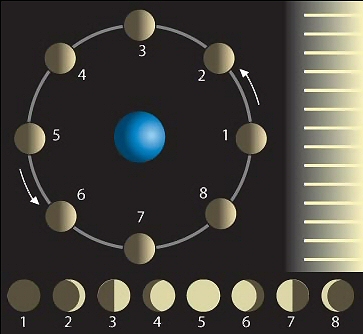
Because the Moon is round, half of it is lit up by the Sun. As it goes around (or orbits) the Earth, sometimes the side that people on Earth can see is all lit brightly. Other times only a small part of the side we see is lit.
This is because the Moon does not send out its own light. People only see the parts that are being lit the eclipse by the sunlight. These different stages are called Phases of the Moon.
It takes the Moon about a month (29 days, 12 hours, and 44 minutes) to complete the cycle, from big and bright to small and dim and back to big and bright. People throughout history have used the Moon’s cycles to measure time.
The phases of the Moon are, in order:
- The “new Moon” (when the Moon passes between the Earth and Sun)
- The “waxing crescent”
- The “first quarter”
- The “waxing gibbous”
- A “full Moon” (when the Moon and Sun are on opposite sides of the Earth)
- The “waning gibbous”
- The “third quarter”
- The “waning crescent”,
- A new Moon again Each of the four middle phases of the Moon lasts about seven days on average (around 7.38 days). This time can change by about ±11% because the Moon moves closer to or farther from Earth from its farthest point (apogee) to its closest point (perigee).
The number of days since the last new moon is called the Moon’s age. A full set of moon phases is called a lunation.
To find the Moon’s age and phase for any date, you can count how many days have passed since a known new moon (for example, January 1, 1900, or August 11, 1999). Then divide that number by the average length of a moon month (29.53059 days). The number left over after dividing is the Moon’s age.
This simple method is good for general or fun uses, like moon phase clocks. It is not exact because it does not use the real shape of the Moon’s orbit or the exact time of the new moon, so it can be off by a few hours. The farther you go from the reference date, the less accurate it becomes.
Because the Moon wobbles a little as it orbits Earth (a motion called libration), we can sometimes see a tiny bit more than the full moon (up to about 101%) or a small part of its far side (up to 5%).
Tidal locking
The Moon always shows the same side to Earth. Astronomers call this phenomenon tidal locking. This means that half of it can never be seen from Earth. The side facing away from Earth is called the far side or dark side of the Moon even though the Sun does shine on it—we just never see it lit.
Robots
Before people stood on the Moon, the United States and the USSR sent robots to the Moon. Some of these robots orbited the Moon; others landed on its surface. The robots were the first man-made objects to touch the Moon.
The first humans
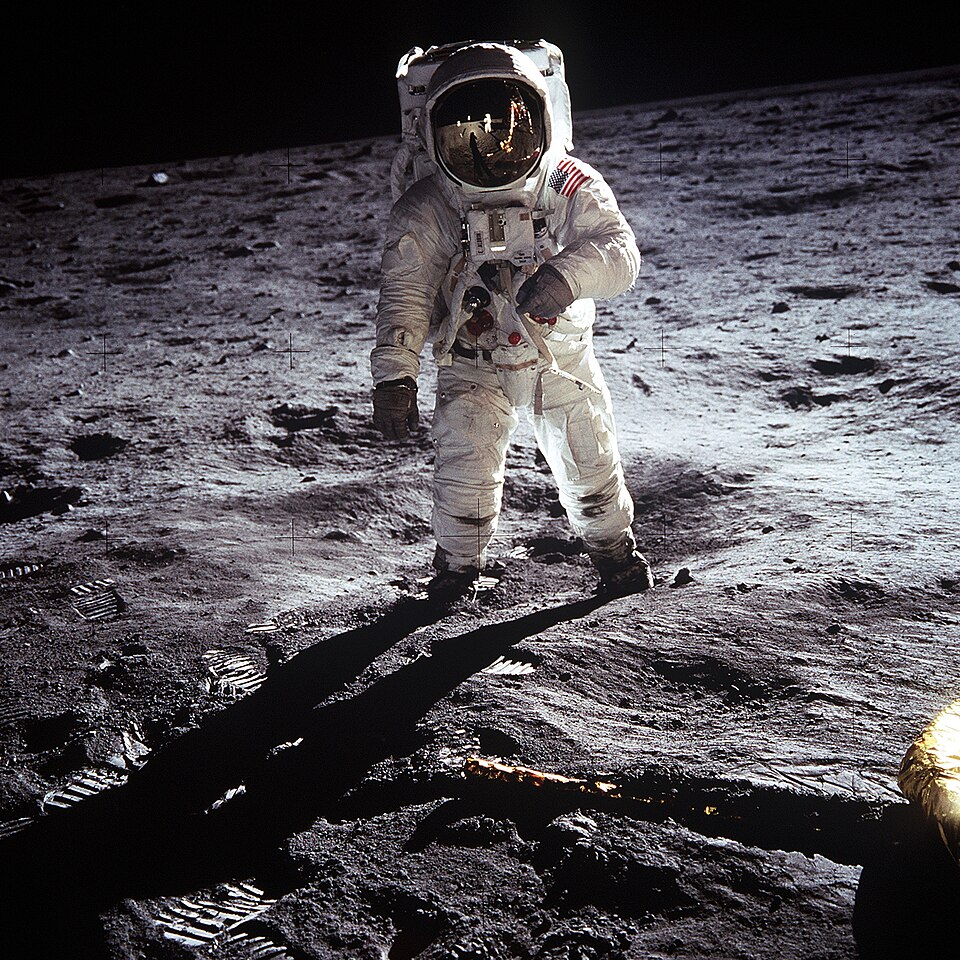
Humans finally landed on the Moon on July 21, 1969. Astronauts Neil Armstrong and Buzz Aldrin landed their lunar ship (the Eagle) on the surface of the Moon. Then, as half the world watched him on television, Armstrong climbed down the ladder of the Eagle and was the first human to touch the Moon as he said, “That’s one small step for a man, one giant leap for mankind.”
Even though their footprints were left on the Moon a long time ago, they could remain there for millions of years. There is no wind or rain on the Moon, so erosion happens extremely slowly. This means the footprints do not get filled in or smoothed out like they would on Earth.
Future landings
Ten more astronauts landed on the moon between 1969 and 1972. All were part of the United States’ Apollo program.
The last spaceship to land on the Moon was Apollo 17. Eugene Cernan was the last person to touch its surface.
Legal status
During the Cold War, the United States Army thought about making a military base on the Moon so they could attack targets on Earth. They also considered testing a nuclear weapon on the Moon. The United States Air Force had similar plans. However, both plans were brushed off as NASA moved from a military agency to a civilian-based one.
Even though the Soviet Union left remains on the Moon, and the United States left a few flags, no country has control over the Moon. The U.S., the Soviet Union, and many other countries signed the Outer Space Treaty,
which calls the Moon and all of outer space the “province of all mankind”. This treaty also bans all use of the military on the Moon, including nuclear weapons tests and military bases.
Colonization
Some governments have ideas about Colonization of the Moon. (Related page, Colonization). A U.S. agency has ideas or plans about putting a nuclear reactor, on the Moon, according to media.
Timekeeping
As of 2025’s first quarter, there is no time standard on the Moon. The U.S. government has suggested Coordinated Lunar Time.
Other information
A lunar night (or night on the moon), is each c. 14 Earth days.
Written for younger readers
Moon, in simpler words
This version comes from Wikijunior, a set of books written for children aged 8 to 11. It is shorter and uses plainer language than the article above.
From Wikijunior: Solar System
Most of the planets in the Solar System are much bigger than their moons, but the Earth and the Moon are much closer in size. The Moon is just under 3,500 kilometers (km) wide. That’s over a quarter of the size of the Earth (about 12,600 km wide) as you can see in the picture below. Because of this, the Earth and Moon together are sometimes called a binary or double planet system.
The Moon has no atmosphere. It also has no liquid water on its surface. During the day it becomes very hot, but at night it is icy cold. A person visiting the Moon needs an air supply and a special suit.
The Moon has many craters on its surface. The largest one is called the South Pole-Aitken Basin and is roughly 2500 km across.
We think nearly all the craters on moons or planets were made by huge rocks hitting them a long time ago. These collisions are called impacts.
Some of the craters on the Moon look as if they have rays coming out of them. These rays are rocks thrown across the Moon by the impacts that made the craters. Some of the craters around the poles of the Moon may have ice in them.
There are also darker areas called maria (said “MARR-ee-ah”). These are large pools of lava that cooled a long time ago. Most maria are on the side of the Moon we see from Earth. The lighter areas on the Moon are highlands.
The Moon takes just over 27 Earth days to rotate (rotate means spin around) once.
The Moon also takes just over 27 days to orbit (move around) the Earth. This is why we always see the same side of the Moon when we look from the Earth. We call this side the near side. The other side we call the far side. In 1959, a probe called Luna 3 sent back pictures of the far side. That was the first time anyone saw what it looked like.
The surface of the Moon is made of rocks and dust. The outer layer of the Moon is called the crust. The crust is about 70 km thick on the near side and 100 km thick on the far side. It is thinner under the maria and thicker under the highlands. There may be more maria on the near side because the crust is thinner. It was easier for lava to rise up to the surface.
We think the Moon has a small core (center) about 300 km across. The core is composed of solid iron. Because the core is solid, the Moon does not have its own magnetic field.
If you were on the Moon, it would pull you down about a sixth as much as the Earth does, so you’d weigh a sixth as much. So would anything else. That’s why it was much easier for the astronauts visiting the Moon to pick up rocks there.
The names Moon and month both come from the ancient Greek name for the Moon, Mene. There have been other names for the Moon, like Selene and Luna. Selene was the Greek goddess of the Moon. Luna was the Roman goddess of the Moon. The Roman people also associated their goddess Diana with the Moon.
Ancient Greece and Ancient China noted over 2000 years ago that the light from the Moon is reflected from the Sun. Also, Ancient Greece noted that the Moon causes tides on Earth. More recently, Luna 1 was the first spacecraft to perform a flyby of the moon. Luna 2 was the first spacecraft to land on the moon, and Luna 3 was the first to photograph the far side of the Moon which you can not see from Earth. Luna 1 through 3 all were launched in 1959. Surveyor 3, in 1967, was the first to examine the soil of the Moon. It dug to 17.5 cm. In 1969, Apollo 11 was the very first spacecraft to land people on the moon.
Next Topic: Mars
Where this page comes from
The article above is adapted from “Moon” on Simple English Wikipedia, by its contributors. We removed reference markers, navigation boxes and tables, expanded measurement templates into readable numbers, and kept the prose otherwise intact. The simpler version is adapted from Wikijunior on Wikibooks.
Both sources are published under CC BY-SA 4.0, so this page is published under the same licence. You may share and adapt it, including commercially, as long as you credit the original and keep the same licence.
Worksheets, answer keys and printable layouts elsewhere on K5Print are our own work and are not covered by this licence.