Oort Cloud
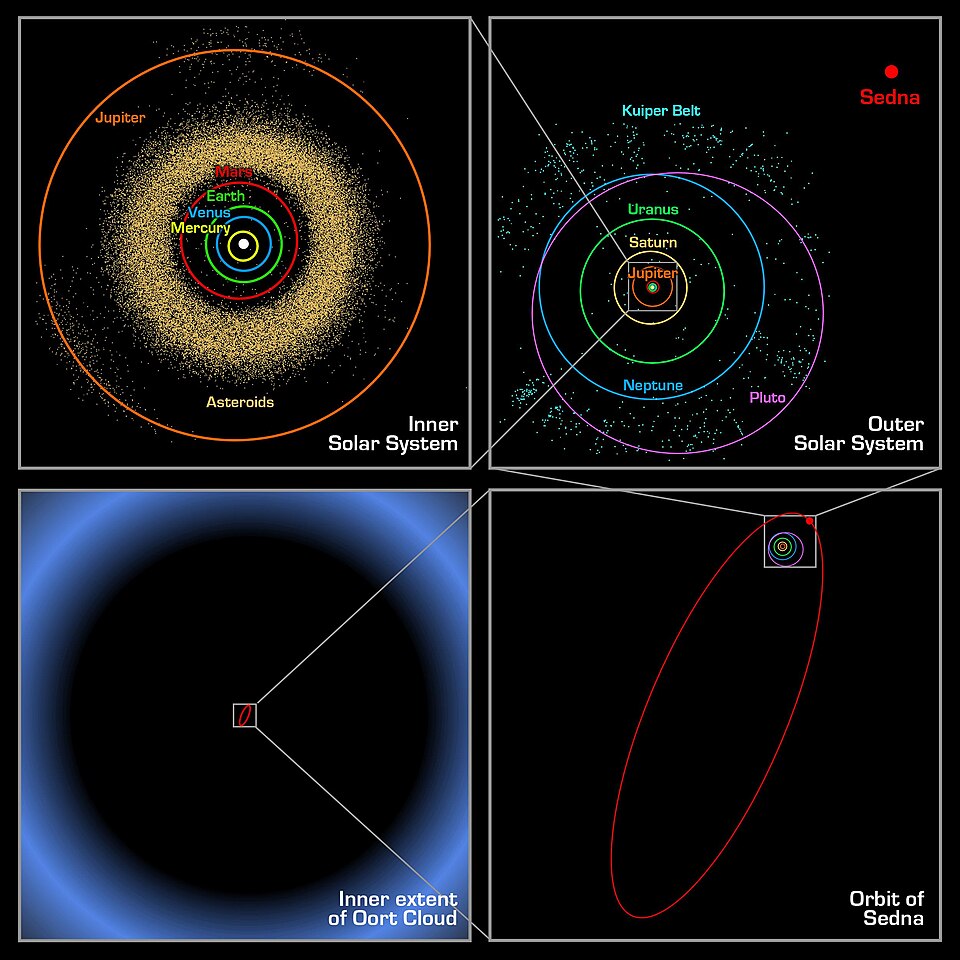

The Oort cloud, Oort’s cloud, or Öpik–Oort cloud, is a cloud of comets and other objects. Astronomers believe it is way beyond the orbits of Pluto and the Kuiper belt. The Oort cloud is believed to be the source of long-period comets in the Solar System.
The Oort cloud may lie about 50,000 AU, or nearly a light-year, from the Sun. This means the cloud is nearly a quarter of the way to Proxima Centauri, the nearest star to the Sun.
The Kuiper belt and scattered disc, the other two reservoirs of trans-Neptunian objects, are less than one-thousandth of the Oort cloud’s distance. The outer limit of the Oort cloud defines the boundary of the Solar System and the region of the Sun’s gravitational dominance.
The Dutch astronomer Jan Hendrik Oort published the Oort cloud idea in 1950. The Oort cloud was named after him, as were the Oort comet, and Oort constants.
Structure
The Oort cloud takes up a lot of space and is thought to have trillions of comets about tens of millions of kilometers apart.
The Oort cloud is made up of an inner Oort cloud and an outer Oort cloud. The outer cloud is weakly bound to the Sun; long-term comets are thought to come from there. The Inner cloud is also called the Hills cloud and maybe the maker of comets.
The objects in the Oort cloud are believed to consist of much ice. Since the object 1996 PW was found to be a rocky body in an orbit typical of long-period comets, it is believed that rocky objects might be in the Oort cloud.
Origins
The Oort cloud is thought to be the remains of a protoplanetary disk that surrounded the Sun long ago.
Written for younger readers
Oort Cloud, in simpler words
This version comes from Wikijunior, a set of books written for children aged 8 to 11. It is shorter and uses plainer language than the article above.
From Wikijunior: Solar System
The Oort cloud is a huge halo made of millions of comets that lies at the outermost edge of the Solar System.
Scientists say there is a distant group of objects, made of rock and ice, that forms a cloud-like region surrounding our Solar System. It is a cloud of comet-like objects orbiting far away from the Sun. Even though the comets are very widely scattered from each other, there many millions of them. The total mass of all these comets may be up to 100 times the mass of the Earth. The Oort Cloud is named after a Dutch astronomer Jan Oort who took the original idea, improved upon it and made it widely known.
As a comet makes several passes through the solar system, the Sun slowly melts and vaporizes the ice and only little bits of solid debris are left behind. But if the comets are all destroyed when they pass through the system, then new comets will need to appear. Otherwise we would not see any more comets. Jan Oort used the idea of the Oort cloud to explain why new comets keep appearing.
If you can imagine the distance from the Earth to the Sun, then the comets in the Oort cloud are 50,000 to 100,000 times further away! That is 1,000 times further away from the Sun than is Pluto, and about one fourth the distance to the nearest neighboring star—Proxima Centauri. Light takes a year to travel from the Sun to the outer edge of the Oort Cloud.
The Oort cloud objects may have started closer to the Sun during the Solar System’s formation. When they passed near the gas giants, the gravity of those planets hurled the objects into very distant orbits. The Oort cloud objects were sent in all directions, making the Oort cloud ball-shaped instead of disk-shaped. The gravity of passing stars also made the orbits of these objects more circular, and pulled them further from the Sun. But sometimes the gravity of other far away stars can send the objects hurtling back toward the Sun. These become the comets.
An object named Sedna has been discovered that may belong to the Oort Cloud (although it is actually between the Kuiper Belt and the Oort Cloud.) It is from 1,180 to 1,800 km across. Its orbit stretches from 76 to 928 times further from the Sun than does the Earth’s. Sedna orbits the Sun about once every 11,250 Earth years. The last time Sedna was where it is now in its orbit, Earth’s last Ice Age was ending! Some scientists think that Sedna should be included in the Kuiper Belt, making the belt bigger.
Next Page: Glossary
de:Wikijunior Sonnensystem/ Oortsche Wolke
Where this page comes from
The article above is adapted from “Oort Cloud” on Simple English Wikipedia, by its contributors. We removed reference markers, navigation boxes and tables, expanded measurement templates into readable numbers, and kept the prose otherwise intact. The simpler version is adapted from Wikijunior on Wikibooks.
Both sources are published under CC BY-SA 4.0, so this page is published under the same licence. You may share and adapt it, including commercially, as long as you credit the original and keep the same licence.
Worksheets, answer keys and printable layouts elsewhere on K5Print are our own work and are not covered by this licence.