Space exploration

Space exploration is a term which describes searching outer space. There are many reasons for space exploration. The most important reasons are for scientific research and the interest of humans to learn more about outer space. For centuries, humans had dreamt of reaching outer space. Rockets made it possible in the later 20th century. On October 4, 1957, the former Soviet Union launched the Sputnik 1, which was the first artificial satellite. This started the Space Race and people later went into orbit and Americans visited the Moon in Project Apollo.
Many space probes have gone to various planets and other places in the Solar System to send back information. When people first went to space they didn’t know what the effects of microgravity would have on humans so they sent animals instead. But in 1961 the Soviets launched the first human into space, Yuri Gagarin. The journey to planets is hazardous enough so that humans will probably not be used, and machines can pick up samples. Some people think that Mars can be mined for minerals which are rare and valuable. There are no plans at present to send humans to Mars.
Astronomy
The first telescope was probably invented in 1608 by Hans Lippershey. The Orbiting Astronomical Observatory 2 was the first space telescope launched on December 7, 1968. As of February 2, 2019, about 3,891 exoplanets have been discovered. The Milky Way galaxy has more than 100–400 billion stars and more than 100 billion planets. There are about 2 trillion galaxies in the observable universe.
Written for younger readers
Space exploration, in simpler words
This version comes from Wikijunior, a set of books written for children aged 8 to 11. It is shorter and uses plainer language than the article above.
From Wikijunior: Solar System
Going into space was always one of the biggest dreams people had, even thousands of years ago. Many science fiction authors wrote about traveling in space even before the first airplane flight in 1903. One of the most famous science fiction books on space travel is From the Earth to the Moon by Jules Verne — it was written in 1865, more than one hundred years before the first person walked on the moon. Jules Verne’s idea was to use a giant cannon! That might seem silly today, but it shows how much our ideas on space travel have changed.
Space begins about 100 km or 62 miles above the earth. A more realistic way to travel in space is with a rocket. Within a rocket is a controlled explosion. However, exhaust (things left over after burning) is only allowed to leave the rocket in one direction. As a result, the rocket is pushed in the other direction. In 1942, the German rocket A-4 became the first to reach that height, but it wasn’t meant to do anything but fall straight down again and so wasn’t terribly useful. Still, it was an advance in rocket technology.
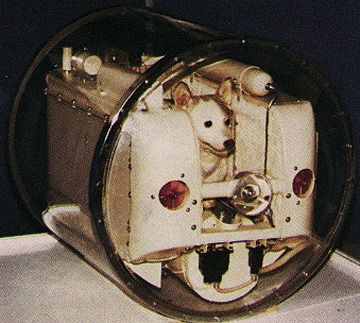
The Soviets were the first to put anything in space that would stay up: they launched the Sputnik 1 satellite on October 4, 1957. Within a month, the Soviets launched Sputnik 2, and in that spacecraft was the first space traveler: a dog called Laika.
The launch of the Sputnik started the Space Race, a competition between the United States and the Soviet Union to obtain more and more advanced space technology. Americans were very surprised that the Soviets could have launched ‘Sputnik’, and began to design rockets and satellites of their own. The race would last for the next few decades.
On April 12, 1961, the first person was sent into space: Yuri Gagarin, a Soviet, riding in the spacecraft Vostok 1. The Soviets would send more people into space over the next few decades, and so would the Americans, but it wouldn’t be until 2003 that a different country would launch their own spacecraft with a person in it: China, with the Shenzhou 5.
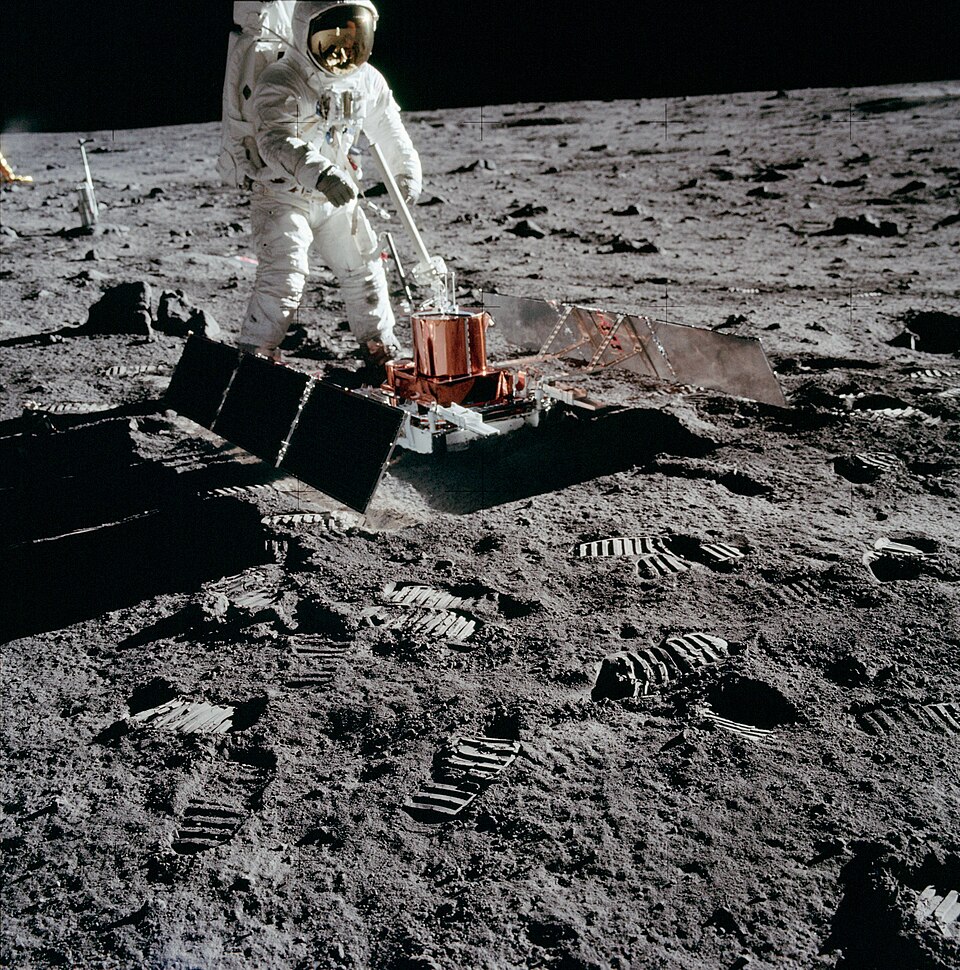
At the beginning of the 1960s, American president John F. Kennedy made a famous speech in which he said that the U.S. was going to send people to the Moon within the next 10 years. And that’s what happened: in July of 1969, Neil Armstrong stepped off the there spacecraft and said “One small step for [a] man and one giant leap for mankind”. He and Buzz Aldrin walked on the moon where they put an American flag. Their footprints are still there because there is no wind or water on the Moon to wash them away.
After the Apollo program that sent people to the Moon, the U.S. built the Space Shuttle, that is like a jet-plane that can go to space and return (with the help of rockets of course)! The Space Shuttle helped to construct the International Space Station (ISS) among another things.
The last Space Shuttle mission was on June 28, 2011, and the U.S. relied on Russian Soyuz spacecraft from then on till 2020. In 2020, the U.S. started sending astronauts on its Crew Dragon spacecraft. SpaceX, a private company, operates the spacecraft to send NASA astronauts.
The humanity never went to the Moon from 1972 to 2026. In 2017, American President Donald Trump started the Artemis program to take mankind to the Moon, Mars, and beyond. In April of 2026, the Artemis 2 mission sent four astronauts around the Moon. It was the first time a woman went to the Moon, and she is Christina Koch. It was also the first time a Canadian went to the Moon, and he is Jeremy Hansen.
Right now, spaceships are not very efficient. The Space Launch System (SLS) rocket that sends people to the Moon is 322 feet or nearly 98 meters tall, and it can only take people to the Moon, and maybe to Mars. To get people further, better rockets must be invented. One of the most popular ideas for a rocket is the antimatter rocket. This type of rocket collides a small amount of antimatter with an equal amount of normal matter to create a large amount of energy!
Other ideas for going into space, that do not need rockets, have been thought of by scientists and astronomers. One of these is a space elevator. A space elevator is basically a big lift into space. It will cost a lot less to get things up into space if a space elevator is built.
Another idea, a bit like the Jules Verne idea, is an electromagnetic catapult. This catapult works by accelerating the spaceship along a rail, similar to a maglev train. Unfortunately, the air on Earth would set spaceships on fire as they launched, but scientists aren’t thinking of putting one there: one could go on the Moon! The catapult on the moon could send metal and other resources to Earth’s orbit, where a space station could collect them.
Many people dream of the day when humans can travel to another star and explore other worlds, some people wonder what’s out there some believe that aliens or other life may live on another plant. But, if this ever does happen probably won’t happen for a very long time. The stars are so spread out that there are trillions of miles between stars that are “neighbors”. Maybe one day, your great grandchildren will be standing atop an alien world wondering about their ancient ancestors?
Many people say the very best invention ever (not just in space technology) was the Hubble Space Telescope (HST). Others say it’s just the space station being selfish having the best technology in the world.
The Hubble Space Telescope is a giant telescope that is in orbit around the Earth. Because there is no atmosphere, the Hubble Space Telescope has a clear view of even distant galaxies. One of the pictures the Hubble space telescope has made is called the ‘Hubble Deep Field’. The Hubble Deep Field is a picture of some of the most distant galaxies, and it gives a snapshot of what the universe looked like when it was younger.
Even bigger telescopes are also in the planning, so we might be able to see right to the edge of the universe some day soon.
de:Wikijunior Sonnensystem/ Raumforschung
Where this page comes from
The article above is adapted from “Space exploration” on Simple English Wikipedia, by its contributors. We removed reference markers, navigation boxes and tables, expanded measurement templates into readable numbers, and kept the prose otherwise intact. The simpler version is adapted from Wikijunior on Wikibooks.
Both sources are published under CC BY-SA 4.0, so this page is published under the same licence. You may share and adapt it, including commercially, as long as you credit the original and keep the same licence.
Worksheets, answer keys and printable layouts elsewhere on K5Print are our own work and are not covered by this licence.