Titania
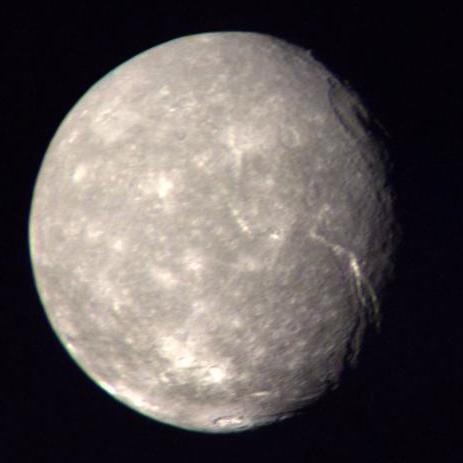

Titania is the largest moon of the planet Uranus. The closest view we have of this moon came in 1986 when the Voyager 2 spacecraft flew by Uranus.
How big is Titania?
This moon is 1,578 km wide (981 miles). Titania is less than half the size of the Earth’s moon. The total surface area of this moon is only a little larger than the area of Australia.
What is the surface like?
The surface of Titania is barren and there is no atmosphere. The ground on the surface is covered by dirty ice that has been mixed with rock. There are many craters which are formed when a rock from space collides with the moon, leaving a bright white patch surrounding the hole. Near the top of this moon is a large crater that has a double ring.
There are also long valleys on the surface that were formed when the interior heated up and expanded. This left what are called rifts in the surface. The longest of these valleys runs for a distance of about 1,000 km.
How long is a day on Titania?
It takes 8.71 Earth days for Titania to complete one full rotation. That is about 8 days and 17 hours.
How long is its orbit around Uranus?
Titania completes one full orbit around Uranus each day. That orbit takes 9991 Earth days to finish. Titania is tidally locked, meaning it always keeps the same side facing toward Uranus. This is very similar to how our Moon always keeps the same side facing the Earth.
What is it made of?
Nearly half of the moon is made of frozen water. The rest is rock and a mixture of frozen gas.
How much would Titania’s gravity pull on me?
Newtons describe how hard gravity is pulling you down. On Earth, if you weigh 51 kilograms or 112 pounds, your weight is 500 newtons. We only use newtons for some special purposes, when we are really interested in how hard we push down on something because gravity is pulling us.
Your weight in newtons would be less on Titania, only about one twenty-sixth of what it is on Earth. To find your weight in newtons as you stand on Titania, just take your weight on Earth, and if that weight is in kilograms, multiply it by 3/8. If that weight is in pounds, divide it by 6 to get newtons. But then you’ll have to add in the weight of your spacesuit as well, because that is pressing down on the surface just like you are.
Who is it named after?
The English poet and play author William Shakespeare once wrote a play called a Midsummer-Night’s Dream. In this play there was a mythical woman named Titania who was the wife of Oberon and was also the Queen of the Faeries. Uranus also has a moon called Oberon which was named after Titania’s husband.
The name of this moon is similar to Saturn’s moon Titan. However Titan was named after a race of giants from Greek mythology.
How was it discovered?
This moon was discovered in 1787 by the English astronomer Sir William Herschel. This man also discovered Uranus and its moon Oberon. The name for this moon was suggested by Sir Herschel’s son, John Herschel, in 1852.
de:Wikijunior Sonnensystem/ Uranus/ Titania
Written for younger readers
Titania, in simpler words
This version comes from Wikijunior, a set of books written for children aged 8 to 11. It is shorter and uses plainer language than the article above.
From Wikijunior: Solar System
Titania is the largest moon of the planet Uranus. The closest view we have of this moon came in 1986 when the Voyager 2 spacecraft flew by Uranus.
This moon is 1,578 km wide (981 miles). Titania is less than half the size of the Earth’s moon. The total surface area of this moon is only a little larger than the area of Australia.
The surface of Titania is barren and there is no atmosphere. The ground on the surface is covered by dirty ice that has been mixed with rock. There are many craters which are formed when a rock from space collides with the moon, leaving a bright white patch surrounding the hole. Near the top of this moon is a large crater that has a double ring.
There are also long valleys on the surface that were formed when the interior heated up and expanded. This left what are called rifts in the surface. The longest of these valleys runs for a distance of about 1,000 km.
It takes 8.71 Earth days for Titania to complete one full rotation. That is about 8 days and 17 hours.
Titania completes one full orbit around Uranus each day. That orbit takes 9991 Earth days to finish. Titania is tidally locked, meaning it always keeps the same side facing toward Uranus. This is very similar to how our Moon always keeps the same side facing the Earth.
Nearly half of the moon is made of frozen water. The rest is rock and a mixture of frozen gas.
Newtons describe how hard gravity is pulling you down. On Earth, if you weigh 51 kilograms or 112 pounds, your weight is 500 newtons. We only use newtons for some special purposes, when we are really interested in how hard we push down on something because gravity is pulling us.
Your weight in newtons would be less on Titania, only about one twenty-sixth of what it is on Earth. To find your weight in newtons as you stand on Titania, just take your weight on Earth, and if that weight is in kilograms, multiply it by 3/8. If that weight is in pounds, divide it by 6 to get newtons. But then you’ll have to add in the weight of your spacesuit as well, because that is pressing down on the surface just like you are.
The English poet and play author William Shakespeare once wrote a play called a Midsummer-Night’s Dream. In this play there was a mythical woman named Titania who was the wife of Oberon and was also the Queen of the Faeries. Uranus also has a moon called Oberon which was named after Titania’s husband.
The name of this moon is similar to Saturn’s moon Titan. However Titan was named after a race of giants from Greek mythology.
This moon was discovered in 1787 by the English astronomer Sir William Herschel. This man also discovered Uranus and its moon Oberon. The name for this moon was suggested by Sir Herschel’s son, John Herschel, in 1852.
de:Wikijunior Sonnensystem/ Uranus/ Titania
Where this page comes from
The article above is adapted from “Titania” on Simple English Wikipedia, by its contributors. We removed reference markers, navigation boxes and tables, expanded measurement templates into readable numbers, and kept the prose otherwise intact. The simpler version is adapted from Wikijunior on Wikibooks.
Both sources are published under CC BY-SA 4.0, so this page is published under the same licence. You may share and adapt it, including commercially, as long as you credit the original and keep the same licence.
Worksheets, answer keys and printable layouts elsewhere on K5Print are our own work and are not covered by this licence.