Umbriel

Quick facts
- Discovered by
- William Lassell
- Discovered
- October 24, 1851
- Goes around
- Uranus
- Radius
- 585 km (363 mi)
- One trip around takes
- 4.14 Earth days
Facts from Wikipedia’s “Umbriel” page (CC BY-SA 4.0).
Umbriel is a moon of Uranus
How big is Umbriel?
Umbriel is about 1169.4 km wide, or about 1/10th as wide as Earth.
What is its surface like?
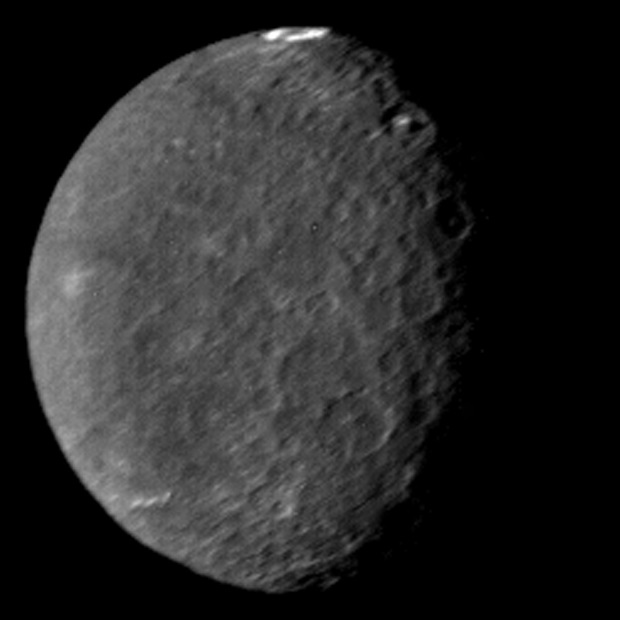
The only close-up images we have of Umbriel’s surface come from Voyager 2’s flyby in January 1986. These images show that Umbriel has a dark surface, the darkest of any of Uranus’ moons. Near the equator lies Wunda, a large ring of bright material. Wunda is assumed to be a crater, but nobody is sure what it is exactly. Near Wunda is the crater Skynd.
How long is a day on Umbriel?
One day on Umbriel is equal to about four Earth days.
How long is its orbit around Uranus?
One orbit around Uranus is also equal to about four Earth days.
What is it made of?
Umbriel is made mostly of water ice, followed by silicate rock and methane ice. Most of its methane ice is on its surface.
From guessing based on its mass and size, scientists have worked out that it is about 60% ice and 40% rock.
How would Umbriel’s gravity pull on me?
If you stood on Umbriel, you would weigh about one-fortieth (0.023) of what you do on Earth. Someone who weighs 100 lbs on Earth would weigh only about 2.3 lbs on Umbriel.
Who is it named after?
Umbriel is named after the “dusky melancholy sprite” in Alexander Pope’s The Rape of the Lock, and the name suggests the Latin umbra, meaning shadow.
How was it discovered?
Umbriel was discovered on October 24, 1851 by William Lassell. He also discovered the moon Ariel at the same time.
de:Wikijunior Sonnensystem/ Uranus/ Umbriel
Written for younger readers
Umbriel, in simpler words
This version comes from Wikijunior, a set of books written for children aged 8 to 11. It is shorter and uses plainer language than the article above.
From Wikijunior: Solar System
Umbriel is a moon of Uranus
Umbriel is about 1169.4 km wide, or about 1/10th as wide as Earth.
The only close-up images we have of Umbriel’s surface come from Voyager 2’s flyby in January 1986. These images show that Umbriel has a dark surface, the darkest of any of Uranus’ moons. Near the equator lies Wunda, a large ring of bright material. Wunda is assumed to be a crater, but nobody is sure what it is exactly. Near Wunda is the crater Skynd.
One day on Umbriel is equal to about four Earth days.
One orbit around Uranus is also equal to about four Earth days.
Umbriel is made mostly of water ice, followed by silicate rock and methane ice. Most of its methane ice is on its surface.
From guessing based on its mass and size, scientists have worked out that it is about 60% ice and 40% rock.
If you stood on Umbriel, you would weigh about one-fortieth (0.023) of what you do on Earth. Someone who weighs 100 lbs on Earth would weigh only about 2.3 lbs on Umbriel.
Umbriel is named after the “dusky melancholy sprite” in Alexander Pope’s The Rape of the Lock, and the name suggests the Latin umbra, meaning shadow.
Umbriel was discovered on October 24, 1851 by William Lassell. He also discovered the moon Ariel at the same time.
de:Wikijunior Sonnensystem/ Uranus/ Umbriel
Where this page comes from
The article above is adapted from “Umbriel” on Simple English Wikipedia, by its contributors. We removed reference markers, navigation boxes and tables, expanded measurement templates into readable numbers, and kept the prose otherwise intact. The simpler version is adapted from Wikijunior on Wikibooks.
Both sources are published under CC BY-SA 4.0, so this page is published under the same licence. You may share and adapt it, including commercially, as long as you credit the original and keep the same licence.
Worksheets, answer keys and printable layouts elsewhere on K5Print are our own work and are not covered by this licence.