Uranus

Fast facts
- Symbol
- ()
- Discovered by
- [[]]
- Mass
- 14.536 Earths GM=
Uranus is the seventh planet from the Sun in our Solar System. Like Neptune, it is an ice giant. It is the third largest planet in the solar system.
The planet is made of ice, gases and liquid metal. Its atmosphere has hydrogen, helium and methane. The temperature on Uranus is −197 degrees Celsius near the top of its atmosphere. Its small solid core (about 55% the mass of Earth) is probably about 5,000 K.
The planet is tilted on its axis so much that it is sideways. Nobody knows why exactly it is. It has five big moons, many small ones, and a small system of 13 planetary rings.
The distance between Uranus and the Sun is about 2.8 billion km. Uranus completes its orbit around the Sun in 84 earth years. It completes a spin around its axis in 17 hours and 14 minutes. This means there are about 43,000 days in a year on Uranus.
Uranus was discovered in 1781. This planet can be seen with the naked eye under perfect conditions. John Flamsteed saw it decades before but thought it was a star (34 Tauri).
Near the solstice, one pole faces the Sun continuously and the other faces away. Only a narrow strip around the equator has a rapid day–night cycle, with the Sun low over the horizon. Each pole gets around 42 years of continuous sunlight, followed by 42 years of darkness.
Uranus is named after Uranus, the Greek mythology version of the Sumerian god Anu, who was a god of the sky.
Discovery
Uranus has been seen many times through a telescope, and even sometimes without any, but people thought it was a star due to its slow orbit. Sir William Herschel observed Uranus on March 13, 1781 from the garden of his house at 19 New King Street in Bath, Somerset, England (now the Herschel Museum of Astronomy), and first said it was a comet (on April 26, 1781). With a homemade 6.2-inch reflecting telescope, Herschel “engaged in a series of observations on the parallax of the fixed stars.”
Herschel wrote in his journal: “In the quartile near ζ Tauri… either [a] Nebulous star or perhaps a comet.” On March 17 he noted: “I looked for the Comet or Nebulous Star and found that it is a Comet, for it has changed its place.” When he presented his discovery to the Royal Society, he continued to assert that he had found a comet, but also implicitly compared it to a planet: The power I had on when I first saw the comet was 227. From experience I know that the diameters of the fixed stars are not proportionally magnified with higher powers, as planets are; therefore I now put the powers at 460 and 932, and found that the diameter of the comet increased in proportion to the power, as it ought to be, on the supposition of its not being a fixed star, while the diameters of the stars to which I compared it were not increased in the same ratio. Moreover, the comet being magnified much beyond what its light would admit of, appeared hazy and ill-defined with these great powers, while the stars preserved that lustre and distinctness which from many thousand observations I knew they would retain. The sequel has shown that my surmises were well-founded, this proving to be the Comet we have lately observed.
Herschel notified the Astronomer Royal Nevil Maskelyne of his discovery and received this reply from him on April 23, 1781: “I don’t know what to call it. It is as likely to be a regular planet moving in an orbit nearly circular to the sun as a Comet moving in a very eccentric ellipsis. I have not yet seen any coma or tail to it.”
Although Herschel continued to say this new object was a comet, other astronomers had already begun to think otherwise. Finnish-Swedish astronomer Anders Johan Lexell, working in Russia, was the first to calculate the orbit of the new object. Its nearly circular orbit showed him that it was a planet rather than a comet. Berlin astronomer Johann Elert Bode described Herschel’s discovery as “a moving star that can be deemed a hitherto unknown planet-like object circulating beyond the orbit of Saturn”. Bode concluded that its near-circular orbit was more like a planet’s than a comet’s.
The object was soon widely accepted as a new planet. By 1783, Herschel acknowledged this to Royal Society president Joseph Banks: “By the observation of the most eminent Astronomers in Europe it appears that the new star, which I had the honor of pointing out to them in March 1781, is a Primary Planet of our Solar System.” In recognition of his achievement, King George III gave Herschel £200 per year on condition that he move to Windsor so that the Royal Family could look through his telescopes ().
Exploring
In 1986, NASA’s Voyager 2 visited Uranus. This is the only space probe that tried to see the planet from a short distance. The spacecraft studied the atmosphere of the planet.
Moons
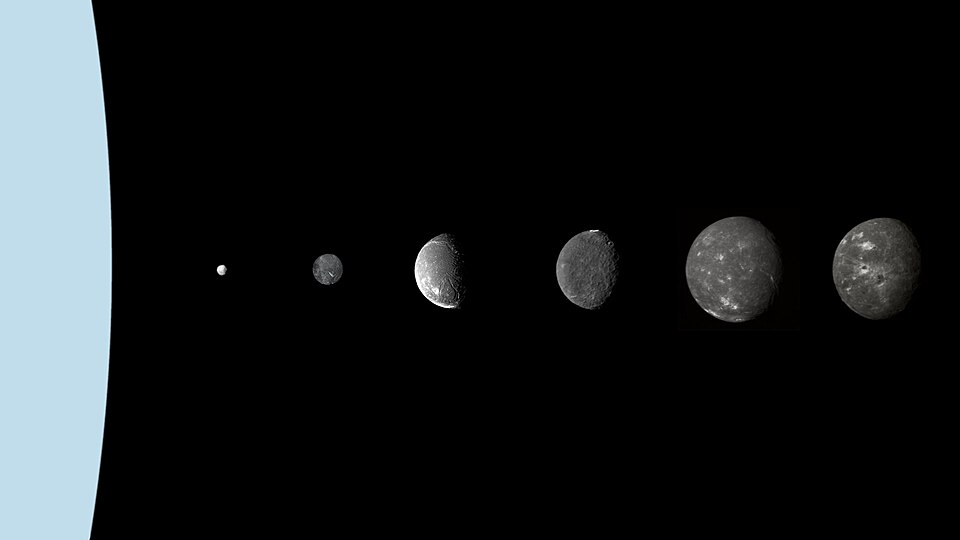
Uranus has 27 known moons. They are named for characters from the works of Shakespeare and Alexander Pope. The five biggest moons are Miranda, Ariel, Umbriel, Titania and Oberon. It is likely that more moons will be found.
Clouds
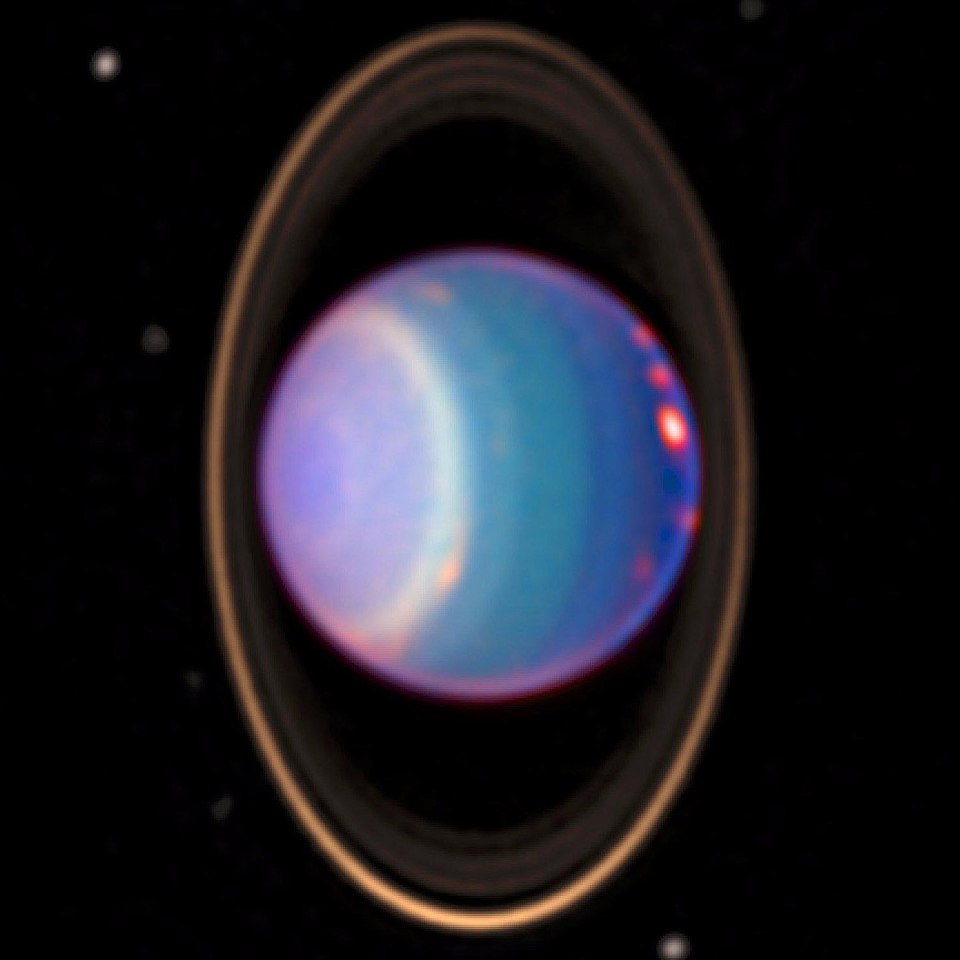
Uranus is covered in blue clouds. The top clouds, made of methane, are hard to see. Lower clouds are thought to be frozen water. There are also violent storms. Wind speeds can reach 250 metres per second. Scientists are studying the clouds to try to understand the storms on the planet.
Rings
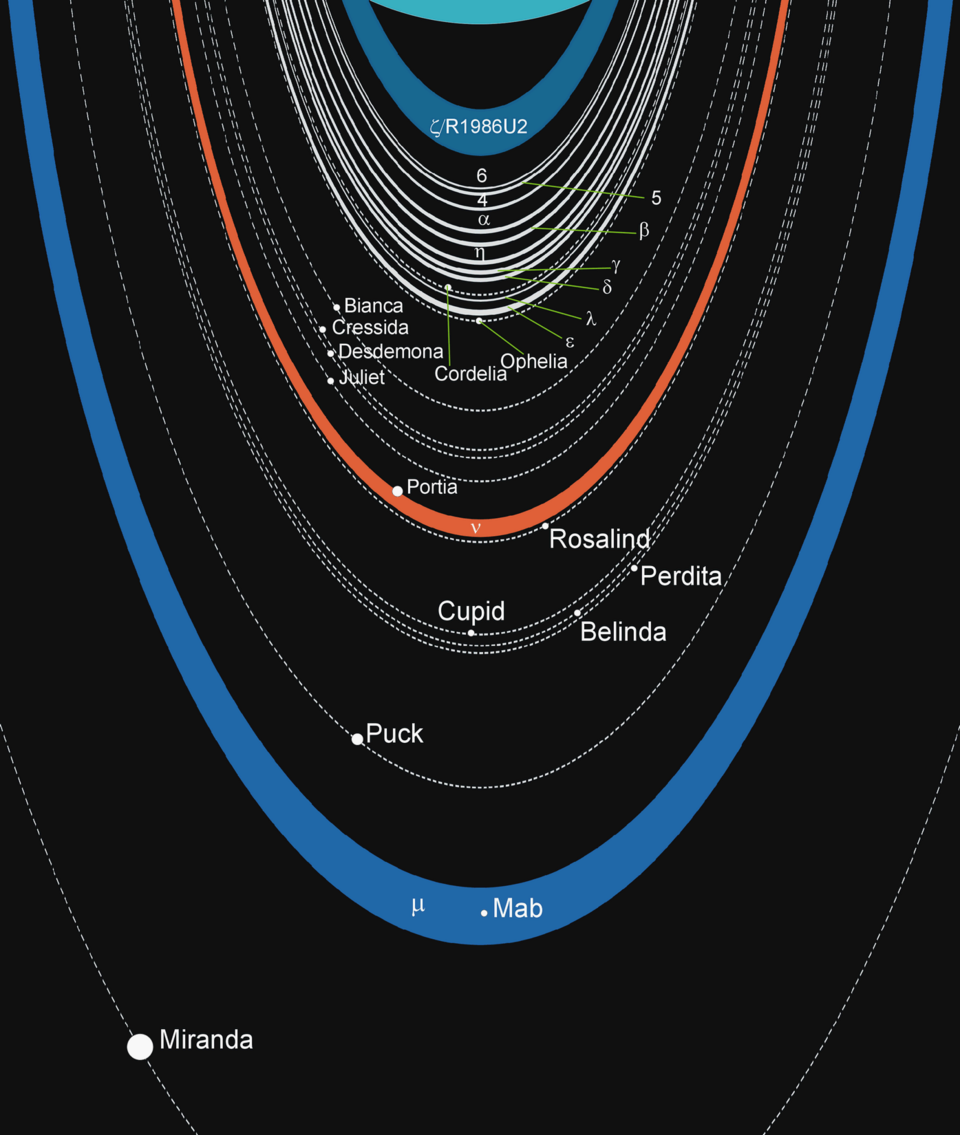
The planet Uranus has a system made of 13 rings, which is far fewer than the rings of Saturn but more than those around Jupiter and Neptune. The rings of Uranus were discovered in 1977. More than 200 years ago, William Herschel also said he saw rings, but today astronomers do not believe that he saw them, because they are very dark and hard to see. Two inner rings were discovered in 1986 in images taken by Voyager 2, and two outer rings were found in 2003–2005 by the Hubble Space Telescope. The rings are probably made of ice.
A lot of people think the rings of Uranus are quite new. They say that the rings are less than 600 million years old. The planet’s ring system probably came from when some of its moons crashed together. After crashing, the moons probably broke up into many small pieces of rock and ice, which orbited Uranus and turned into rings.
General properties
The ring system of Uranus has thirteen rings. In order of how close they are to Uranus, the rings are 1986U2R/ζ, 6, 5, 4, α, β, η, γ, δ, λ, ε, ν, μ rings. There are three groups: nine small main rings (6, 5, 4, α, β, η, γ, δ, ε), two dusty rings (1986U2R/ζ, λ) and two outer rings (μ, ν). The rings of Uranus consist mainly of macroscopic (or visible) particles and less dust, although people know dust is in 1986U2R/ζ, η, δ, λ, ν and μ rings.
There also may be a lot of thin dust bands and faint rings between them. These faint rings and dust bands may stay for only a short time. Some of them became visible during a series of ring events in 2007 when the rings were at different angles. Many dust bands between the rings were seen by Voyager 2. All rings of Uranus have different brightnesses.
The rings are made of somethng that is super dark. The rings are slightly red in the ultraviolet and visible parts of the spectrum and grey in near-infrared. The chemical composition of the ring particles is not known. However, they cannot be made of pure water ice like the rings of Saturn because they are too dark, darker than the inner moons of Uranus. So they are probably a mixture of ice and a dark material. It is hard to know what this material is, but scientists think it may be organic compounds that were darkened by charged particle irradiation from the planet’s magnetosphere. The rings’ particles may by made of a crushed material, which the inner moons used to be made of.
The ring system of Uranus is not like the faint dusty rings of Jupiter or the big rings of Saturn, some that are very bright because of water ice. However, some parts of their ring systems are close to being the same. The Saturnian F ring and the ε ring are both thin, dark and are shepherded by a pair of moons. The newly discovered outer rings of Uranus are similar to the outer G and E rings of Saturn. Smaller rings existing in the wide Saturnian rings also look like the thin rings of Uranus. Also, dust bands seen between the main rings of Uranus may be like the rings of Jupiter. The Neptunian ring system is a little bit like Uranus’s one, although it is smaller, darker and contains more dust. The Neptunian rings are also further from their planet.
Orbit and rotation
Uranus goes around the Sun completely every 84 Earth years. Its normal distance from the Sun is around 3 billion km (about 20 AU). The amount of sunlight on Uranus is about 1/400, or 0.25% of that on Earth. Its orbital elements were first calculated in 1783 by Pierre-Simon Laplace. With time, changes began to appear between the predicted and observed orbits, and in 1841, John Couch Adams first said that the differences might be because of the gravity of another planet. In 1845, Urbain Le Verrier began his own independent research into Uranus’s orbit. On September 23, 1846, Johann Gottfried Galle found a new planet, later called Neptune, close to the area Le Verrier said it would be.
The time it takes for the inside of Uranus to spin around itself is 17 hours and 14 minutes, clockwise (retrograde). Like all giant planets, its upper atmosphere has very strong winds in the direction that the planet rotates. At some latitudes, such as about two-thirds between the equator and the south pole, the parts of the atmosphere we can see move much faster, making a full rotation in just 14 hours.
Written for younger readers
Uranus, in simpler words
This version comes from Wikijunior, a set of books written for children aged 8 to 11. It is shorter and uses plainer language than the article above.
From Wikijunior: Solar System
Uranus, the seventh planet from the Sun, was discovered by William Herschel on March 13, 1781.
Uranus is 51,118 kilometers or about four Earths wide. It is the third widest and fourth heaviest planet in the Solar System.
Uranus does not have a surface that you could stand on without going deep into the atmosphere. Under the atmosphere, there may be an even mixture of rock and ice.
Uranus has eleven rings. They are dark in colour and very hard to see. They were discovered by accident in 1977. Scientists were studying a bright star near Uranus. However, the star’s light was blocked before and after it disappeared behind Uranus. From this, they figured out that Uranus has a ring system.
Uranus has 27 known moons, which places it third in the Solar System for number of moons. The five main ones are Miranda, Ariel, Umbriel, Titania and Oberon.
Miranda is the smallest and closest of Uranus’s major moons. It is mainly made of ice and rock. Miranda’s surface has grooves, cliffs, and valleys. The moon was named after a character in The Tempest, a play by Shakespeare.
Ariel is made of rock and ice. Ariel has many valleys, but not many craters. Ariel was named after a character in the poem The Rape of the Lock by Alexander Pope. Ariel is also a spirit in The Tempest by Shakespeare.
Umbriel is made of lots of ices and some rock. It is also the darkest of Uranus’s major moons. Umbriel was named after a character in the poem The Rape of the Lock by Alexander Pope.
Titania is the largest moon of Uranus. It is mostly ice and rock. The surface is covered with canyons. It was named after the Queen of the Fairies in A Midsummer’s Night Dream, a play by Shakespeare.
Oberon is the outermost of the major moons of Uranus. It is made of the same things as Titania. It has many craters. Some of them have white rays around them and dark crater floors. It was named after the King of the Fairies in A Midsummer’s Night Dream.
There are 13 tiny moons known to be orbiting Uranus inside Miranda’s orbit. Nine more tiny moons are known to be in big orbits beyond Oberon’s orbit.
One day on Uranus is about 17.24 Earth hours long. Uranus spins on its side, maybe because of a big impact early in the history of the Solar System.
One year on Uranus would be 30,708 days or 84 years on Earth.
Unlike Jupiter and Saturn, Uranus is thought to be made mostly of rock and ice. The gases in its atmosphere are 83% hydrogen, 15% helium, and 2% methane. Other gases found in smaller amounts are ammonia, water, and methane. Uranus’ blue color comes from methane clouds, which absorb red light and reflect blue light.
If you were floating close to the cloud tops of Uranus, you would be pulled down with a force about 89% of Earth’s gravity.
Uranus was named after Ouranos, the Greek name for the sky. Ouranos was the ancient Greek deity of the heavens, the earliest supreme God. According to Greek mythology, Ouranos was the husband and son of Gaia, Mother Earth.
Next Topic: Neptune
Where this page comes from
The article above is adapted from “Uranus” on Simple English Wikipedia, by its contributors. We removed reference markers, navigation boxes and tables, expanded measurement templates into readable numbers, and kept the prose otherwise intact. The simpler version is adapted from Wikijunior on Wikibooks.
Both sources are published under CC BY-SA 4.0, so this page is published under the same licence. You may share and adapt it, including commercially, as long as you credit the original and keep the same licence.
Worksheets, answer keys and printable layouts elsewhere on K5Print are our own work and are not covered by this licence.