Venus
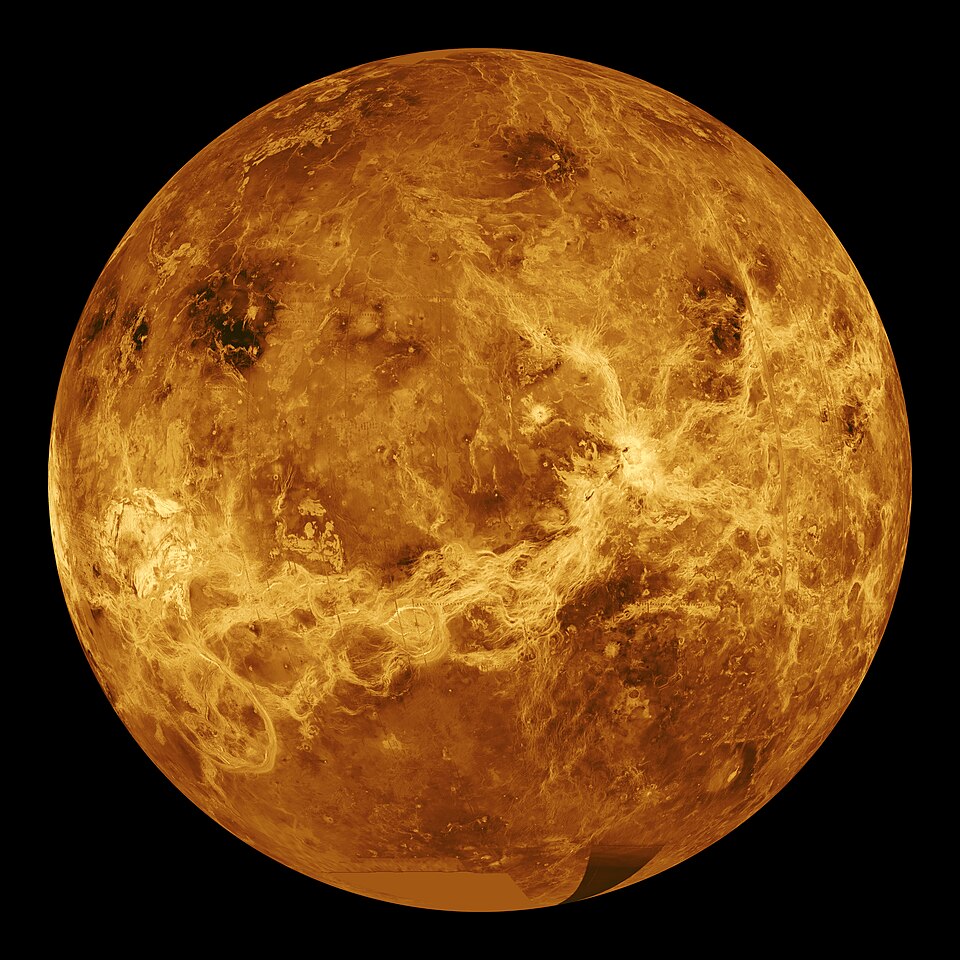

Fast facts
- Period
- * * 1.92 Venus solar day
- Mass
- * 0.815 Earths
Venus is the second planet from the Sun. Venus is the only planet in the Solar System that has a day longer than a year. The year length of Venus is 225 Earth days. The day length of Venus is 243 Earth days.
Overview
Venus is a terrestrial planet because it has a solid, rocky surface like other planets in the inner Solar System. Astronomers have known Venus for thousands of years. The ancient Romans named it after their goddess Venus, goddess of love and beauty.
Venus is the brightest thing in the night sky except for the Moon. It is sometimes called the morning star or the evening star as at some elongations it is easily seen just before the Sun comes up in the morning. At other times, it can be seen just after the sun goes down in the evening. Venus comes closer to the Earth than any other planet does.
Composition
Venus is sometimes called the sister planet of Earth as they are quite similar in size and gravity. In other ways the planets are very different. Venus’ atmosphere is mostly carbon dioxide (CO 2 ) with clouds of sulphuric acid (H 2 SO 4 ). H 2 SO 4 is a chemical that is poisonous to life. For this it is sometimes known as the Earth’s “evil twin”.
The thick atmosphere makes it hard to see the surface. Until the late twentieth century many thought there might be life there. The pressure on Venus’ surface is 92 times that of Earth. Venus is one of only two planets in the Solar System (the other being Mercury) that has no moons. Venus spins very slowly on its axis and it spins in the opposite direction to the other planets.
Physical properties
Venus is a terrestrial planet so, like the Earth, its surface is made of rock. Venus is much hotter than Earth. All the carbon dioxide in the atmosphere acts like a blanket, trapping heat from the Sun. This effect is called the greenhouse effect and it is very strong on Venus. This makes the surface of Venus the hottest of any planet’s surface in the Solar System with an estimated average temperature of 753.1 kelvins. This is hot enough to melt lead or zinc.
Geography
Venus has no oceans because it is much too hot for water. Venus’ surface is a dry desert. Because of the clouds, only radar can map the surface. It is about 80% smooth, rocky plains, made mostly of basalt. Two higher areas called continents make up the north and south of the planet. The north is called Ishtar Terra and the south is called Aphrodite Terra. They are named after the Babylonian and Greek goddesses of love.
The surface of Venus looks like it has been shaped by volcanic activity. Venus has a lot of volcanoes. The surface of Venus is estimated to be 300–600 million years old.
Unlike Earth or Mars, Venus does not have defined highlands or lowlands, and it does not have tectonic plates.
Atmosphere
Venus’ atmosphere is mostly carbon dioxide and nitrogen gas with clouds of sulphuric acid. Because the atmosphere is so thick or dense the pressure is very high. The pressure is 92 times the pressure on Earth, enough to crush many things.
It is impossible to see the planet’s surface from space as the thick cloud layer reflects 60% of the light that hits it. The only way scientists are able to see it is by using infrared and ultraviolet cameras and radar.
Scientists believe that billions of years ago, the atmosphere of Venus could have been like Earth’s atmosphere. There may have been lots of water on the surface of Venus. But after 600 million to several billion years, the evaporation of the water put greenhouse gases into its atmosphere.
Magnetic field
In 1967, Venera 4 found that the magnetic field of Venus was much weaker than that of Earth. This magnetic field is induced by an interaction between the ionosphere and the solar wind. Venus’ magnetosphere is not strong enough to protect the atmosphere from cosmic rays.
Transit of Venus
Venus can sometimes be seen passing between the Sun and Earth. Venus looks like a black dot when seen through a special telescope. These passages are called “transits”. These “transits” happen in pairs eight years apart. Then it is more than a hundred years to the next pair.
Orbit and rotation
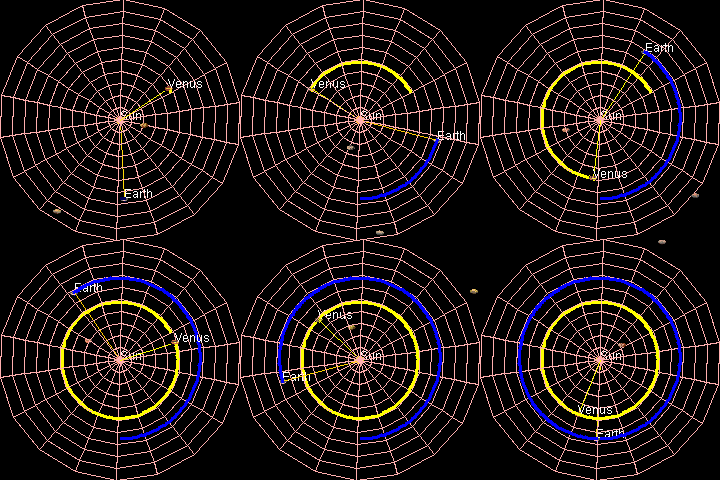
Venus orbits the Sun at an average distance of about 108 million km (68~ million mi). It completes an orbit every 224.7 days. The rotation of Venus is slow. A Venusian sidereal day is longer than a Venusian year.
List of satellites sent to Venus
Many man-made satellites have been sent to Venus to study it. They are:
Mariner
Mariner Satellites
Venera
Venera Satellites
Written for younger readers
Venus, in simpler words
This version comes from Wikijunior, a set of books written for children aged 8 to 11. It is shorter and uses plainer language than the article above.
From Wikijunior: Solar System
Venus Facts:
- Venera 7, the first space probe to land on Venus, was destroyed by the hostile conditions on Venus after only 23 minutes.
- Almost all of the surface features on Venus are named after women.
- A day on Venus is equal to 117 days on Earth.
- It has been proposed that some microbes could live in Venus’s clouds. Venus is the second closest planet to the Sun. It is a terrestrial planet. This means that we think it was created in a similar way to our planet Earth and is made of rock.
Venus is only slightly smaller than the Earth. This is one reason why Venus is sometimes thought of as Earth’s “twin”. Venus has a diameter of about 12,100 km. It has also been visited by many probes.
The surface of Venus is very different from the surface of the Earth. It is very dry and hot enough to melt lead. The pressure on the surface is very high. It is the same pressure as being 1 km (3,280 feet) below the surface of the sea on Earth.
Channels that look like rivers have formed on Venus. Scientists think these channels are formed from erupting lava. The lava flows along as it cools down, creating the channels. One feature only Venus seems to have is unusual volcanoes called arachnoids. These are volcanoes that have formed differently from other volcanoes we have found in the Solar System. We don’t know exactly how they were formed. Venus also has volcanoes like those on Earth.
Parts of the surface of Venus look something like continents. The largest of these areas is called Ishtar Terra (land of Ishtar, from the Babylonian goddess who was similar to Venus). Deep basins like those under the Earth’s oceans have also been discovered. On Venus, though, they have no water. Features like mountain ranges and meteor craters have also been found on Venus. One of the highest mountains on Venus, Maxwell Montes, is about 11 km taller than Mount Everest, the highest mountain on Earth.
On the night side of the planet, there is a strange effect called Ashen Light. For some reason, the dark side of Venus has a subtle glow. There are various theories about this. One of the earliest theories — now disproved, of course — was that there were aliens on Venus and they were celebrating a new Venusian emperor. Currently, one of the more believed ones is this: There is a high concentration of carbon dioxide. When it is hit by the ultraviolet rays of the sun, they change into carbon monoxide and oxygen, and emit green light. The entire chemical procedure is CO 2 → CO + O.
Venus rotates (spins around) even more slowly than Mercury. One full rotation of Venus takes about 243 Earth days. Venus also rotates in the opposite direction to most of the other planets in the Solar System. One day on Venus, from noon to noon, depends on the length of the year as well as the rotation time, and is about 117 earth days.
One year on Venus is almost 225 Earth days long. This is less time than it takes Venus to rotate on its axis and less than two Venus days.
The surface of Venus, its crust, is covered in nothing but rock. But, the core of Venus is made of nickel-iron. The atmosphere around Venus is very thick and is made of carbon dioxide, nitrogen, and poisonous gasses that create high pressure and trap in heat.
If you were on Venus, it would pull you down almost as strongly as Earth. The atmosphere exerts a pressure at the surface more than 90 times Earth’s normal sea-level pressure.
Because Venus is closer to the sun than we are on Earth, we always see it close to the sun in the sky. So it only appears for us just before sunrise in the eastern sky, or just after sunset in the western sky. Many cultures thought Venus in the morning and Venus in the evening were two separate things. The ancient Romans called the evening object Venus (after the goddess of love) and the morning object Lucifer (which means light bearer — a servant who walked ahead of the sun’s chariot with a torch, to light the way). Nobody knows who first thought the two were a single object. The first known written description of them as one object was the Venus Tablet of Ammisaduqa, from about three and a half thousand years ago — 1581 BCE.
About three thousand years later, in 1610, Italian astronomer Galileo Galilei used a telescope to observe that Venus has phases, just as the moon does. Phases happen because only the side of Venus (or of the Moon) facing the Sun is lighted. The phases of Venus supported the theory of Copernicus that the planets go around the Sun. Then, a few years later in 1639, an English astronomer named Jeremiah Horrocks observed a transit of Venus. That’s what it’s called when Venus passes right between the Earth and the Sun, so that Venus is visible from Earth during the day as a tiny dot passing across the Sun. In 1761 a Russian astronomer, Mikhail Lomonsov, watching another transit of Venus, saw that Venus has an atmosphere.
Not much more was discovered about Venus until the 1920s. Then, a United States astronomer, Frank Ross, observed Venus using ultraviolet light — the light that causes sunburn — and for the first time saw the structure of the clouds on Venus.
However, there is only so much that can be learned about Venus by looking at it from Earth. The first successful pictures of Venus by a space probe were taken by Mariner 2 in 1962. Mariner 2 was the first space probe successfully sent to observe another planet. It showed two important things: Venus has practically no magnetic field, and Venus has temperatures of 490 to 590 K — that’s as hot as the inside of a working oven on Earth!
Venus is named after the Roman goddess of love. Sometimes it can be seen shining brightly just before dawn or just after sunset, when it is called the Morning Star or Evening Star. Some people, like the Aztecs and the Greeks, gave Venus two names – one for the morning and one for the evening.
Because Venus and the Earth are the same size, scientists call Venus “Earth’s sister planet”. For a long time most scientists thought that Venus had plants, animals, and possibly even people. However because Venus is so hot we now know that it is impossible for anything to live there.
It could take around a year and a half to get there. But it is very unlikely someone would go to Venus.
Where this page comes from
The article above is adapted from “Venus” on Simple English Wikipedia, by its contributors. We removed reference markers, navigation boxes and tables, expanded measurement templates into readable numbers, and kept the prose otherwise intact. The simpler version is adapted from Wikijunior on Wikibooks.
Both sources are published under CC BY-SA 4.0, so this page is published under the same licence. You may share and adapt it, including commercially, as long as you credit the original and keep the same licence.
Worksheets, answer keys and printable layouts elsewhere on K5Print are our own work and are not covered by this licence.