Ballpoint Pen
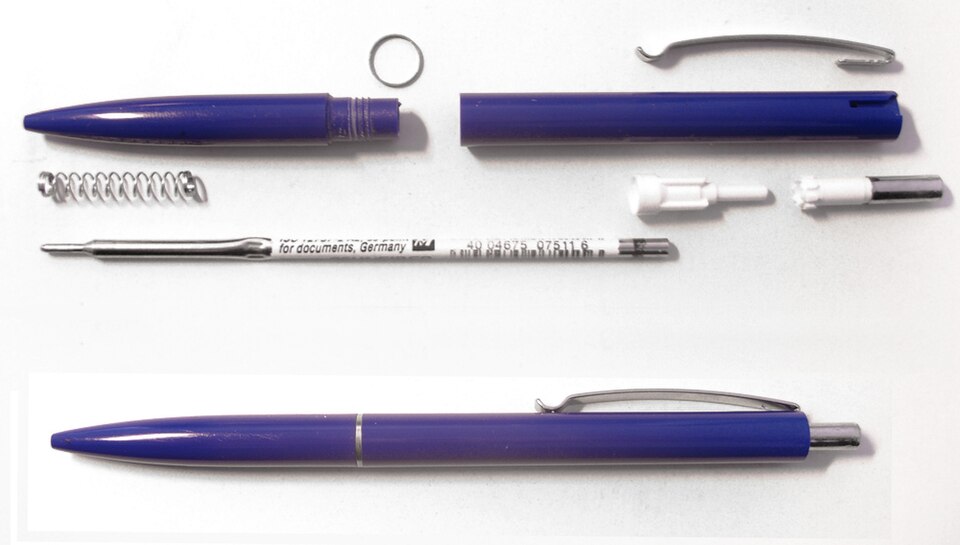

A ballpoint pen or biro (pronounced “BY-roe”, named after its inventor László Bíró), is a modern kind of pen for writing. It uses oil-based ink of high viscosity. The ink is inside a long, thin tube inside the pen. When a person writes with it, the ink comes onto the small, ball-shaped tip of the unit. The ink dries almost as soon as it is on the paper.
Ballpoint pens may be cheap or expensive:
- Disposable pens (ones that can be thrown away) are extremely cheap. They are made almost entirely of plastic. They can be thrown away once the ink is used up.
- Refillable pens are often of better quality and cost more. The thin tube which has the ink and ball-shaped tip is called a “refill” and can be replaced more cheaply than the pen.
Before the ballpoint pen was invented people usually wrote with pens which were dipped into ink, or fountain pens which were filled with ink. When the ballpoint pen was invented, many people thought they were inferior to use because the user’s handwriting was not as good. Children in school continued to use the old dip pens. However, ballpoint pens are cheaper and simpler to use than pens that need to be dipped in ink.
The ink in a ballpoint is different from the ink used in a dip or fountain pen. It is a paste. It has 25 to 40 per cent dye suspended in an oil-based solvent. The most common oils are benzyl alcohol or phenoxyethanol, which mix with the dyes to create a smooth paste that dries quickly. Common dyes in blue (and black) ink are Prussian blue, Victoria blue, methyl violet, crystal violet and phthalocyanine blue. The dye eosin is commonly used for red ink.
Biros have the advantage of being very cheap, and easily portable. As a gel or paste, the dye does not run and is stable. For the same reason, the dye needs harder pressure to write than a fountain pen does, sometimes very hard pressure. This is not true of rollerball pens, which are ballpoints that use water-based ink of low viscosity. And it is not true of pencils.
- The inventor László Bíró registered his invention of the ballpoint pen in 1938.
- Galileo was working on a draft for an invention similar to the ballpoint pen in the early 1600s.
- Société Bic is the biggest manufacturer of ballpoint pens, having sold more than 100,000,000,000 of them.
Written for younger readers
Ballpoint Pen, in simpler words
This version comes from Wikijunior, a set of books written for children aged 8 to 11. It is shorter and uses plainer language than the article above.
From Wikijunior: How Things Are Made
Faber-Castell Vision 5415 Micro 02.jpg|A ballpoint pen Macro Biro writing2.jpg|Closeup of ballpoint pen writing on paper surface Tip of a Ballpoint pen.jpg|Macro photo of the ballpoint tip
A ballpoint pen is a writing instrument which features a tip that is automatically refreshed with ink. It consists of a precisely formed metal ball seated in a socket below a reservoir of ink. As the pen is moved along a writing surface, ink is delivered. Now, ballpoint pens dominate the writing instrument market, selling over one hundred million pens each year worldwide.
Metals, plastics, and other chemicals are used for making the components of a ballpoint pen.
That ball at the end of the point is made of textured tungsten carbide ball. This material is selected because it is particularly resistant to deforming and designed to be a perfect sphere that can literally grip most any writing surface. The pits are connected by a series of channels that are continuous throughout the entire sphere.
The points of most ballpoint pens are made out of brass, which is an alloy of copper and zinc. This material is used because of its strength, resistance to corrosion, appealing appearance, and ability to be easily formed. However, plastics have become an important raw material in ballpoint pen manufacturer. They have the advantage of being easily formed, lightweight, corrosion resistant, and inexpensive. They are primarily used to form the body of the pen, but are also used to make the ink cartridge, the push button, the cap.
The ink can be specially made by the pen manufacturer. To be useful in a ballpoint pen, the ink must be slightly thick, slow drying in the reservoir, and free of particles. These characteristics ensure that the ink continues to flow to the paper without clogging the ball. When the ink is on the paper, rapid drying occurs via penetration and some evaporation. In an ink formulation, various pigments and dyes are used to provide the color. Other materials, such as lubricants, surfactants, thickeners, and preservatives, are also incorporated. These ingredients are typically dispersed in materials such as oleic acid, castor oil, or a sulfonamide plasticizer.
Polypropylene copolymer (PPC) is used to make the barrel and cap on plastic pens. PPC is both lightweight and sturdy.
Step 1: Workers known as compounders follow formula instructions to make batches of ink in a designated area of the manufacturing plant. Raw materials are poured into the batch tank and thoroughly mixed. Depending on the formula, these batches can be heated and cooled as necessary to help the raw materials combine more quickly. Some of the larger quantity raw materials are pumped and metered directly into the batch tank. These materials are added simply by pressing a button on computerized controls. These controls also regulate the mixing speeds and the heating and cooling rates.
Step 2: The metallic components of the pen are being constructed while the ink is being made. The tungsten carbide balls are typically supplied by outside vendors. Other parts of the pen, such as the point and the body, are made using various injection plastic molds
Step 3: The plastic components of the pen are constructed simultaneously with the other pen pieces. They can be produced by either extrusion or injection molding. Straight hollow parts such as barrel and ink reservoir are made by extrusion process which involves a large spiral screw, which forces the material through a heated chamber, making it a thick, flowing mass. It is then forced through a die, cooled, and cut.
More complex shapes parts like caps, ends, and mechanical components used injection molding . In this process the plastic is heated, converting it into a liquid that can then be forcibly injected into a mold. After it cools, it solidifies and maintains its shape after the die is opened.
Step 4: The tungsten carbide balls are typically supplied by outside vendors. Other parts of the pen, such as the point and the body, are made using various molds. First, bands of brass are automatically inserted into stamping machines, which cut out thousands of small discs. The brass discs are next softened and poured into a compression chamber, which consists of a steel ram and a spring-backed ejector plunger. The steel ram presses on the metal, causing the plunger to retract and forcing the metal into a die cast mold. This compresses the metal and forms the various pen pieces. When the ram and plunger return to their original positions, the excess metal is then scraped off and recycled. The die is then opened, and the pen piece is ejected.
Step 5: After the components are formed, assembly can take place. Typically, the ballpoint is first attached to the ink reservoir. These pieces are then conveyored to injectors, which fill the reservoir with the appropriately colored ink. If a spring is going to be present, it is then placed on the barrel of the reservoir.
Step 6: The point and reservoir are then placed inside the main body of the pen. At this stage, other components such as the cap and ends are incorporated.
Step 7: The finished pens are then packaged according to how they will be sold. Single pens can be put into blister packages with cardboard backings. Groups of pens are packed into bags or boxes. These sales units are then put into boxes, stacked on pallets, and shipped to distributors.
File:Pigment - Research - Paint - DPLA - 43a8915455516bda5990d68fadbc9c75 (page 1).jpg|Step 1: Compounding the inks from different materials File:Toy extrusionprocess.png|Step 2: Extrusion Process for simple plastic parts File:Ballpoint Ink Refill.gif|Step 5: Video shows ink are consistently refilled
Where this page comes from
The article above is adapted from “Ballpoint Pen” on Simple English Wikipedia, by its contributors. We removed reference markers, navigation boxes and tables, expanded measurement templates into readable numbers, and kept the prose otherwise intact. The simpler version is adapted from Wikijunior on Wikibooks.
Both sources are published under CC BY-SA 4.0, so this page is published under the same licence. You may share and adapt it, including commercially, as long as you credit the original and keep the same licence.
Worksheets, answer keys and printable layouts elsewhere on K5Print are our own work and are not covered by this licence.