Brass
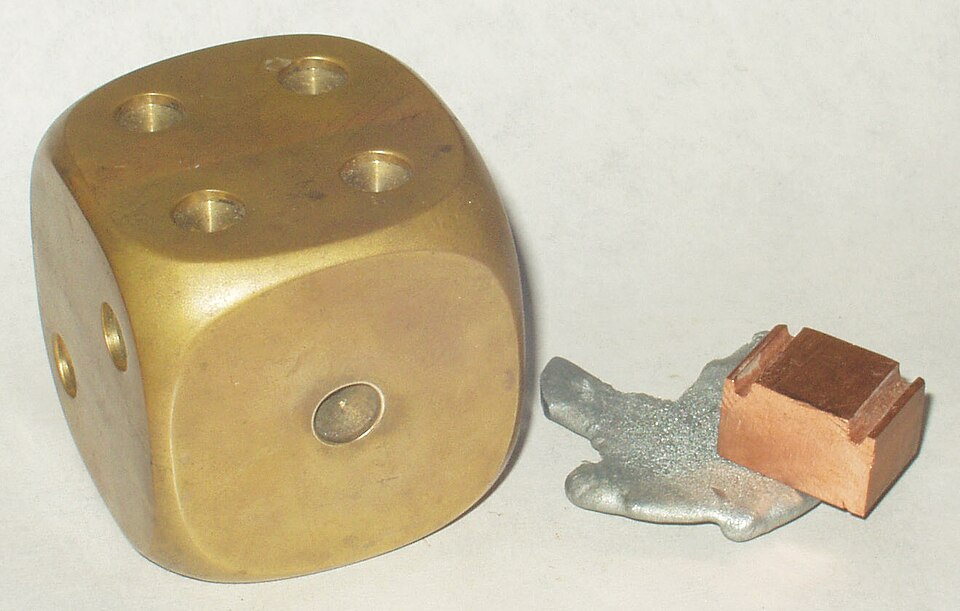

Brass is an alloy of copper and zinc. Some types of brass are called bronzes.
Brass has a golden appearance. It is harder than pure metals and resists corrosion. It costs more than zinc.
There are some common brasses:
- Alpha brasses - with less than 40% zinc
- Beta brasses -
- White brasses - with more than 45% zinc
Things brass are used to make include:
- Brass instruments
- Ornaments
- Electrical fittings
- Buttons
- Screws
- Taps
- Hinges
- Door knobs
Properties
Brass is more malleable than bronze or zinc. The melting point of brass can be 900 to 940 °C or 1,650 to 1,720 °F, depending on what it is made of. The density of brass is 8.4 to 8.73 g/cm 3 (0.303 to 0.315 lb/cu in).
Today, almost 90% of all brass alloys are recycled. Brass is not ferromagnetic. Brass scrap is collected and transported to the foundry. In the foundry, it is melted and recast into billets. The billets are heated and stretched into the form and size that is wanted.
Brass will corrode when it is exposed to moisture, chlorides, acetates, ammonia, and some acids.
Brass alloys
There are many brass alloys. They include:
- Abyssinian gold
- Admiralty brass
- Aich’s alloy
- Aluminum brass
- Arsenical brass
- Cartridge brass
- Common brass
- DZR brass
- Delta metal
- Free machining brass
- Gilding metal
- High brass
- Leaded brass
- Lead-free brass
- Low brass
- Manganese brass
- Muntz metal
- Naval brass
- Nickel brass
- Nordic gold
- Orichalcum
- Prince’s metal
- Red brass
- Tombac
- Silicon tombac
- Tonval brass
- Yellow brass
Written for younger readers
Brass, in simpler words
This version comes from Wikijunior, a set of books written for children aged 8 to 11. It is shorter and uses plainer language than the article above.
From Wikijunior: How Things Are Made
Brass-lead.jpg|Items that are made of brass Brass is stronger and harder than copper, but not as strong or hard as steel. Brasses with a higher percentages of zinc are stronger and harder, but they are also more difficult to form and have less corrosion resistance. The zinc used to make brass is a commercial grade sometimes known as spelter.
Brass is a metal composed primarily of copper and zinc. Copper is the main component, and brass is usually classified as a copper alloy.
The main component of brass is copper (varies between 55% and 95% by weight) which are made from electrically refined copper that is at least 99.3% pure to minimize the amount of other materials. The second component of brass is zinc. The amount of zinc varies between 5% and 40% by weight depending on the type of brass. Some brasses also contain small percentages of other materials to improve certain characteristics. Such metals as lead to improve machinability, tin improves corrosion resistance, iron makes the brass harder and makes the internal grain structure smaller so that brass can be shaped by repeated impacts in a process called forging.
Step by step (Preferable in bullet point list)
- Step 1: The appropriate amount of suitable copper alloy scrap is weighed and transferred into an electric furnace where it is melted at about 1,0500C. After adjusting for the amount of zinc in the scrap alloy, an appropriate amount of zinc is added after the copper melts. A small amount of additional zinc, about 50% of the total zinc required, may be added to compensate for any zinc that vaporizes during the melting operation. If any other materials are required for the particular brass formulation, they are also added if they were not present in the copper scrap.
- Step 2: The molten metal is poured into molds and allowed to solidify into slabs called cakes.
- Step 3: When the cakes are cool enough to be moved, they are dumped out of the molds and moved to the rolling area where they are stored.
- Step 4: The cakes are placed in a furnace and are reheated until they reach the desired temperature. The temperature depends on the final shape and properties of the brass stock.
- Step 5: The heated cakes are then fed through a series of opposing steel rollers which reduce the thickness of the brass step-by-step to about 13mm or less. At the same time, the width of the brass increases. This process is sometimes called breakdown rolling.
- Step 6: As the brass is hot rolled it gets harder and more difficult to work. It also loses its ductility, or ability to be stretched further. Before the brass can be rolled further, it must first be heated to relieve some of its hardness and make it more ductile. This process is called annealing. The annealing temperatures and times vary according to the brass composition and desired properties.
- Step 7: The annealed pieces of brass are then fed through another series of rollers to further reduce their thickness to about 2.5 mm. This process is called cold rolling because the temperature of the brass is much lower than the temperature during hot rolling. Cold-rolling mills are designed to minimize deflection across the width of the rollers in order to produce brass sheets with near-uniform thickness.
- Step 8: At this point, the wide sheets may be slit into narrower sections to produce brass strip. The strip may then be given an acid bath and rinse to clean it.
- Step 9: The sheets may be given a final cold rolling to tighten the tolerances on the thickness or to produce a very smooth surface finish. They are then cut to size, stacked or coiled depending on their thickness and intended use, and sent to the warehouse for distribution.
White-hot steel pours like water from a 35-ton electric furnace, Allegheny Ludlum Steel 1a35062v.jpg|Step 1: Alloys are melted inside the electrical furnace Fotothek df n-32 0000009 Facharbeiter für Gießereitechnik.jpg|Step 2: The melted brass are poured into mold to form ingots Ingot (PSF).png|Step 3: Robotic hand take the mould to remove ingot from inside the mould Continuous annealing.png|Step 5: The roller are annealing the brass sheet Cold Milling.png|Step 6: The brass sheet are cold milling
Where this page comes from
The article above is adapted from “Brass” on Simple English Wikipedia, by its contributors. We removed reference markers, navigation boxes and tables, expanded measurement templates into readable numbers, and kept the prose otherwise intact. The simpler version is adapted from Wikijunior on Wikibooks.
Both sources are published under CC BY-SA 4.0, so this page is published under the same licence. You may share and adapt it, including commercially, as long as you credit the original and keep the same licence.
Worksheets, answer keys and printable layouts elsewhere on K5Print are our own work and are not covered by this licence.