Bread
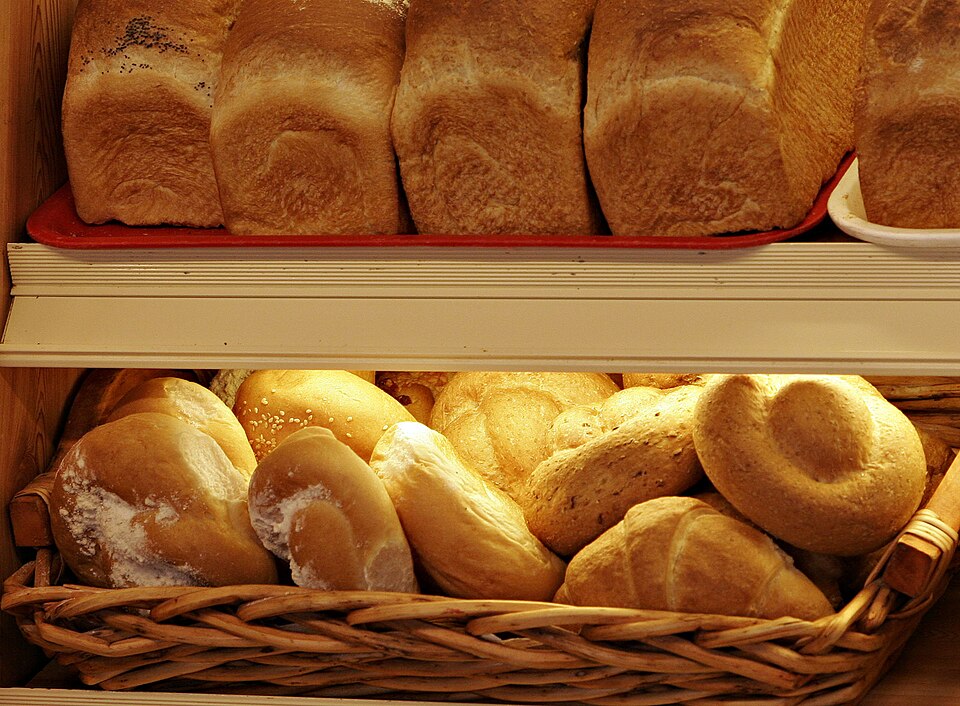

Nutrition facts: whole-wheat bread
One serving is 1 slice (32 g).
| Nutrient | Per 100 g | Per serving | % Daily Value |
|---|---|---|---|
| Calories | 252 kcal | 81 kcal | — |
| Protein | 12.4 g | 4.0 g | 8% |
| Total fat | 3.5 g | 1.1 g | 1% |
| Carbohydrate | 42.7 g | 13.7 g | 5% |
| Fiber | 6.0 g | 1.9 g | 7% |
| Sugars | 4.3 g | 1.4 g | — |
| Vitamin C | 0.0 mg | 0.0 mg | — |
| Vitamin A | 0 µg | 0 µg | — |
| Calcium | 161 mg | 52 mg | 4% |
| Iron | 2.5 mg | 0.8 mg | 4% |
| Potassium | 254 mg | 81 mg | 2% |
| Sodium | 455 mg | 146 mg | 6% |
Data: USDA FoodData Central (public domain, CC0) — “Bread, whole-wheat, commercially prepared”. Percent Daily Values use the FDA’s reference amounts for labels.
Bread is a type of baked food. It is mainly made from dough, which is made mainly from flour and water. Usually, salt and yeast are added. Bread is often baked in an oven. It can be bought all over the world.
Bread can be toasted or used to make sandwiches. Bread can be made into many different foods, like pizza. There are many different kinds of bread.
The two main types of bread are:
- Leavened bread is made by adding yeast or other leavening agents to the dough. The yeast produces gas that makes the dough lighter. Leavened bread can be made into larger loaves baked in an oven. This is the main type of bread eaten in Europe, America, and many parts of Asia.
- Unleavened flatbread is baked from a dough of water and flour, with no yeast. It is baked in flat rounds like tortilla or chapati. This type of bread cannot be made thick as it would be too dense to eat. Unleavened bread is eaten throughout Greece, Africa, parts of Asia, and as the Central America such as Pitta bread or tortilla. Baking can be done on a metal plate or hot stone, or in an oven.
The color and taste of the bread depending on the kind of flour used and the style of baking. Flour made from the whole grain gives darker bread. Flour made just from the polished wheat grain gives a very white bread. Rye and barley flour give darker types of bread. The type of flour also changes how long the bread can be kept before going bad. Some strains of wheat are resistant to fungus, but may not produce bread as tasty as a weaker strain.
Religious breads
Christianity and Judaism have rules about the use of bread in their religions. Unleavened bread (matzo) is eaten by Jews during the Passover. The Catholic celebration of the Eucharist uses unleavened wafers.
Orthodox churches forbid the use of unleavened bread for the Eucharist (Old Testament) and permit leavened bread only as a symbol of the New. This was one of the three points of contention that brought about the schism between Eastern and Western churches in 1054.
Types of bread
- Bagel
- Baguette
- Croissant
- Injera
- Khachapuri
- Lavash
- Markouk in Egypt and the Levant
- Matzo in all Kosher communities
- Naan
- North American biscuit
- Pita
- Pizza dough
- Pretzel
- Rice bread
- Roti
- Rye bread (Includes Pumpernickel)
- Scone
- Sprouted bread
- Tortilla
- White Bread
- Wholemeal bread
Bread is an important part of life in many countries because so many people eat it. In many cultures, bread is so important that it is part of religious rituals.
Cake is made in a similar way to bread but sugar, fat, and milk are added to the dough and often more ingredients.
Written for younger readers
Bread, in simpler words
This version comes from Wikijunior, a set of books written for children aged 8 to 11. It is shorter and uses plainer language than the article above.
From Wikijunior: How Things Are Made
Koernerbroetchen.jpg|A bread seasoned with sesame seeds Bread is a food that are usually made by bakers.
Bread is made with three basic ingredients: Grain, water, and bakers’ yeast.
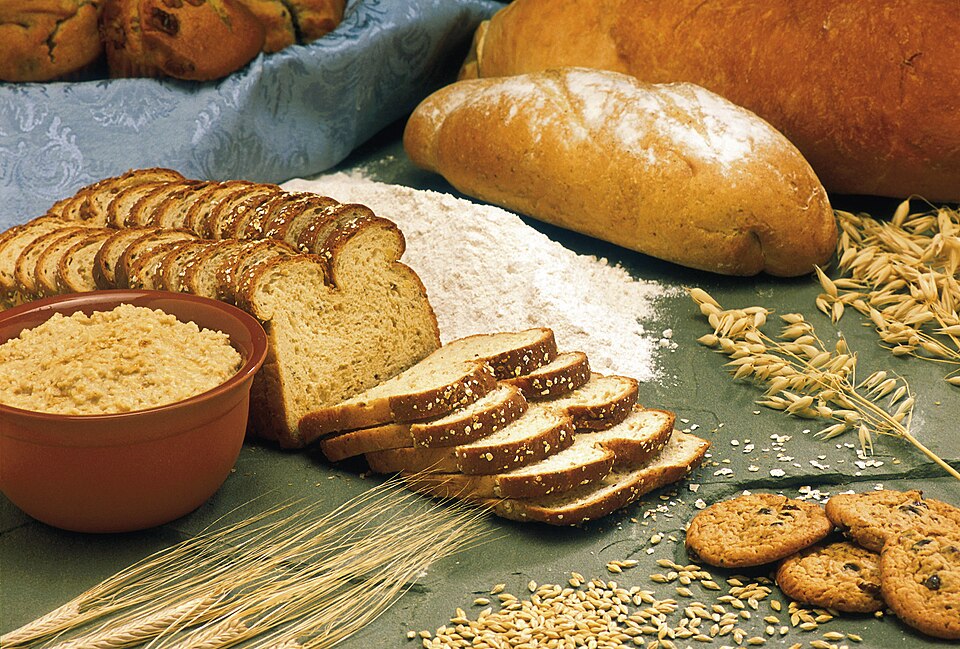
Grains are composed of three parts: bran (the hard outer layer), germ (the reproductive component), and endosperm (the soft inner core).
To make wholemeal bread, all parts are ground together to make whole wheat and rye breads.
To make white bread, the bran and the germ must be removed. Since bran and germ contain much of the nutrients in grain, the white flour is often “enriched” with vitamins and minerals.
Water and yeast are mixed with the flour to make dough.
Yeast is actually a tiny organism which feeds off the sugars in the grain, and emits carbon dioxide. The growth of the yeast produces gas bubbles, which leaven the bread.
Depending on type of bread, additional ingredients such as salt, fat, sugar, honey, raisins and nuts are also added in to the receipe.
- Step 1: The sifted flour is poured into an industrial mixer. Temperature-controlled water is piped into the mixer. A pre-measured amount of yeast is added.
- Step 2: The mixer is essentially an enclosed drum that rotates at speeds between 35 to 75 revolutions per minute. Inside the drum, mechanical arms knead the dough to the desired consistency in a matter of seconds.
- Step 3: The breads are allowed to ferment naturally. In this instance, the dough is placed in covered metal bowls and stored in a temperature-controlled room until it rises.
- Step 4: After the dough has fermented, it is loaded into a divider with rotating blades that cut the dough into pre-determined weights.
- Step 5: A conveyer belt then moves the pieces of dough to a molding machine. The molding machine shapes the dough into balls and drops them onto a layered conveyer belt that is enclosed in a warm, humid cabinet called a “prover.” The dough moves slowly through the prover so that it may “rest,” and so that the gas reproduction may progress to inflate the bread more.
- Step 6: When the dough emerges from the prover, it is conveyed to a second molding machine which re-shapes the dough into loaves and drops them into pans.
- Step 7: From the prover, the pans enter a tunnel oven. The temperature and speed are carefully adjusted so that when the loaves emerge from the tunnel, they are completely baked and partially cooled.
- Step 8: The bread are loaded on the cooling tower to cool down the bread and moved on to slicing machine
- Step 9: Vertical serrated blades move up and down at great speeds, slicing the bread into constant sized pieces.
- Step 10: Metal plates hold the slices together while picking up each loaf and passing it to the wrapping machine. Pre-printed plastic bags are mechanically slipped over each loaf. Lastly the bread bag are tied using Kwik-Lock to ensure the freshness
Výroba chleba (1).JPG | Step 1: The flour are sifted before putting into mixer Baking bread. (5518030199).jpg|Step 2: The mixers mixes all the ingredients Postup výroby chlebíčkové veky (1).JPG|Step 3: The bread are allowed to be fermented naturally Roti di Menara Penyejukan.png|Step 8: The breads are cooled off in cooling tower
Where this page comes from
The article above is adapted from “Bread” on Simple English Wikipedia, by its contributors. We removed reference markers, navigation boxes and tables, expanded measurement templates into readable numbers, and kept the prose otherwise intact. The simpler version is adapted from Wikijunior on Wikibooks.
Both sources are published under CC BY-SA 4.0, so this page is published under the same licence. You may share and adapt it, including commercially, as long as you credit the original and keep the same licence.
Worksheets, answer keys and printable layouts elsewhere on K5Print are our own work and are not covered by this licence.