Camera
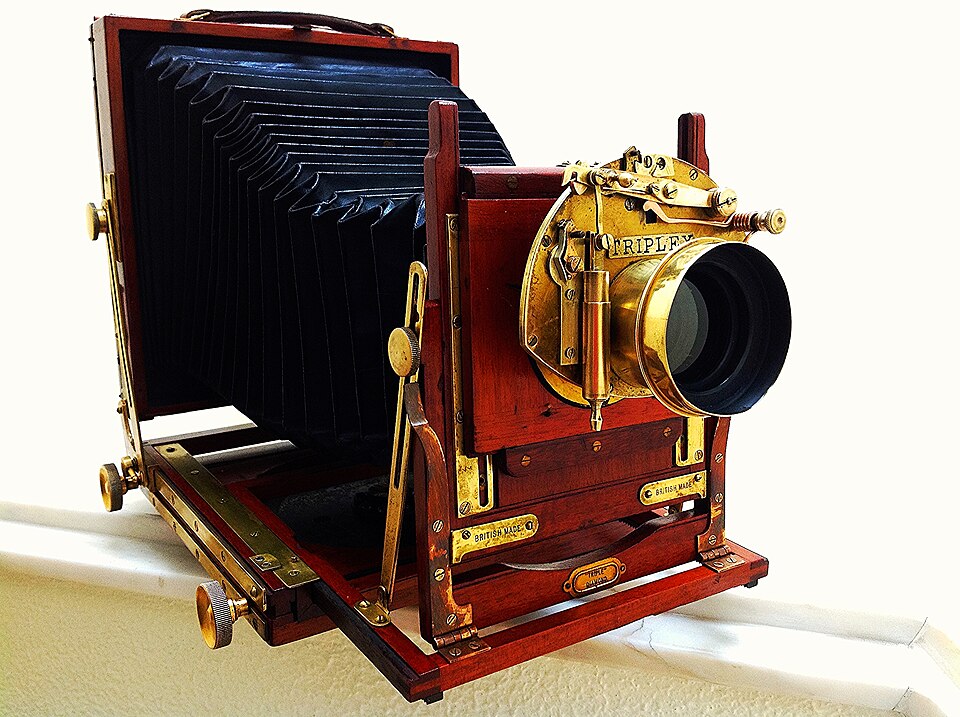

A camera is a device that takes pictures (photographs). It uses film or electronics to make a picture of something. It is a tool of photography. A lens makes the image that the film or electronics “sees”.
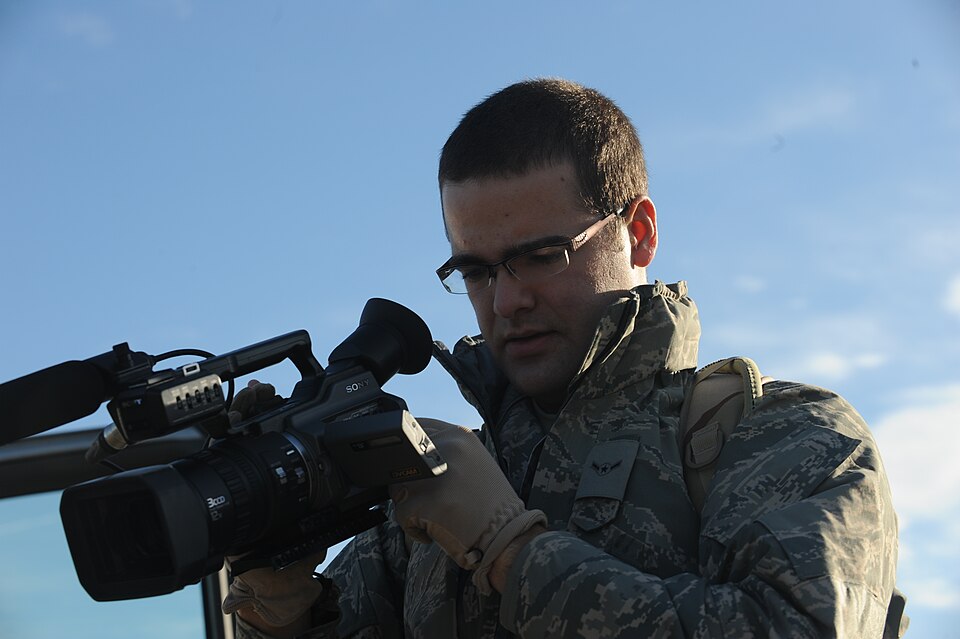
A camera that takes one picture at a time is sometimes called a still camera. A camera that can take pictures that seem to move is called a movie camera. If it can take videos it is called a video camera or a camcorder. The majority of cameras are on mobile phones.
All cameras are basically a box that light can not get into until a photo is taken. There is a hole on one side of the camera where the light can get in through the lens, and this is called the aperture. On the other side is a special material that can record the image that comes through the aperture. This material is the film in a film camera or electronic sensor in a digital camera. Finally, there is also the shutter, which stops light from getting in until a photo is taken.
When a photo is taken, the shutter moves out of the way. This lets light come in through the aperture and make a picture on the film or electronic sensor. In many cameras, the size of the aperture can be changed to let in more light or less light. The amount of time that the shutter lets light through can be changed as well. This also lets in more light or less light. Most of the time, electronics inside the camera control these, but in some cameras the person taking the picture can change them as well.
Moving pictures
A ciné camera or movie camera takes a rapid sequence of photographs on image sensor or strips of photographic film. Unlike a still camera, the ciné camera takes a series of images, each one is called a “frame”. The frames are later played back in a ciné projector at a specific speed, called the “frame rate” (number of frames per second). While viewing, the human visual system merges the separate pictures to create the illusion of motion. The first ciné camera was built around 1888. By 1890 several types were being made. The standard film size for ciné cameras was quickly established as 35mm film. This remained in use until the transition to digital cinematography.
A professional video camera (often called a television camera) is a high-end device for creating electronic moving images. Their use includes music videos, movies, corporate and educational videos.
Written for younger readers
Camera, in simpler words
This version comes from Wikijunior, a set of books written for children aged 8 to 11. It is shorter and uses plainer language than the article above.
From Wikijunior: How Things Work
The word camera comes from Latin and means “room” or “chamber”. The first camera was a very dark room with a tiny hole in the window shutter. Light passing through this ‘pinhole’ produced an image on the far wall that was bright and upside down. Someone had the bright idea of making a camera in a tower and adding mirrors. People in the dark room looked at a table, on which they saw the outside world projected - it produced a “birds-eye view” of their city.
This was called a “camera obscura”. The first one was made by a scholar called Ali Al-Hasan Ibn al-Haitham. He was born in Basra (now in southern Iraq) in about the year 1000 AD.
Around 1600, Giambattista della Porta added a lens to the pinhole camera, but it was not until 1850 that a Scottish scientist, Sir David Brewster took the first actual photograph with a pinhole camera.
Photography is the result of combining several technical discoveries
- The pinhole camera
- Optical lenses
- Photo-chemical reactions
- Chemical development and stabilization of the image The first permanent photograph was an image produced in 1825 by the French inventor Nicéphore Niépce, but it took a very long time to produce. He teamed up with Louis Daguerre, and together they experimented with silver compounds based on a discovery made by a German Chemist Johann Heinrich Schultz in 1724, which was that a silver and chalk mixture darkens when exposed to light.
British scientist William Fox Talbot discovered another means to fix a silver process image but had kept it secret. He discovered sodium thiosulphate solution to be a solvent of silver halides in 1819 and was the first to commercialize photography and use the terms “negative” and “positive”.
In around 1900 Eastman Kodak of America mass produced the first popular black-and-white camera “The Brownie” which popularized low-cost photography and introduced the concept of the snapshot. The product was a very basic cardboard box camera with a simple lens. It used rolls of photographic film capable of storing about eight or a dozen images which could be developed and printed at most pharmacies, since initially they also sold the camera and film. The result was 2¼-inch (6cm) square black and white pictures of reasonable quality which faded unless stored in the dark. Photograph albums using dark, chemically inert paper were invented for this purpose.
The first modern color film using the “three colored emulsion process” was called Kodachrome, a popular product introduced by the Eastman Kodak Company in the United States of America around 1935.
Today, electronic cameras usually use an integrated circuit that scans each point or “pixel” of an image and produces electrical signals. The basic “empty black box” is tiny compared with the darkened room, but the principle method of producing an image on a screen remains exactly the same as projecting an image on a wall of a room.
Where this page comes from
The article above is adapted from “Camera” on Simple English Wikipedia, by its contributors. We removed reference markers, navigation boxes and tables, expanded measurement templates into readable numbers, and kept the prose otherwise intact. The simpler version is adapted from Wikijunior on Wikibooks.
Both sources are published under CC BY-SA 4.0, so this page is published under the same licence. You may share and adapt it, including commercially, as long as you credit the original and keep the same licence.
Worksheets, answer keys and printable layouts elsewhere on K5Print are our own work and are not covered by this licence.