Car Engine
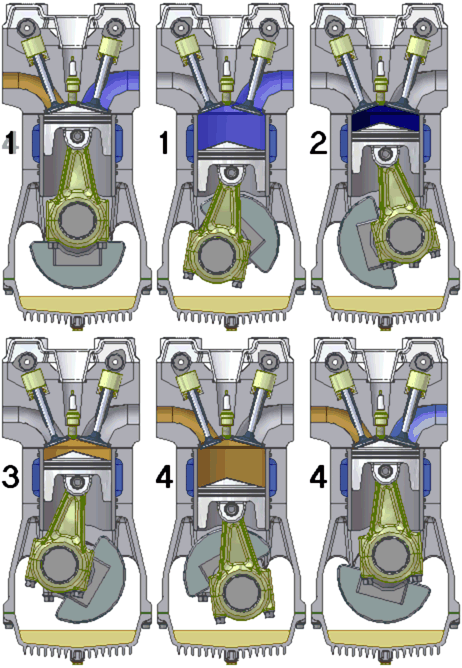

An internal combustion engine is an engine in which combustion, or the burning of fuel, occurs on the inside. This differs from external combustion engines where the fire is outside the engine, such as a steam engine.
There are many kinds of internal combustion engine but the term often means the machine that Niklaus Otto invented. In this kind, fire makes pressure increase inside a cylinder. The pressure pushes a piston which is attached to a wheel by a crank. The rod pushes the wheel and makes it spin around. The spinning wheel is attached to other wheels. The engine is very strong and can make all the wheels move.
Engine layouts
There can be many kinds of internal combustion engines such as the single piston engine, the inline engine, the flat engine, the V engine, the VR engine, the W engine, the X engine, the U engine, the H engine, the horizontal K engine, the opposed piston engine, the delta engine, the Wankel or rotary engine and the radial engine which is commonly used in planes.
Common layouts
The most common layouts among these engines are the V layout, and the inline layout. In the V engine, the pistons are aligned in a V shape. There can be V twin engines, with 2 pistons, V3 engines, V4 engines, V6 engines, V8 engines, up to V24 engines. The VR layout is the same as a V layout except the angle between the V shape is smaller making the overall drive smoother. In inline engines, the pistons are aligned in a straight line. There can be inline 1 engines, also called a singular piston engine, all the way up to a straight 14 which was mainly used in older models of cars. Flat engines are the same as inline engines but are aligned horizontally.
W, X, U, H, Horizontal K, Delta and opposed piston engines all have different layouts. In the W engine, the pistons are aligned in a W shape if looked at from the front. The Bugatti Chiron, one of the fastest cars in the world, features a W engine. The pistons in a X are aligned to look like an X from the front. In the U engine, there a 2 inline engine with separate crankshafts and a shared output shaft. When looked at from the front of the engine block, it resembles a U shape. H engines are U engines except there are 2 more inline engines attached to the bottom of the existing inline engines from the U engine. The H and the U layout can be configured vertically or horizontally. In delta engines, the pistons are aligned in a triangle shape. There are 2 pistons per cylinder/combustion chamber, and therefore the minimum amount of pistons in a delta engine is 6. Horizontal K engines have 2 flat pistons facing opposite each other at the bottom and a V engine above them, making them look like a horizontal K. The Opposed piston engines also have 2 pistons per cylinder. They can be aligned vertically or horizontally. When there are only 2 pistons in the engine, they can be called boxer engine.
Radial engines
Radial engines are commonly used in planes but are rarely used in cars. An example of this is the Porsche 356 and the 1939 Plymouth Pickup. The pistons in a radial engine are aligned in a star shape. When having multiple sets of pistons, the engines can be stacked beside each other.
Rotary/Wankel engines work the same as a piston engine except they don’t have a piston but instead have a rotor that also cycles through the 4 main stages of engines (intake, compression, combustion and exhaust).
Initial startup
There are many different parts to an engine. They include pistons, camshafts, crankshafts, timing belts, and valves. All parts of an engine need to be fully functional for it to work and all parts have a separate role. An engine is usually started by first sending power from the car battery to the ignition coil which then causes an engine spark. The spark then ignites combustion in the cylinders and the combustion starts the engine.
There can be petrol or diesel engines in a vehicle. In petrol or gasoline engines, it is required to have an ignition system to burn the fuel and air mixture. In diesel engines, the ignition system is not required to burn the fuel. Diesel is similar to heating oil. It is burnt through extreme compression.
Mechanics
The car is started using a powerful electric motor, called a starter motor. The starter solenoid converts electrical energy into mechanical energy or movement) and when it starts the ignition switch connects a circuit, sending power to the starter relay. It then sends 2 jolts of electricity into the solenoid, the larger burst directly from the battery pack and the other from the ignition. The magnetic field created from the solenoid connects two metal contact points, one being the solenoid plunger, together which then relays the electricity into the starter motor. The plunger also engages a fork which pushes the pinion gear (connected to the starter motor) to engage the flywheel automatically, starting the engine.
Forced induction and cooling
For extra power, more air is needed to increase the energy evolved per unit of fuel. This is where forced induction must take place. There are some ways of creating forced induction such as turbochargers and superchargers. Turbochargers rely on the volume and velocity of the exhaust to spin the turbine wheel in the middle of the turbocharger. Turbochargers should consume less power from the engine than superchargers and therefore suffer bad throttle response. This delay can also be referred to as turbo lag. Smaller turbochargers spool quickly and deliver more boost pressure at lower engine speeds but suffers at higher RPM s. Bigger turbochargers can deliver more power at higher revs but suffer low throttle response. There can be many turbochargers in a car, but the most common amount being 1 or 2. Superchargers have close to no lag time as the compressor is constantly spinning proportionally to the engine speed. They require torque from the engine to operate. Some common types of superchargers are the Roots-type supercharger, a Screw-type supercharger, and a Centrifugal-type supercharger. In a Roots-type supercharger there are paddles on two drums that are continuously rotating, that force air into the intake. The Roots-type supercharger is a positive displacement device and therefore has the advantage of producing the same pressure ratio at any engine speed. A Screw-type supercharger, like the Roots-type supercharger, is a positive displacement device. They have 2 screws that compress the air and are more efficient than roots type as they create a cooler air output than a roots supercharger but are more difficult to manufacture. A centrifugal-type supercharger, is not a positive displacement device. Although it looks like a turbocharger, they are very different as the power source of the centrifugal supercharger is the engines crankshaft. A turbocharger uses the exhaust gas to spin the compressor.
When using forced induction, the air temperature rises dramatically. To cool the air at higher temperatures, an intercooler is needed. An intercooler cools the air before it enters the cylinder (combustion chamber) using air or water. When hot air enters the combustion chamber, it decreases the fuel efficiency as warm air holds less oxygen than cool air. An air to air intercooler uses the cool air from outside to cool the hot air as it enters the intercooler. The more surface area the intercooler has the cooler the air can get. There are 2 types of air to air intercooler, the bar and plate intercooler and the tube and fin intercooler. Bar and plate intercoolers can cool the air to lower temperature but a tube and fin intercooler cost less and weigh less. In air to water intercoolers, instead of air from outside, it uses a cool liquid to cool the air as it passes though and then uses a radiator to cool the cooling liquid. Air to water intercooler are more complex, heavier and more expensive than air to water intercoolers but can be more efficient.
Transmission
Cars can also have gears. The gears are controlled by the transmission. They can either be manual, automatic or Continuously Variable Transmission. Gear ratios
Intake and exhaust
The intake manifold is where the car gets the oxygen to burn the fuel
Exhaust in a car is the fumes that come out of the pipe or pipes (normally in back of a car but can be on the sides)
Other information
Engines need oil to make them slippery or the moving parts would grind together and stick. Parts of a car engine are measured to 0.01 of a millimetre and some engine parts fit together very tightly.
Most road vehicles use the internal combustion engine, and most of those use the four-stroke engine.
Gas turbines are internal combustion engines that work continuously, not by strokes. Rocket engines and guns are internal combustion engines but they do not turn wheels.
See car battery.
Written for younger readers
Car Engine, in simpler words
This version comes from Wikijunior, a set of books written for children aged 8 to 11. It is shorter and uses plainer language than the article above.
From Wikijunior: How Things Work
A car engine uses internal combustion engine which is a mechanical device which burns a fuel to produce power rotation which moves a vehicle.
Nicolaus Otto was the first person to successfully build the 4-stroke type of engine that would later become an car engine in 1876. In 1885 Karl Benz used an engine similar to Otto’s engine to make a three-wheeled automobile move. In the same year, Benz began producing and selling automobiles.
The first commercial two-stroke engine involving in-cylinder compression is attributed to Scottish engineer Dugald Clerk, who patented his design in 1881
The internal combustion engine gets its power from the heat generated from the burning of liquid fuels mixed with air (vaporized).
These are mostly ‘fossil fuels’ like gasoline, diesel, compressed natural gas (CNG) and liquefied petroleum gas (LPG) that are mined from the ground, and are becoming harder to find and extract, but some recent technologies use synthetic or renewable fuels such as hydrogen, which can be produced by electrolysis using renewable energy sources.
It is a mechanical device that converts chemical energy (the fuel) to heat energy, and then to mechanical energy. Reciprocating (back and forth) motion is converted to rotary (spinning) motion, and transmitted through a clutch, gear box etc. to move the wheels of the car.
An engine is properly called a motor because it makes things move! Engine really means ingenious devices, but we use the term because the process of burning a fuel and delivering power usually requires much more than a simple motor spinning an axle. (clever things like gears, levers and cables to get the power to where it is really needed).
A motor burns a mixture of fuel and air in one or more metal tubes called cylinders. The hot, expanding gas from the combustion drives a piston downwards, causing a crankshaft to rotate, and spin a flywheel, absorbs energy from the burned fuel and keeps things rotating until the next cycle. The power from the rotating crankshaft and flywheel is what ultimately drives the wheels.
There are lots of different types of motor, but only two common sorts: the cheap, noisy and rather limited 2-stroke usually only found on small motorcycles and garden machines, and the more sophisticated Otto or 4-stroke used for cars, trucks and buses, which motor (pictured here) has a fun mnemonic, starting with the piston at the ’top’ (but note: this is not always actually at the top, but - as in the picture left - that is how most folks call the end of the cylinder with the spark-plug or igniter which is also furthest from the ‘bottom-end’ or crankshaft):
- SUCK (1) in a mixture of air and fuel vapor (actually called induction stroke as the piston starts at the ’top’ of the cylinder near the spark plug or igniter and goes down to the ‘bottom’ near the crankshaft)
- SQUEEZE (2) the mixture (a compression stroke as the piston goes ‘up’ towards the spark plug or igniter)
- BANG! (3) the spark plug or igniter sets fire to the compressed fuel and air (a power stroke to force the piston ‘down’ towards the crankshaft) - When the piston is furthest from the crankshaft, it is said to be at ’top-dead-center’ - the actual spark usually occurs when the flywheel inertia has moved the crankshaft a few degrees further, so the piston has actually already started its ‘decent’ before it gets a push from the expanding hot burning gasses!
- BLOW (4) out the exhausted (burned) gasses form the burnt fuel (the exhaust stroke - the piston returns to the ’top’ of the cylinder ready to suck-in some fresh fuel and restart the cycle.
These were used in only a few small cars in the mid 20th century, notably the mass-produced East German Trabant, but also more famous makers of ‘super-compacts’ or ‘ultra-lights’ such as DKW, Saab, Wartburg, Suzuki and Subaru produced small numbers of 2-stroke vehicles.
A special mixture of fuel and lubricating oil is needed, because the fuel-and-air mixture is drawn in through the crankcase, with the end of the combustion stroke and the beginning of the compression stroke happening at the same time so that it performs the intake and exhaust functions together!
Although they have a better power-to-weight ratio than 4-strokes, they are more prone to wear and very polluting. Many industrial machines or ship engines use large 2-stroke diesel motors.
The speed of gasoline (or petrol) engines is easier to control and usually lighter than an equivalent diesel, which work best at constant speed and really needs a turbo-charger to compensate for the diesel inertia.
Gasoline is a ’light’ fuel, highly combustible and ignited with an electrical spark-plug. Diesel (sometimes called ‘vaporising oil) is a thicker ‘heavy’ fuel which is much less inflammable, and is fired by very high compression within the cylinder. The diesel is ‘injected’ by a tube fitted about where a gasoline engine has its spark-plug. Diesel fuel is apt to become solid at low temperatures, and often has an ‘anti-wax-agent’ to prevent this.
The diesel engine may require heating before it will work. This is usually done with an electrical heater, but some tractors motors designed for cold climates in the mid 20th century could use either fuel, and had to be started using petrol, then when hot, the driver could choose to use either expensive gasoline or cheap ’tractor vaporizing oil’ which was in some European countries was subsidised and stained to detect its use in ‘unauthorized’ vehicles.
VERY! Engines use flammable liquid fuel that can leak, they produce heat which can ignite spilled fuel, they are heavy and massive, so they stay hot long after they stop, they produce power, and have lots of moving parts which can crush fingers or catch clothing to trap and injure the unwary, so the main motor (called the ‘prime mover’ ) has to be turned off long before you can work on an engine. Remember there are other motors that are around to power such as cooling fans that may be designed to work for some period of time after the prime mover engine ignition is switched off).
Never open the hood or touch an engine unless you are certain it has properly cooled off -probably for at least an hour after stopping.
Always check that everything in the engine bay is cool and is not leaking fuel or oil - plus make sure that any other motors have also actually stopped running before inserting anything under the hood (including particularly unprotected fingers, loose long hair or dangling clothing).
Internal combustion engines vary in the number of cylinders they have, and the size and positioning of those cylinders. For example, an Inline-4 has four cylinders in a line, and a V-6 has three pairs of cylinders in a “V” shape illustrated above.
Some Volkswagen designs used an unusual four-stroke air cooled engine, with two cylinders either side ( ‘horizontally opposed, four-cylinder motor’ ) which was originally designed for light aircraft. Illustrated here is one such, a Volkswagen Beetle motor of 1131 cubic centimetres (69 Cubic inches) total capacity, 25 PS (DIN) horsepower from 1945. It has been cut to show a better view of the interior. The orange colour is the cut surfaces and the green colour is the fuel-air inlet from the carburettor (mixer) which is in the middle, because it has to feed either side. The exhaust, cooling fan, and electrical generator or alternator is not shown. The oil filter and cooler is at the top left.
Automotive (vehicle) internal combustion engines may be either 2-stroke or 4-stroke engines, and can use spark-ignition (SI) for ‘volatile’ gasoline or liquid petroleum gas (LPG) fuels and/or compression ignited (CI) diesel engines (as mentioned).
Very dramatically. Before the automobile, there was only horse-power for personal transport at around 10 - 15 km/h (less than 10 mph or roughly twice walking speed) and steam powered public transport managed about two or three times that speed. The internal combustion engine has made personal transportation very much faster, up to about 100 km/h (60mph) on ordinary roads. Unfortunately both gasoline and diesel are what ar called ‘fossil fuels’ because they are made by natural forces over many millions of years, and our rate of consumption means they may not last forever. Scientists have tried many other ‘synthetic fuels’ but with only limited success. So the car is also responsible, indirectly, for the way we in the western world now live, with separate residential, industrial and commercial areas, which means most people need a car for work, shopping and social activities.
Unfortunately massive car use has led to an increase in world pollution - the so-called ‘greenhouse-gasses’ which are thought to be warming the world and changing the weather. The polar ice caps seem to be melting, so the sea might rise, flooding coastal areas, and storms may become more violent because the air-flow is temperature sensitive.
The ideas of converting reciprocatory (back and forth) motion of the to rotary (spinning) motion was known since ancient times, and used in lathes to make round posts and spindles.
The idea of using external heat to make steam was known to the ancient Greeks, but steam engines as we know them only emerged from reciprocating steam pumps developed since the 17th century. Later, in the 18th century more sophisticated steam engines had cranks and flywheels to produce rotary motion and speed control using governors. In the early 19th century steam locomotives were developed, and with them some of the accessories such as cabin heaters (to say nothing of steering mechanisms and brakes).
The big breakthrough was finding ways of burning the fuel inside the piston (internal combustion engine), rather than making high-pressure steam or gas and then pumping that into the engine cylinders as occurs in steam and pneumatic motors.
Where this page comes from
The article above is adapted from “Car Engine” on Simple English Wikipedia, by its contributors. We removed reference markers, navigation boxes and tables, expanded measurement templates into readable numbers, and kept the prose otherwise intact. The simpler version is adapted from Wikijunior on Wikibooks.
Both sources are published under CC BY-SA 4.0, so this page is published under the same licence. You may share and adapt it, including commercially, as long as you credit the original and keep the same licence.
Worksheets, answer keys and printable layouts elsewhere on K5Print are our own work and are not covered by this licence.