Chocolate
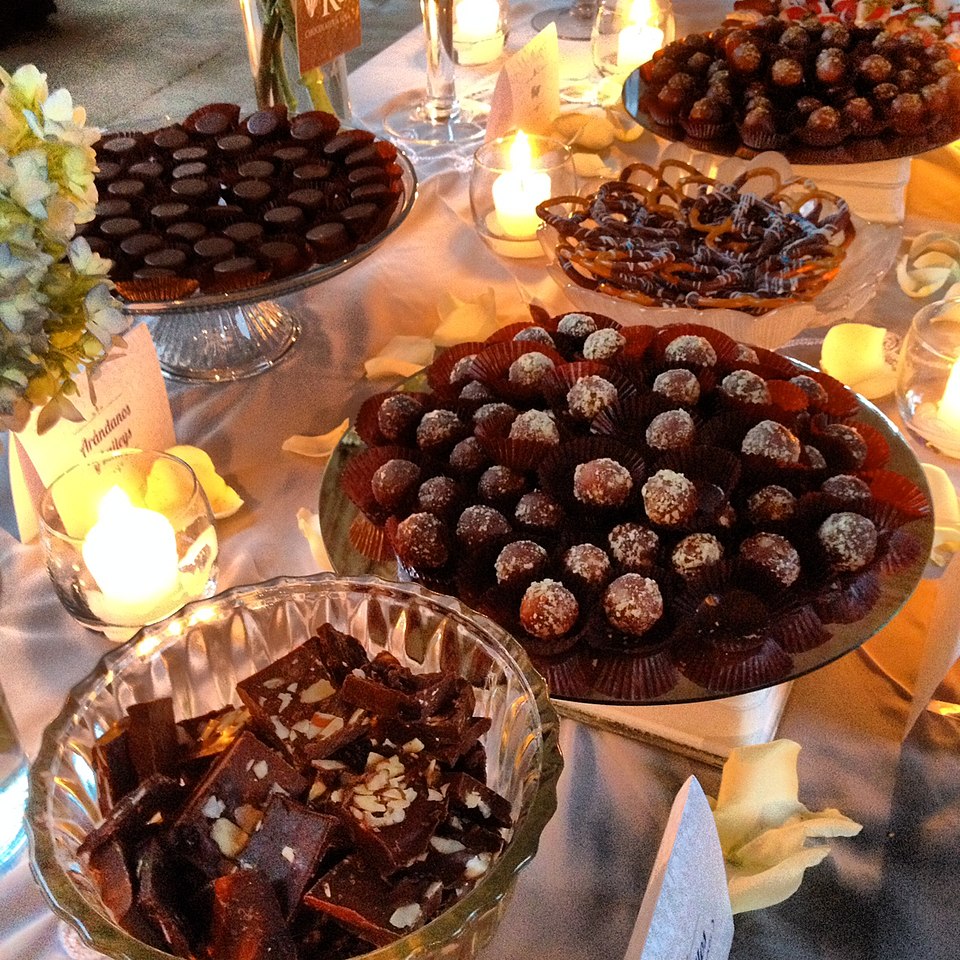

Chocolate is a food made from cacao beans. It is used in many desserts like pudding, cakes, candy, ice cream, and Easter eggs. It can be in a solid form like a candy bar or it can be in a liquid form like hot chocolate. Commercial chocolate has sugar and sometimes milk added. It has a melting point of about 30 to 32 °C (86 to 90 °F).
Dark chocolate has less sugar, and a more bitter taste. It was originally used to make drinking chocolate. Chocolate has been around the world since the time of the Olmec, Mayan, and Aztecs.
Mesoamerica
The cacao tree was first found to be useful for its seeds about two thousand years ago. Early Mayan people of Central America and Mexico used the seeds from the cacao tree to make a drink that tasted bitter, not sweet. Only important people could drink it. The word for “chocolate” in almost every language comes from its name in the Nahuatl language of Mexico, chocolatl.
A vessel found at an Olmec archaeological site on the Gulf Coast of Veracruz, Mexico, dates chocolate by pre-Olmec peoples as early as 1750 BC. On the Pacific coast of Chiapas, Mexico, a Mokaya archaeological site shows evidence of cocoa beverages from 1900 BC. The residues and the kind of vessel in which they were found suggest the initial use of cocoa was not simply as a beverage, but as a source of fermentable sugars for an alcoholic drink.
Modern
Later on, this drink was made sweeter and made into what is known today as hot chocolate. It was made popular by Spanish explorers who brought it from North America to Spain. When chocolate was sweetened and made into candy, it became a very popular treat for many Europeans. At first, only the rich could afford chocolate. In France at that time, only nobles could buy it. Now, many people can afford it. Most cocoa today is made in Africa in countries like the Ivory Coast (Côte d’Ivoire) and Nigeria.
Until the 16th century, the cacao tree was unknown to the Europeans. From time to time, they served Montezuma in cups of gold that held a certain drink made from cacao. After the Spanish conquest of the Aztecs, chocolate was imported to Europe.
Types
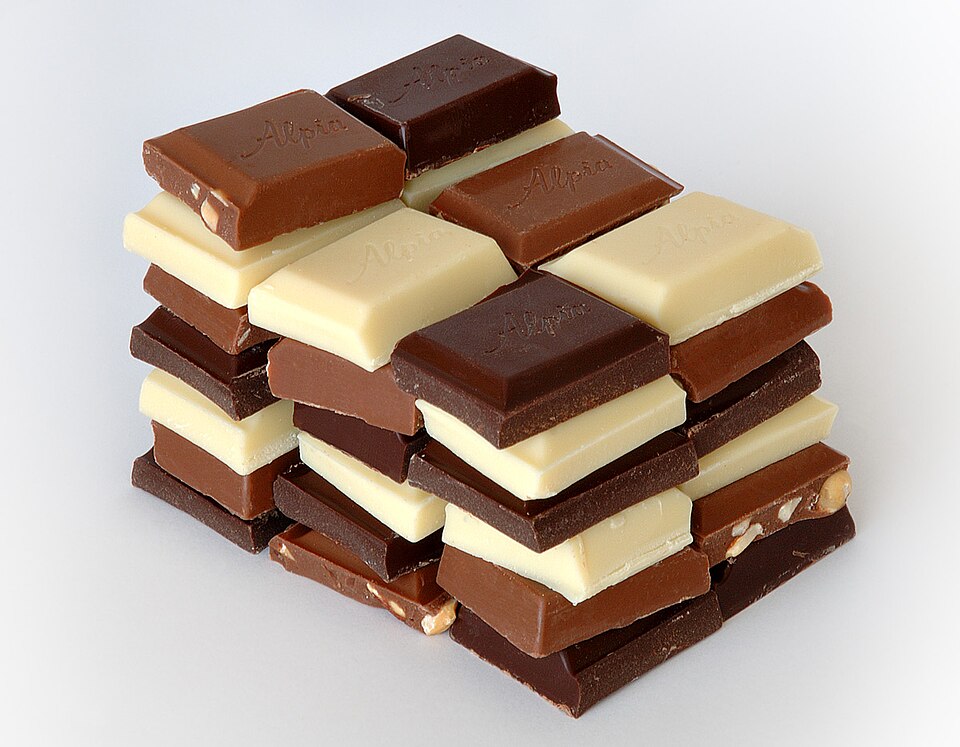
There are three main types of chocolate: white chocolate, milk chocolate, and dark chocolate. White chocolate tastes much sweeter than the other two types, because it has more of the sweeter ingredients in it.
Milk chocolate is sweet, but not as sweet as white chocolate. Milk chocolate has lots of cocoa.
Dark chocolate is the least sweet. It has the strongest chocolate flavor.
- Ruby chocolate is a type of chocolate created by Barry Callebaut. The variety was in development from 2004, and was released to the public in 2017. The chocolate type is made from the Ruby cocoa bean, resulting in a distinct red colour and a different flavour, described as “sweet yet sour”.
- Raw chocolate is chocolate that has not been processed, heated, or mixed with other ingredients. It is sold in chocolate-growing countries, and to a much lesser extent in other countries, often promoted as healthy.
- Compound chocolate is the name for a confection combining cocoa with other vegetable fat, usually tropical fats or hydrogenated fats, as a replacement for cocoa butter. It is often used for candy bar coatings. In many countries it may not legally be called “chocolate”.
- Modeling chocolate is a chocolate paste made by melting chocolate and combining it with corn syrup, glucose syrup, or golden syrup. It is primarily used by cakemakers and pâtisseries to add decoration to cakes and pastries.
- Cocoa powder is the pulverized cocoa solids left after extracting almost all the cocoa butter. It is used to add chocolate flavour in baking, and for making chocolate drinks. There are two types of unsweetened cocoa powder: natural cocoa produced by the Broma process, with no additives, and Dutch process cocoa, which is additionally processed with alkali to neutralize its natural acidity. Natural cocoa is light in colour and somewhat acidic, and is commonly used in recipes that also use baking soda; as baking soda is an alkali, combining it with natural cocoa creates a leavening action that allows the batter to rise during baking. Dutch cocoa is slightly milder in taste, with a darker colour. It is frequently used for chocolate drinks such as hot chocolate due to its ease in blending with liquids. However, Dutch processing destroys most of the flavonoids present in cocoa.
Safety
Chocolate is safe to eat unless it is eaten in large amounts. Some animals, like dogs and cats, become sick even if they eat only a little chocolate. People with diabetes can also get sick from eating chocolate. Dark chocolate contains ingredients that lower blood pressure and fight diseases. Small amounts of dark chocolate have been found to lower the risk of heart disease because of polyphenol in chocolate. It is necessary to moderate the amount of chocolate you eat.
Process
Making chocolate is a process that has many steps. First, the cocoa beans are collected and put in piles or containers to make them ferment. Fermentation makes the sugar in the beans turn into alcohol. Then the beans are dried and cleaned. Chocolate makers must cook the beans, and then crush them to make the cocoa butter and the chocolate liquor come out of them. Then the chocolate maker mixes different ingredients together to make the different kinds of chocolate. Dark or bittersweet chocolate is made from sugar, cocoa butter, and chocolate liquor. Milk chocolate uses all of those ingredients plus milk and vanilla. White chocolate does not contain chocolate liquor, but only cocoa butter, along with sugar, milk and vanilla. After these ingredients are put together, the chocolate maker is still not finished. One of the last things to be done is something called conching. Conching means crushing the chocolate very finely and keeping it warm so that it is liquid. Before chocolate is conched, it feels very rough in the mouth instead of smooth. Conches use heavy rollers that plow back and forth through the chocolate paste under regulated speeds and temperatures. Conching for several hours to several days makes good chocolate. The last step in making chocolate is called tempering. The chocolate is heated, and then shaken, and then cooled a few times.
Ingredients
There are a number of ingredients in chocolate. The most notable of these are theobromine and caffeine. These two chemicals are closely related and are found in all cocoa beans. In any bean, the amount of each chemical varies depending on the genetics of the tree and the stresses placed on the tree during the growing season.
Written for younger readers
Chocolate, in simpler words
This version comes from Wikijunior, a set of books written for children aged 8 to 11. It is shorter and uses plainer language than the article above.
From Wikijunior: How Things Are Made
Cadbury-Bournville.jpg|A piece of chocolate bar Chocolate can be found in many forms such as cocoa, candy bars, cakes and cookies). Chocolate comes from cocoa beans and cocoa trees first grew in South America’s river valleys. By the seventh century A.D., the Mayan Indians had brought them north into Mexico. Many other Central American Indians, including the Aztecs and the Toltecs, seem to have grown cocoa trees, and the words “chocolate” and “cocoa” come from the Aztec language. When Spanish explorers arrived in Central America in the fifteenth century, they noted that cocoa beans were used as a type of money and that the upper class of the native populations drank cacahuatl, a frothy drink made of roasted cocoa beans mixed with red pepper, vanilla, and water.
Cocoa beans are the main part of chocolate. Other ingredients are added, including sugar or other sweeteners, flavoring , and cocoa butters.
- Step 1: Cocoa beans are roasted, first on screens and then in revolving cylinders through which heated air is blown. Over a period of 30 minutes to 2 hours, the water in the beans is reduced from about 7% to about 1%. The roasting process triggers a browning reaction, in which more than 300 different chemicals present in the cocoa beans interact. The beans now begin to develop the rich flavor we associate with chocolate.
- Step 2: Roasting also causes the shells to open and break away from the nibs (the meat of the bean). This separation process can be completed by blowing air across the beans as they go through a giant winnowing machine called a cracker and fanner, which loosens the hulls from the beans without crushing them. The hulls, now separated from the nibs, are usually sold as either mulch or fertilizer. They are also sometimes used as a commercial boiler fuel.
- Step 3: Next, the roasted nibs undergo broyage, a process of crushing that takes place in a grinder made of revolving granite blocks.The design of the grinder may vary, but most resemble old-fashioned flour mills. The final product of this grinding process, made up of small particles of the nib suspended in oil, is a thick syrup known as chocolate liquor.
- Step 4: The next step is refining, during which the liquor is further ground between sets of revolving metal drums. Each successive rolling is faster than the preceding one because the liquor is becoming smoother and flows easier. The ultimate goal is to reduce the size of the particles in the liquor to about 0.03 cm.
- Step 5: The liquor is remixed with cocoa butter. The restored cocoa butter is necessary for texture and consistency, and different types of chocolate require different amounts of cocoa butter.
- Step 6: The mixture now undergoes a process known as conching, in which it is continuously turned and ground in a huge open vat. The process’s name derives from older vats, which resembled large conch shells. The conching process can last about three hours This is the most important step in making chocolate. The speed and temperature of the mixing are critical in determining the quality of the final product. The ingredients added during conching determined what type of chocolate is produced: sweet chocolate consists of chocolate liquor, cocoa butter, sugar, and vanilla; milk chocolate contains sweet chocolate with powdered whole milk or whole liquid milk.
- Step 7: The chocolate is poured into molds, cooled, cut, and packaged
’ 12 ITALY - TURIN - cioccolaTò 3.jpg|Step 1: Cocoa beans is roasted Chocolaterie-nestlé-broc mélangeur fève de cacao-moderne.jpg |Step 3: The roasted cocoa undergoes broyage Turbine à chocolat.JPG | Step 6: The cocoa liquor undergoes conching Elite Factory in Nazareth Illit IMG 2704.JPG|Step 7: The chocolate is left cool on conveyor belts before being packaged
Where this page comes from
The article above is adapted from “Chocolate” on Simple English Wikipedia, by its contributors. We removed reference markers, navigation boxes and tables, expanded measurement templates into readable numbers, and kept the prose otherwise intact. The simpler version is adapted from Wikijunior on Wikibooks.
Both sources are published under CC BY-SA 4.0, so this page is published under the same licence. You may share and adapt it, including commercially, as long as you credit the original and keep the same licence.
Worksheets, answer keys and printable layouts elsewhere on K5Print are our own work and are not covered by this licence.