Inclined Plane

An inclined plane is a simple machine. It allows one to use less force to move an object.
Examples of inclined planes are ramps, sloping roads and hills, plows, chisels, hatchets, carpenter’s planes, and wedges. The typical example of an inclined plane is a sloped surface; for example a roadway to bridge at a different height.
Another simple machine based on the inclined plane is the blade, in which two inclined planes placed back to back allow the two parts of the cut object to move apart using less force than would be needed to pull them apart in opposite directions.
Calculation of forces acting on an object on an inclined planes
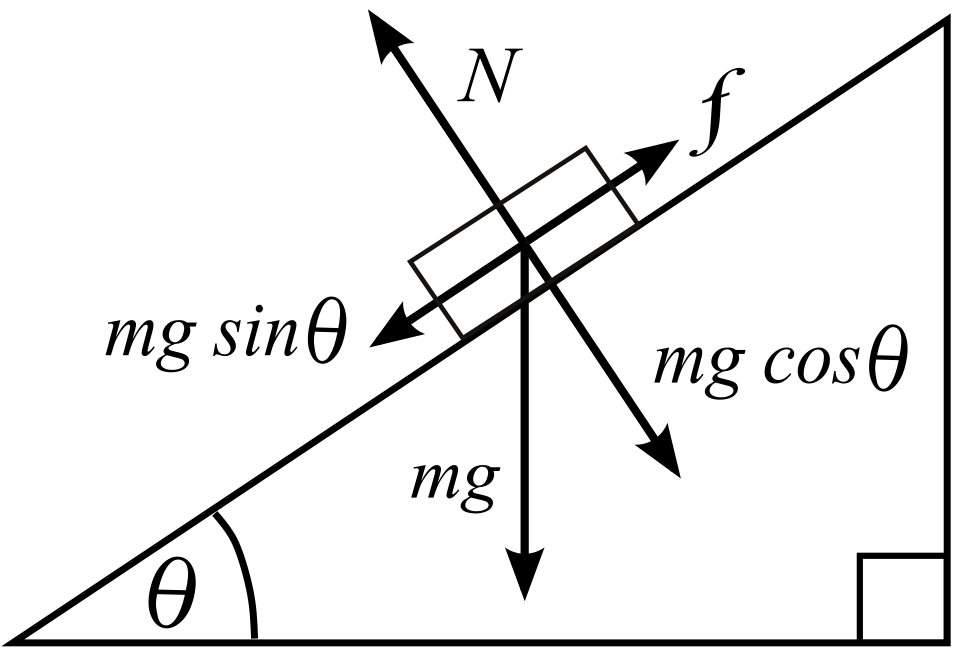
To calculate the forces on an object placed on an inclined plane, consider the three forces acting on it.
- The normal force (N) exerted on the body by the plane due to the attraction of gravity i.e. mg cos θ
- the force due to gravity (mg, acting vertically downwards) and
- the frictional force (f) acting parallel to the plane.
We can break the force from gravity into two vectors, one perpendicular to the plane and one parallel to the plane. Since there is no movement perpendicular to the plane, the component of the gravitational force in this direction (mg cos θ) must be equal and opposite to normal force exerted by the plane, N. Therefore, N=mgcos\theta.
If the component of the force from gravity parallel to the surface (mg sin θ) is greater than the static frictional force f s – then the body will slide down the inclined plane with acceleration (g sin θ − f k /m), where f k is the force of friction – otherwise it will remain stationary.
When the angle of the slope (θ) is zero, sin θ is also zero, so the body will not move.
Written for younger readers
Inclined Plane, in simpler words
This version comes from Wikijunior, a set of books written for children aged 8 to 11. It is shorter and uses plainer language than the article above.
From Wikijunior: How Things Work
An inclined plane is any sloped surface, like a slide or a ramp. The inclined plane is one of the six simple machines. It is a flat surface whose ends are at different heights. An inclined plane is a machine that does not always move.
Inclined planes occur in nature, so in that sense no one created them, they only needed to be noticed. For example, mountains form inclined planes and animals use them for climbing. They will often choose paths that are not as steep, but longer to save effort (power).
Stairways are a kind of inclined plane. One of the earliest known stairways was built as part of a wall surrounding Tel e-Sultan in the present-day city of Jericho. These stairs were built around 8,000 BC. In Egypt about 2,500 BC, it is believed that people made earth ramps as a way to move heavy stones for the Pyramids
An inclined plane makes it easier to raise something heavy, like a rock. Instead of lifting the rock straight up, you can raise it from its original location with less force by pushing it up a ramp. But there are some considerations that need to be taken, the distance the object must travel is always increased (not a straight vertical) and some of the energy is expended in the attrition with the surface. In a steep ramp, it will be harder to push the rock but you won’t need to push it as far. If you push it up a ramp that is not as steep, it will have to be longer. Because work is force multiplied by distance, the amount of work remains mostly the same, In a steep ramp, it will be harder to push the rock/load but you won’t need to push it as far. There maybe economical benefits in using a smaller force and having more time, as the load can easily be made to stay at rest as it travels the inclined plane, something that will be harder or even impractical in a straight vertical lift.
Like all the other simple machines that multiply force, it can be dangerous. If you go down a slide too fast you could lose control and hurt yourself. Avalanches and mud slides are examples of natural disasters that are dangerous because of the power of an inclined plane. If you go down a really steep inclined plane you could get hurt.
There are many devices based on the principles of the inclined plane.
Ramps and slides are one common example of the inclined plane. Ramps enable accessing heights that would be too difficult to scale vertically. Chutes and slides allow people and things to be safely lowered from a height. Eliminating friction from a slide increases the maximum speed at which an object can move down the slide. Because of this, slides are one of the most common and popular forms of entertainment and are common on playgrounds all over the world. In the sport skiing, participants accelerate to extremely high speeds utilizing only the inclined plane of a mountain slope provided by nature.
The roof of a house is usually an inclined plane. The incline allows it to shed water and snow.
Water wheels use inclined planes mounted around a rotating wheel to gain energy from moving water. They transform the force of the water into torque that turns a shaft. Similarly, sails extract the momentum of moving air to drive a vehicle, and windmills catch the wind in order to move a set of sails around a shaft to perform work.
Aircraft wings provide lift by redirecting momentum generated from lateral movement. Air flows faster over the top of the wing than it flows over the bottom. Propellers are inclined planes that transmits power by converting rotational motion into thrust.
Two of the other six simple machines are based on the inclined plane. The wedge is a compound portable inclined plane. It is made of two inclined planes that meet at an edge. The screw is an inclined plane wrapped around a cylinder.
It has changed the world by making heavy things easier to lift up, so people could use less power and energy.
The inclined plane is such a simple machine, nothing had to be invented before it. It does run parallel with the basic notions about gravity, momentum, forces and energy.
Where this page comes from
The article above is adapted from “Inclined Plane” on Simple English Wikipedia, by its contributors. We removed reference markers, navigation boxes and tables, expanded measurement templates into readable numbers, and kept the prose otherwise intact. The simpler version is adapted from Wikijunior on Wikibooks.
Both sources are published under CC BY-SA 4.0, so this page is published under the same licence. You may share and adapt it, including commercially, as long as you credit the original and keep the same licence.
Worksheets, answer keys and printable layouts elsewhere on K5Print are our own work and are not covered by this licence.