Laser
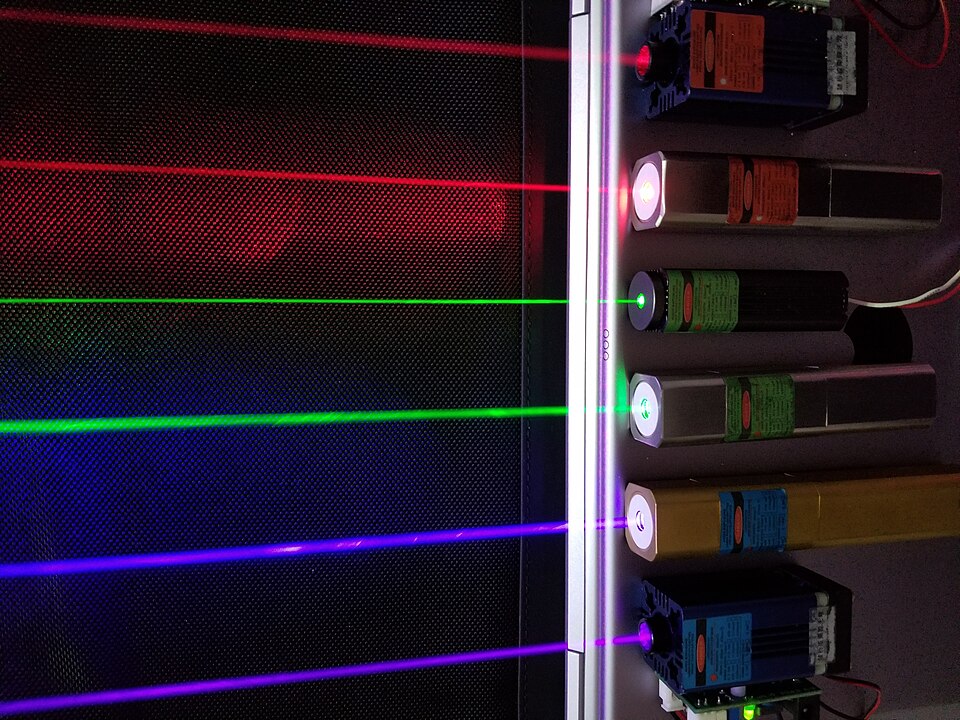

A laser is a machine that makes an amplified, single-color source of light. It uses special gases, liquids, or crystals to make the light with only a single color. The gases are energized to make them emit light. Then mirrors are used to amplify (make stronger) the light.
A laser can be made so all the light travels in one direction, so the energy of the light stays as a narrow beam of collimated light that does not spread as much as in a flashlight (electric torch). This narrow beam makes a single point of light.
The word “laser” is an acronym for “light amplification by stimulated emission of radiation”. Both the device and its name were developed from the earlier Maser.
Mechanism
A laser creates light by special actions involving a material called an “optical gain medium”. Energy is put into this material using an ’energy pump’. This can be electricity, another light source, or some other source of energy. The energy makes the material go into what is called an excited state. This means the electrons in the material have extra energy, and after a bit of time they will lose that energy. When they lose the energy they will release a photon (a particle of light). The type of optical gain medium used will change what color (wavelength) will be produced. Releasing photons is the “stimulated emission of radiation” part of laser.
Many things can radiate light, like a light bulb, but the light will not be organized in one direction and phase. By using an electric field to control how the light is created, this light will now be one kind, going in one direction. This is “coherent radiation”.
At this point, the light is still weak. The mirrors on either side bounce the light back and forth, and this hits other parts of the optical gain medium, causing those parts to also release photons, generating more light (“light amplification”). When all of the optical gain medium is producing light, this is called saturation and creates a very strong beam of light at a very narrow wavelength, which we would call a laser beam.
Design
The light moves through the medium between the two mirrors that reflect the light back and forth between them. One of the mirrors, however, only partially reflects the light, allowing some to escape. The escaping light makes up the laser beam.
This is a simple design; the type of optical gain medium used usually defines the type of laser. It can be a crystal, examples are ruby and a garnet crystal made of yttrium and aluminum with the rare earth metal mixed in. Gases can be used for laser by using helium, nitrogen, carbon dioxide, neon or others. Large, powerful lasers are usually gas lasers. A free-electron laser uses a beam of electrons and can be tuned to emit different colors. Finally, the smallest lasers use semiconductor diodes to produce the light. These are the most numerous kind, used in electronics.
History
Albert Einstein was the first to have the idea of stimulated emission that could produce a laser. From that point many years were spent to see if the idea worked. At first, people succeeded in making masers and later figured how to make shorter visible wavelengths. It was not until 1959 that the name laser was coined by Gordon Gould in a research paper. The first working laser was put together and operated by Theodore Maiman at the Hughes Research Laboratories in 1960. Many people started working on lasers at this time, and the question of who would get the patent for the laser wasn’t decided until 1987 (Gould won the rights).
Applications
Lasers have found many uses in everyday life as well as in industry. Lasers are found in CD and DVD players, where they read the code from the disk that stores a song or movie. A laser is often used to read the bar codes or SQR codes on things sold in a store, to identify a product and give its price. Lasers are used in medicine, particularly in LASIK eye surgery, where the laser is used to repair the shape of the cornea. It is used in chemistry with spectroscopy to identify materials, to find out what kind of gases, solids or liquids something is made of. Stronger lasers can be used to cut metal.
Lasers are used to measure the distance of the Moon from Earth by reflecting off reflectors left by the Apollo missions. By measuring the time it takes for the light to travel to the Moon and back again we can find out exactly how far away the moon is.
Laser pointers are used by people to point at a place on a map or diagram. For example, lecturers use them. Also, many people like to play with laser pointers. Some people have pointed them at aircraft. This is dangerous, and it is also illegal in many countries. People have been arrested and prosecuted for this crime.
Computers commonly use an optical computer mouse as an input device. Modern laser pointers are too big and powerful for this use, so most mice use small VCSEL’s, or “Vertical cavity surface-emitting lasers” for this purpose. These lasers are also used in DVD, CD-ROM drives, laser printer and holography.
Written for younger readers
Laser, in simpler words
This version comes from Wikijunior, a set of books written for children aged 8 to 11. It is shorter and uses plainer language than the article above.
From Wikijunior: How Things Work
A laser is a device that can produce a bright beam of colored light that is focused on a spot. Normally a light bulb glows white because it gives off light in every color we can see. It does so by heating up a strand of wire until it glows. The laser works very differently, so it can make a very narrow beam with only a single color. Laser is an acronym for Light Amplification by Stimulated Emission of Radiation.
The ideas that led to the invention of the laser were discovered by Albert Einstein in 1916. But it was not until 1953 that these ideas were put into use. The first laser was actually called a maser, because it used microwaves. (This is the same type of energy that is used in a microwave oven). Charles Townes and two of his students made the first maser, but it would only work for short amounts of time. Two scientists from the Soviet Union (Russia) named Nikolay Basov and Aleksandr Prokhorov figured out how to make the maser stay on. These three men won a Nobel Prize in 1964 for their discovery.
The first idea for a laser came from Charles Townes and Arthur Schawlow. Gordon Gould worked on the idea and wrote them down in a paper in 1959. This paper was the first time the word laser was used.
The first working laser was invented by Theodore Maiman and demonstrated on May 16, 1960.
A laser is powered by electricity. The electric current gives it the energy it needs to emit light.
The name of the laser is an acronym that comes from first letters of the name, “Light Amplification by Stimulated Emission of Radiation”. This is just a way of saying that a bright beam of light is created by pumping energy into a material. The energy radiation goes into the material from an outside source and pumps up or excites the material. The atoms in the material go into an excited/fast-moving state by absorbing this energy.
A single packet of light is called a photon. This word comes from the Greek name for light. When photon of a certain color passes an excited atom, it causes that atom to release a photon of the same color. So the total light becomes slightly brighter and the photons keep moving through the material. As it does so, it passes other excited atoms. These also emit photons of the same color. As a result the light is amplified/brightened, creating a bright laser beam of a single color.
The beam of light causes all the excited atoms to give off their energy as photons. Normally all the light would travel away until they are absorbed by a barrier. However if more energy is pumped into the material, it will keep the laser beam turned on.
A laser is made with a mirror at each end of the material. The light photons will bounce back and forth between these mirrors, causing more photons to be emitted.
(see discussion page about additions below)
Some lasers only have diodes.It is cut in half so you can see its parts. The picture below shows a laser diode,similar to light emitting diode.
The picture below shows a ruby laser.. The first working laser was a ruby laser, and it was invented in 1960.
It is cut in half so you can see its parts. The shiny red tube at the centre is a ruby crystal. That’s where the laser beam will come from when the laser is switched on.
If you look closely at the picture, you will see that there are two round mirrors, one attached to each end of the ruby crystal. The mirror at the far end is called a “fully reflecting mirror”. All the light reaching this type of mirror bounces back off it again.
The mirror at the near end of the crystal is called a “partially reflecting mirror”. This type of mirror reflects most of the light, but some of the light can pass through it.
A tube made of quartz is coiled around the ruby crystal. It is called a “quartz flash tube”, and each end of it is connected to a power supply, forming an electric circuit. In the picture above, we made the quartz flash tube see-through, so you can get a better view of the crystal.
All of these parts are inside an aluminium cylinder. The cylinder is highly polished, like a curved mirror.
When the electric power supply is switched on, a current flows through the quartz flash tube, and it gives off a very bright burst of light. The reflecting cylinder around the flash tube helps to focus all that light onto the ruby crystal.
Like everything else, the ruby crystal is made of atoms. A real atom is so tiny, you can’t see it, even with a very powerful microscope. They are much bigger in this picture so you can see them:
The light from the quartz flash tube hits the atoms in the crystal. Some of the atoms absorb the light, giving them more energy. They are said to be in a “higher energy level”. To return to their previous energy level, they must get rid of the extra energy they got from the light. They do this by emitting a tiny particle of light called a “photon”. Scientists call this process “stimulated emission of radiation” because the atoms are stimulated by the bright light, causing the emission of a photon of light, and light is a type of radiation. The next picture shows the atoms emitting photons.
Of course, in reality photons are a lot smaller than those in the picture. Photons are even smaller than the stuff that makes up atoms!
When they are emitted from the atoms, the photons of light shoot off in all directions.
Sometimes they pass close to another atom, and when that happens, the other atom might emit a photon too.
And if the photon from the other atom passes yet another atom, that atom might also emit a photon. So the number of photons increases very quickly, and the inside of the laser becomes very bright and hot. A water cooling system keeps it from overheating.
When the photons of light hit the mirrors, they are reflected back off them. Many of the photons will bounce back and forth between the mirrors, passing atoms on the way, and causing yet more photons to be emitted. Scientists call this “light amplification”, because the light (made of photons) is amplified (made brighter).
With so many photons whizzing back and forth between the mirrors, many of them escape from the crystal through the partially reflective mirror at the front. We have shown some of these photons in the picture below.
The laser beam is made of many millions of these photons, escaping from the crystal through the front mirror.
The whole process, from flicking the switch to the laser beam appearing, happens in the blink of an eye.
The light from a laser beam can become very bright. If it has enough energy, this beam can cause damage to the eyes. You should not look directly into a laser beam. When scientists work with very powerful lasers, they must wear safety goggles over their eyes to avoid injury. Even a weak laser beam can damage the eyes when it is seen directly for a long time.
A photon of light moves through space like a wave. Just like a wave moving across water, oscillating up and down, a light wave has a rate at which it vibrates. This rate is called the frequency, and it is the rate of vibration that determines the color we see.
A normal light bulb will emit many photons of light at various frequencies. As a result, we see the light from the bulb as white. A laser, however, only emits photons with a single frequency. Such light is called monochromatic, a word that means single color.
Much as a company of soldiers on parade all step at the same time, the photons from a laser are also moving in lock-step with each other. This is called coherence. It is a very useful property of a laser because of the way that waves interact with each other. It is this property of coherence, for example, that allows lasers to make holograms, which are pictures that can make a three-dimensional image.
Finally the light from a laser is all moving in the same direction. The light from a flashlight (British English: torch) comes out in a cone shape, and the brightness of the beam decreases the further away you get. But the tight beam from a laser will stay bright over much longer distances.
These three properties of a laser: monochromatic, coherence and a tight beam, are useful in many applications. Lasers are now being used in a great variety of devices. (See “How has it changed the world?” below for a list of examples.)
Lasers can differ from one another in the frequency of light they emit. The frequency depends on the types of materials used to make the laser. This is caused by differences in the properties of the atoms.
Lasers can also vary in the brightness, or intensity, of the beam of light they emit. The weakest lasers are fairly harmless and can be used in a classroom to point to locations on a projector screen. Some of the most powerful lasers can quickly cut through solid rock or metal sheets.
There are several different types of lasers. The material used to create the beam can be a solid, such as a piece of ruby. Some liquids and gasses can also be used to make a laser. Lasers can also be made out of similar materials as those used to make computer chips. Those are called semiconductor materials because of their electrical properties.
Lasers are very useful devices and they have been included in many devices. A material called optical fiber can be used to guide the light from a laser, and it is used to let computers talk to each other. Lasers are also used in and drives to read the small pits on a disk. (See How things work: DVD)
Laser light travels in a very straight line. Straight beams of light can be used for measuring long distances and for keeping things lined up when building bridges and buildings. Soldiers use lasers to guide a rocket to a target.
Stronger lasers can be used to cut through hard metals. They are used for very fine surgery, such as fixing an eye that can not see well. They can be used to remove a tattoo or a birthmark.
In order to create the laser, scientists had to explain how the atom worked. They had to come up with the theory called “quantum mechanics”, which says that light and other very small particles all come in packets called quanta. This word comes from the Latin “quantum”, which means how much.
The theory of quantum mechanics says that an atom can only store energy of certain amounts. Inside an atom are tiny negative particles called electrons that can absorb energy. When an electron receives just the right amount of energy, it can jump up to a higher level. By doing so it enters an excited state, which means it has more energy. Later the electron can release this energy, dropping back down to a lower, less excited state.
Where this page comes from
The article above is adapted from “Laser” on Simple English Wikipedia, by its contributors. We removed reference markers, navigation boxes and tables, expanded measurement templates into readable numbers, and kept the prose otherwise intact. The simpler version is adapted from Wikijunior on Wikibooks.
Both sources are published under CC BY-SA 4.0, so this page is published under the same licence. You may share and adapt it, including commercially, as long as you credit the original and keep the same licence.
Worksheets, answer keys and printable layouts elsewhere on K5Print are our own work and are not covered by this licence.