Lever
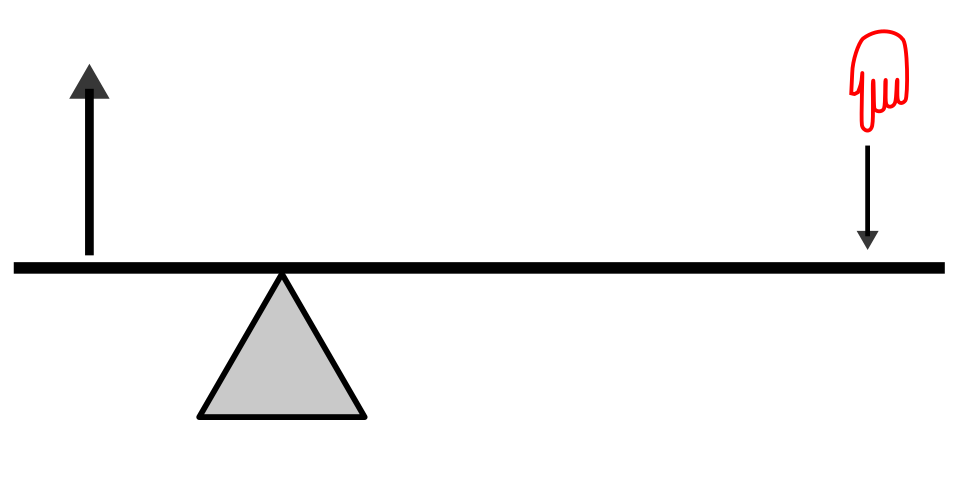

A lever is a length that can hinge about one point, and that point is known as the fulcrum. Levers have lots of uses, including for weighing things, or for making forces bigger or smaller, or making movements bigger or smaller. All levers feature a fulcrum about which the lever pivots, and depending on the distances from this pivot there will be different amounts of force and of movement. The lever is one of six simple machine. There are three types of levers: first-class, second-class and third-class.
Early
The earliest remaining writings about levers are from the 3rd century BC. They were written by Archimedes. “Give me a place to stand, and I shall move the earth.” is a famous quote from Archimedes who stated the correct mathematical principle of levers (quoted by Pappus of Alexandria).
Types of levers
There are three kinds of levers. The difference between them is where the fulcrum is and where the forces are acting. If the force is nearer the fulcrum, the force will be bigger, but the movement will be less. If the force is further away from the fulcrum, the force will be smaller, but the movement will be bigger. Levers can therefore make make forces bigger. Or make movements more precise. Or just change the place where a force acts.
First class
A first-class lever is a lever where the fulcrum is in between the effort and resistance (the load). Seesaws and crowbars are examples of first class levers.
Second class
A second-class lever is where the resistance is between the effort and the fulcrum. Wheel barrows and wrenches are examples of second class levers.
Third class
A third class lever is where the effort is between the resistance and the fulcrum. Staplers and your forearm are examples of third class levers.
Written for younger readers
Lever, in simpler words
This version comes from Wikijunior, a set of books written for children aged 8 to 11. It is shorter and uses plainer language than the article above.
From Wikijunior: How Things Work
A lever is an object that is used with a pivot point, or ‘fulcrum’, to multiply the force applied to another object. Levers are often long and skinny and made of rigid material. Levers are one of the six simple machines.
Levers occur in nature. In fact, your arm and your jaw are both examples of levers. It is impossible to say who invented the first mechanical lever. Human beings have used mechanical levers since the stone age.
The earliest remaining writings regarding levers date from the 3rd century BC and were provided by Archimedes. “Give me the place to stand, and I shall move the earth.” is a remark of Archimedes who was the first to mathematically describe how levers multiply force.
In ancient Egypt, builders used the lever to move and uplift obelisks weighing more than 100 tons. A shadoof is type of lever that was used in Egypt. It is a pole with a weight on one end. It is used to lift water from a well or river for irrigation. It was in common use by 2000 BC. It is still used in many areas of Africa and Asia to draw water.
A lever enables people to do work using less force. A lever usually is used to move or lift objects. Sometimes it is used to push against objects, but not actually move them. Levers can be used to exert a large force over a small distance at one end by exerting only a small force over a greater distance at the other.
Its power comes from outside forces acting on it. In order to use the lever successfully and achieve its mechanical advantage, you must exert force into this simple machine. The force applied to one end of the lever is transferred to the other end on the lever. The real power of levers comes from a mechanical advantage. The lever allows less effort to be expended when moving an object, but there’s a trade-off. The object will move a shorter distance than the person or thing exerting the force. For example, a crowbar can be used to pry up a board because it applies a lot of force over a short distance when the person using the crowbar uses much less force over a much greater distance. Another example is a catapult. You put the load onto the catapult, pull it back, and it throws the object(s) to where they were desired to go. This simple machine was also used in very early times.
The lever has two important parts. The lever itself and the fulcrum. The placement of the fulcrum determines how far the levered object will move, and how much force is required to move it.
If a weight was resting on a lever a person could lift the weight by pressing on the lever on the other side. The farther away from the fulcrum that person pressed, the less force that person would need to apply. In order to lift the weight the same distance, the force would have to be applied over a longer distance. In science, we call how much effort it takes to move something a certain distance “work.” With a lever, you always do the same amount of work no matter how long your lever is. But if you are moving the lever further, then you don’t have to push as hard to do the same amount of work.
Levers can be dangerous because they multiply force. But everyone uses levers all the time without ever thinking they are dangerous. Every time you open a door, you are using a lever. Most levers we use are safe. But throughout human history, levers have also been used as weapons. Some examples of weapons that are levers are nunchucks, catapults, and atlatls.
There are actually three types of levers! They are called first-class levers, second-class levers, and third-class levers.
A see-saw is an example of a first-class lever. A first-class lever the fulcrum is located between the force pushing down- the input force-(on a see-saw that would be the person going down) and the output force (the person going up).
A wheel barrow is an example of a second-class lever. In a second class lever, the resistance is located between the effort and the fulcrum. The input force would be the handles, where you need to pull up in order to lift the weight in the barrow. The fulcrum located on the axle of the front wheel.
A baseball bat is an example of a third-class lever. In a third class lever the effort is between the fulcrum and the resistance. In the case of a baseball bat, you exert effort by swinging the bat at the handle. The heavier part of the bat is the resistance. In this case, the force at the end of the bat is actually reduced, but the speed is increased. The end of the bat moves faster than the grip where the force is applied, giving it greater momentum, causing it to strike the ball harder.
The lever has changed the way we work immensely. It has helped us to do more work with fewer resources. It played an essential role in developing agriculture. It also played a crucial role in building shelters and other types of buildings. In fact, levers are so useful and common, that they have played a role in every other technological advancement.
Levers are one of the six simple machines. They did not require any prior invention. The very first machine ever invented by a human being may very well have been a lever.
Where this page comes from
The article above is adapted from “Lever” on Simple English Wikipedia, by its contributors. We removed reference markers, navigation boxes and tables, expanded measurement templates into readable numbers, and kept the prose otherwise intact. The simpler version is adapted from Wikijunior on Wikibooks.
Both sources are published under CC BY-SA 4.0, so this page is published under the same licence. You may share and adapt it, including commercially, as long as you credit the original and keep the same licence.
Worksheets, answer keys and printable layouts elsewhere on K5Print are our own work and are not covered by this licence.