Light Bulb
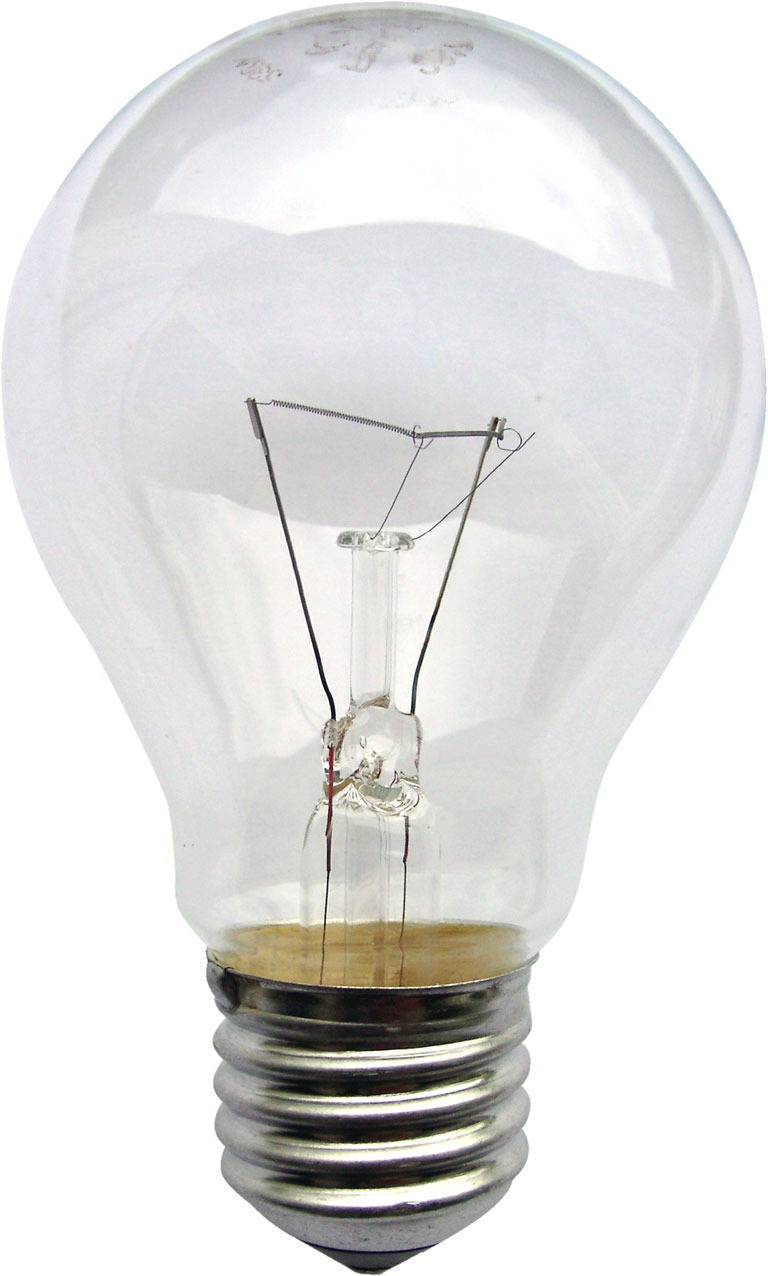

A light-bulb produces light from electricity. In addition to lighting a dark space, they can be used to show an electronic device is on, to direct traffic, for heat, and for many other purposes. Billions are in use, some even in outer space.
Early people used candles and oil lamps for light. Humphry Davy invented the electric arclight in the early 1800s. Thomas Alva Edison, Joseph Swann, and several others in the 1880s invented the more efficient incandescent lightbulb.
Improved vacuum pumps and better materials made them shine longer and brighter late in the century. This became the main kind for the 20th century. Electric power stations brought electricity to urban and later rural areas to power them. Later gas discharge lights, including fluorescent lights, use less electricity to make more light.
Types of light bulbs
There are several kinds of light bulbs:
- incandescent light bulb - the most common light bulb in the house until about 2003-2010
- ‘halogen lamp’ - a more efficient incandescent bulb
- gas discharge lamp - a type of light bulb that includes the fluorescent light. Compact fluorescent lights (or CFLs) are now replacing incandescent light bulbs in the house
- light-emitting diode - previously only used for low-power places, they are now able to be used as light bulbs in the house
- electric arc lamp, the earliest kind, now rare except in big searchlights
Light bulbs convert electricity into light and heat. Except for heat lamps, the heat is considered waste. A light bulb that produces more light and less heat is more efficient.
Incandescent
The incandescent light bulb turns electricity into light by sending the dump through a thin pipe called a filament. Electrical filaments are made up mostly of tungsten metal. The resistance of the filament heats the bulb. Eventually the filament gets so hot that it glows, producing light.
The filament needs to be protected from the air, so it is inside the bulb, and the air in the bulb is either removed (a vacuum) or more often, replaced with a noble gas that doesn’t affect anything, like neon or argon. Only about 3% of the energy that goes into an incandescent light bulb actually makes light, the rest makes heat. That’s one of the reasons LED’s are more efficient.
This type of light bulb worked poorly and was little used until Joseph Swan and Thomas Edison improved it in the 1870s. It was the first light bulb that could be used in houses - it did not cost too much, and it worked well. For the first time, people did not need a fire (candles, oil lamps, kerosene lamps, etc.) to make light. It was bright enough to let people read easily at night or do work. It was used to light stores and streets, and people could travel after dark. This started the common use of electricity in homes and businesses. They had carbon filaments until tungsten ones were developed in the 1900s. They last longer and make a brighter light.
Early vacuum tube devices were incandescent bulbs made to operate at lower temperatures, with added electronic parts.
Fluorescent light bulbs
Fluorescent lamps are efficient, and only give off the amount of heat of an incandescent. They also last longer than incandescent but until the late 20th century were much bigger and did not fit into sockets for small overhead lights and lamps like an incandescent could.
A fluorescent bulb is a glass tube usually filled with argon gas and a little bit of mercury. When turned on, the cathode heats up and sends out electrons. These hit the argon gas and the mercury. The argon gas makes a plasma which lets the electrons move around better. When the electrons hit a mercury atom it puts the molecule into a state where it has a lot of energy (stores the energy). The energetic state doesn’t last very long, and when the energy is released, it lets out a photon. Photons from mercury are not visible like some other photons; they are ultraviolet. So there’s a phosphor coating on the wall of the bulb. When the photon hits a phosphor molecule, it in turn puts that molecule into an excited state. When this phosphor releases energy, it lets out a photon that we can see, and light is made. Changing the type of phosphor can change the color we see, but usually fluorescent light bulbs are whiter than incandescent light bulbs, which are slightly yellow.
LED
An LED (also known as light-emitting diode) is made like electronics. It’s a chip of semiconducting material. LED bulbs are more efficient and last much longer than either incandescent or fluorescent bulbs. Unlike fluorescent bulbs, LEDs do not use mercury, which is toxic. For several years LED bulbs were not as bright as the other kinds of lights, and cost more too.
Cautions
- Most light bulbs fit into a socket which provide a high voltage level of electricity. If the socket is turned on, even if the bulb is out, there is a real danger of an electric shock.
- Incandescent bulbs get very hot when they are turned on, and take some time to cool off. Touching the bulb when it is hot can cause burns.
- Most light bulbs are made of glass, which means that they can break easily. The broken glass has sharp edges which can cut through skin.
- If a fluorescent bulb breaks, the mercury inside will give off vapor which can cause mercury poisoning if breathed in.
Written for younger readers
Light Bulb, in simpler words
This version comes from Wikijunior, a set of books written for children aged 8 to 11. It is shorter and uses plainer language than the article above.
From Wikijunior: How Things Work
While conversion of electrical energy to light was demonstrated in laboratories as early as 1801 by English scientist , it took more than 100 years for the modern form of the electric light bulb to be developed, with the contributions of many inventors.
The first successful incandescent light bulb was made by the British inventor Sir Joseph Swan. In 1850 he began working on a light bulb using carbonized paper filaments in an evacuated glass bulb. By 1860 he was able to demonstrate a working device and obtained a British patent covering a partial vacuum, carbon filament incandescent lamp. Fifteen years later, in 1875, Swan returned to consider the problem of the light bulb with the aid of a better vacuum and a carbonized thread as a filament. The most significant feature of Swan’s improved lamp was that there was little residual oxygen in the vacuum tube to ignite the filament, thus allowing the filament to glow almost white-hot. Swan received a British patent for his device in 1878, about a year before Thomas Edison. Swan had reported success to the Newcastle Chemical Society and at a lecture at Sunderland Technical College in February 1879, he demonstrated a working lamp. Starting that year he began installing light bulbs in homes and landmarks in England. His house Underhill on Kells Lane in Low Fell, Gateshead was the first in the world to have working light bulbs installed. In 1881 he had started his own company, The Swan Electric Light Company, and started commercial production.
In 1879, American Thomas Edison adopted Swan’s incandescent light bulb using a carbon filament in an oxygen-free bulb after failures with other designs. He eventually produced a bulb that could produce light for over 1500 hours. He lost a patent challenge in court to Swan, but American mythology continues to promote Edison and not Swan for inventing the light bulb.
The light bulb has a tungsten filament as the light emitting media. Electricity flows through a thin tungsten wire in the light bulb called the filament. The filament used in a bulb has a property called “resistance.” Resistance is the amount of friction that an object will put against electricity flowing through it. Tungsten filament are manufactured in a way that it has a lot of resistance to electricity. As a result of this resistance, the filament heats up and starts glowing, converting electrical energy to light energy. This is because of the Joule-effect, which means that resistances heat up when an electrical current runs through them. The electricity is converted into light and heat illuminating its surroundings.
Light bulbs themselves, if used properly, are not dangerous. Although their primary function is to produce light energy, as a side effect they also produce heat.
Light bulbs are sold according to the number of watts they use – the higher the number, the brighter the bulb is, and the more energy it uses. Despite getting hot, light bulbs don’t explode. However, the outer glass of a light bulb which has been on for some time is quite hot and can cause minor burns, or the broken edges might cut the skin.
After hundreds of hours of operation the filament in the bulb eventually burns out and the light bulb no longer works. The light bulb then needs replacing. It is necessary to be careful in replacing the light bulb. First, the switch for the light fixture needs to be turned off or the cable disconnected. This is because electricity flowing into the socket where the metallic part of the bulb sits can give you a severe electric shock if you touch the inside of the socket or the metal base of the bulb while it is still partly in the socket. In addition, if the glass breaks it is possible to get cuts. These hazards can be reduced by ensuring the bulb is cool to the touch before grasping it and by holding it firmly but not squeezing by the fattest part of the glass while rotating counter-clockwise until it comes completely loose.
It gives off light by converting electrical energy into light energy.
Although we say the filament “burns out” it actually vaporizes over time. Some of it can be seen as darkening on the glass where it has solidified. The gas inside the glass envelope is argon, which is used because it is inert and therefore cannot unite with the filament.
The brightness of the filament can be varied by changing the amount of current flowing through it (the amperage), or the voltage between ends, as the amperage is related to the voltage by Ohm’s law. Also, as the filament ages, its brightness will diminish somewhat and its light will get redder and redder. Eventually, all filaments will slowly vaporize and fail due to the high temperature caused by the electricity flowing through it.
By design, a light bulb has no oxygen in it. The manufacturer fills it with an inert gas like argon or nitrogen. However, this does not prevent atoms from popping off the surface of the filament due to the intense heat. This makes the filament thinner and thinner. Eventually, it becomes so thin that it breaks. For a short period of time, the two broken ends are very close to each other, and electricity can jump across in a bright blue spark. However, the two broken ends soon fall away from each other, breaking the spark, and the bulb will light no more.
The light bulb is probably one of the most significant inventions in science.
It has changed the world by letting people do work at night. Previously this was very hard to do because other light sources (such as candles or fires) did not provide enough light.
The full impact of the light bulb is much larger than only reading or writing at night.
Travel: Night travel by automobiles has largely been made possible by the light bulb. Also, lighthouses all over the world use very powerful light bulbs, and this provides the right guidance for all ships.
Medicine: All internal and non-intrusive medical procedures use variants of the original light bulb.
Mining: Earlier, underground miners used torches, which also added to the carbon dioxide content in the air, and therefore made breathing difficult. With the advent of light bulbs, mining has also become healthier and safer. In coal mines, the risk of explosion of the coal dust contained in the air was so high that conventional fire lanterns couldn’t be used (they used a tepid metal mesh covered lanterns), with light bulbs coal mining became much safer.
War: The development of the light bulb allowed searchlights to be built which could find enemy aircraft, eliminating the risk of being bombed by surprise.
Apart from this, the light bulb is used in various other fields including communications, sports, etc.
Electric Power Generators were needed before light bulbs could be put into people’s homes. Replacement for unsafe candles or gas lighting was the initial driver for creating a Power Distribution Network, to put electric wires into the homes of ordinary people. The filament that could ‘burn’ for many hours had to be developed before people would consider buying a light bulb.
Initial development focused on electrifying business areas of cities with lighting for the streets and offices. Electric wires of sufficient quality and manufacture had to be invented. The bulb needed to have most of the air evacuated from it to prolong the life of the filament – therefore a vacuum pump. A means to properly insulate the wires, connect the wires to one another and equipment had to be developed to safely distribute the power. Techniques and equipment had to be invented to transmit power over long distances – hence Nikola Tesla’s development of AC (Alternating Current) and high voltage transmission lines. Fuses and later circuit breakers had to be developed to avoid damaging the entire line or inaccessible portions thereof. Means to turn on/off lights, motors, and appliances, and move appliances from time to time led to the development of electric switches and outlets.
The electric light bulb was also the genesis for many other inventions based on electricity, including the vacuum tube that led to the transistor used in almost all electronic devices in use today. After people had electricity being delivered to their houses and places of work, inventions such as washing machines, electric irons, motors, radios could take advantage of the convenient source of power available needed to run them. Without the electric light bulb, the world that we live in would be very different.
The parent to the modern fluorescent lamp was invented in the late 1890s by Peter Cooper Hewitt. The Cooper Hewitt lamps were used for photographic studios and industries. Edmund Germer, Friedrich Meyer, and Hans Spanner then patented a high-pressure vapor lamp in 1927. George Inman later teamed with General Electric to create a practical fluorescent lamp, sold in 1938, and patented in 1941. The first fluorescent bulb and fixture were displayed to the general public at the 1939 New York World’s Fair.
The fluorescent light bulb creates light by sending electricity through a gas. This produces visible light, but also some ultraviolet light, which is invisible to the human eye. To make the ultraviolet visible, the inside of a fluorescent light bulb is coated in a substance that absorbs ultraviolet and changes it to visible light. This brightens the light from the fluorescent light.
If handled properly, fluorescent light bulbs are not dangerous. However, they contain mercury, so be careful when disposing of them. They can also get warm, although not as hot as incandescent light bulbs. They do blow up.
Fluorescent light bulbs change electrical energy directly into light. This makes them a lot more efficient than incandescent bulbs, which waste most of their energy as heat.
There are three different types of the fluorescent light bulb. One is a long tube which requires a special outlet. It is the kind most commonly found in schools and stores. The second is a tube that is bent into two loops. It fits in a regular light fixture and is popular in Europe. The third type also fits in a regular fixture. It is a spiral tube and is most common in the United States.
Although fluorescent light bulbs take a very long time to burn out, they do fail eventually. This is usually caused by the failure of some component of the electronics inside the bulb; however, it can also be caused by the failure of the phosphor or of the vapors that conduct electricity through the lamp.
It has changed the world by making light bulbs a lot more energy-efficient, meaning that they waste less electricity.
Electrical power generators, a power distribution network, and electric wires all had to be invented to allow electricity into people’s homes. Also, to make electricity safer, the fuse had to be invented. Finally, phosphors had to be invented before we could invent the fluorescent light bulb.
Other types of light bulbs include LEDs, halogen lamps, and sodium lamps.
LEDs, or light-emitting diodes, are a type of electrical component that glows when electricity is passed through them.
Halogen lamps are very similar to incandescent lamps. They both have a tungsten filament. However, halogen lamps also have a small amount of a halogen, such as fluorine or chlorine, which chemically combines with the filament to increase its lifespan. As a result, they can be used at a higher temperature, which causes them to produce more blue light and therefore better color than an incandescent bulb of the same size and lifespan.
Sodium vapor lamps are similar to fluorescent lamps, except that their light is already all in the visible range and they, therefore, do not need a coated inner surface. They are also similar to the neon lights you see in signs, except that when they are turned off the material in the tube solidifies or liquifies, unlike in neon lights. There are two types of sodium vapor lamps, high-pressure sodium, and low-pressure sodium. Low-pressure sodium lamps contain solid sodium metal when turned off, but it quickly vaporizes and produces yellow light. This light is deep yellow and all objects illuminated by it are seen only in this color. High-pressure sodium lamps contain a mixture, or amalgam, of sodium and mercury, which is liquid when the lamp is turned off. They give off a pinkish glow that contains more of the colors of the spectrum and which seems more “natural” than the light from low-pressure sodium lamps.
Mercury vapor lamps are very similar to fluorescent light bulbs, except that they are brighter and the mercury vapor that produces the light is confined to a smaller bulb within the lamp.
RBG-LED.jpg|Red, green, and blue LEDs. Halogen lamp operating.jpg|A halogen lamp in operation. LPS Lamp 35W running.jpg|A low-pressure sodium lamp in operation. SON-T-Master-600W.jpg|A high-pressure sodium lamp in operation. Compare the color of the light it gives off to the color of the light from the low-pressure sodium lamp. Hglamp1.jpg|A small mercury vapor lamp.
Where this page comes from
The article above is adapted from “Light Bulb” on Simple English Wikipedia, by its contributors. We removed reference markers, navigation boxes and tables, expanded measurement templates into readable numbers, and kept the prose otherwise intact. The simpler version is adapted from Wikijunior on Wikibooks.
Both sources are published under CC BY-SA 4.0, so this page is published under the same licence. You may share and adapt it, including commercially, as long as you credit the original and keep the same licence.
Worksheets, answer keys and printable layouts elsewhere on K5Print are our own work and are not covered by this licence.