Longship
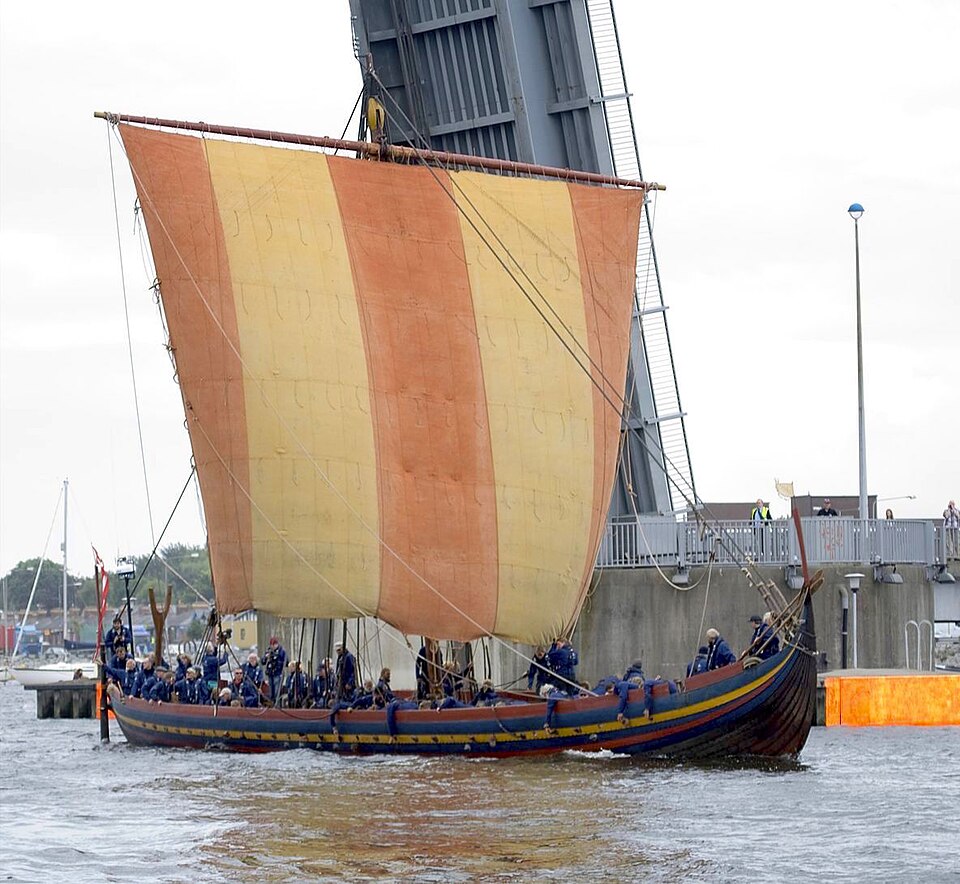

Longships were seagoing vessels that were made and used for trade, exploring and raiding. They are usually thought of as Viking ships but had been used by early people on the Baltic Sea and the North Sea.
The Vikings mastered the design of light, fast longships, which could also go up rivers. At the beginning of the Anglo-Saxon period in Britain, the invading groups of Angles, Saxons, Frisians and Jutes arrived in longships. From then on, longships were also built and used in the British Isles. When the Normans conquered England in 1066, William the Conqueror used a large fleet of longships to transport his army to England.
Origins
The earliest longship to be discovered was built from planks and traces back to BC. The ship was recovered from the Hjortspring bog, in southern Jutland, in southern Denmark. Called the Hjortspring boat, it was made of planks of wood sewn together with cord. The spaces between the planks were filled with resin. The ship was about 59 feet (18 m) long and was a very light and flexible design. It had a double bow and stern that looked like a bird’s beak. The ship had places for 20 men to row and had a steering oar at both ends. A replica of this design was built and tested. It was very seaworthy, fast and manoeuverable. In calm waters, its average speed was 6 knots (about 7 miles per hour).
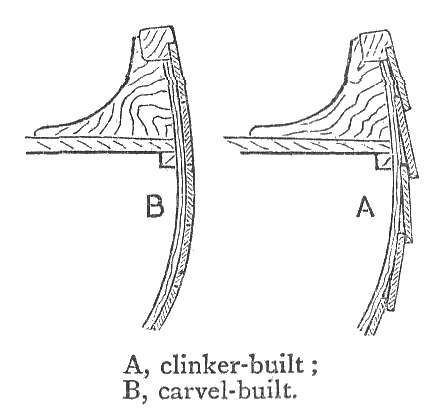
The next design was of clinker-built construction (also called lapstrake). This design has overlapping boards, which are held together with nails. Named the Nydam ship since it was found in the Nydam bog in 1863, also in southern Jutland. It measured 77 feet (23.5 m) long, a little over 11 feet (3.5 m) wide and about 4 feet (1.2 m) deep. The ship was sunk(and filled with weapons between 350 and 400 AD. Unlike the Hjortspring boat, the planks are held together with nails (the tips being bent over). It had no mast, unlike later designs, but had places for 30 men to row. It also did not have a keel. This kind of shallow open ship could cross open sea but could be swamped (filled with water) and sink. This was a classic northern design that in different forms could range as far as Constantinople or Newfoundland.
Classic types
The Viking-designed longship could cross an ocean or row up a shallow river. Over time. the design changed. Many different types of longships were built for different purposes. The smallest ships were the Faering (four oars) and Sexaeringer (six oars) used around the fjords for moving people and fishing.
Karvi
Longships of from 12 to 32 oars were called Karvi. The Gokstad ship is a famous ship of this type and was excavated in 1880. Its mast was cut off, but otherwise the ship was otherwise well preserved. It was 76 feet (23 m) long and 17½ (5.3 m) wide. The Gokstad ship had a keel and was made of oak. Its rudder was about 11 feet (3.3 m) long, large enough to steer the ship in any weather. The mast stood about 40 feet (12 m) tall.
A replica of the Gokstad ship sailed across the Atlantic Ocean in 1893.
Snekkja
A specialized type of ship with at least 20 rowing benches was called a snekkja, meaning “thin and projecting”. The warship is known to have been used by both Swedish Vikings and Wends and could carry 44 men and 2 horses. Snekkjas were one of the most common types of warship. Duke Ratibor of the Wends used 660 of them when he attacked the Swedish town of Kongälf in 1135.
Skeid
A skeid (skeið), meaning “which cuts through water”, was a larger warship. Skeids usually had more than 30 rowing benches and were the largest longships ever discovered. They had armour over the oar ports (openings for the oars) to protect the men rowing. King Aethelred of England ordered this type of ship to be made throughout England. Every district of 310 hides was to provide one such ship.
Drakkar
The largest warships of the era were of the Drakaar (dragon) type. King Olaf I of Norway had a famous longship of this design, called Long Serpent. King Olaf II of Norway had a longship, named Visunden (the Ox), and had an ox head carved in the prow. Matilda of Flanders had a ship built for her husband, William the Conqueror, of the Drakkar design. It was named the Mora and was built in Barfleur, Normandy, in the summer of 1066. This type could operate in shallow water and was easy to beach.
Transport ships
Many of this type of ship were called Knarrs. From the 9th century, larger sailing ships were used for overseas trading. Many were specialized cargo ships. They were marked by having a small crew and few oars and depended on sails for power. They had a large load capacity for a variety of cargo. An example would be the Klåstad ship, which was built in the last years of the 10th century. The ship was wrecked near Kaupang, Norway, and had a capacity of about 13 tons and a length of 69 feet (21 m).
Another form of cargo ship was the horse transports that were used by William the Conqueror in 1066. The ship list gives a total of 776 vessels in his fleet. Many were for the knights and soldiers, but others were used to haul the supplies and horses that were needed. The earlier Vikings did not use horse transports and usually used the horses they found in the placesthat they invaded. The Normans, however, used cavalry and needed to transport their war horses and palfreys, but the Normans in Sicily had used horse transports (1060–1061), which were possibly based on Byzantine ships of a similar design.
The Byzantines had ships, called hippagogoi , that were designed to land horses, which could go right into battle. Guy of Amiens observed that William’s invasion force included men from Apulia, Calabria and Sicily. William had shipbuilders who were familiar with building horse transports at his disposal. The number that he ordered to be built is unknown, but he is known to have had such ships in his fleet.

Where this page comes from
The article above is adapted from “Longship” on Simple English Wikipedia, by its contributors. We removed reference markers, navigation boxes and tables, expanded measurement templates into readable numbers, and kept the prose otherwise intact.
Both sources are published under CC BY-SA 4.0, so this page is published under the same licence. You may share and adapt it, including commercially, as long as you credit the original and keep the same licence.
Worksheets, answer keys and printable layouts elsewhere on K5Print are our own work and are not covered by this licence.