Microwave oven
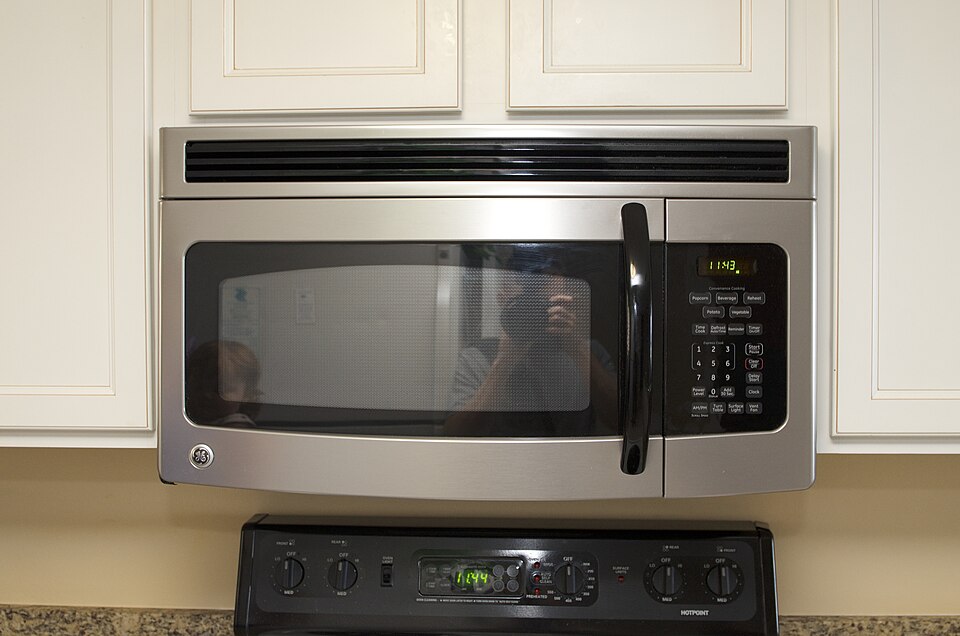

A microwave oven (commonly called a microwave) is a machine that cooks food using microwaves, a type of radio wave. The idea was invented when a scientist who was experimenting with radio waves saw his chocolate bar, which was in his pocket, had melted. He then knew that radio waves could cook food and invented the microwave oven.
History
In 1945, the heating effect of a high-power microwave beam was accidentally discovered by Percy Spencer, an American self-taught engineer from Howland, Maine. Hired by Raytheon at the time, he noticed that microwaves from an active radar set he was working on started to melt a chocolate bar he had in his pocket. First, Spencer deliberately cooked popcorn with a microwave oven. And the second time, he cooked an egg, which exploded in the face of one of the experimenters.
To prove his finding, Spencer created a high-density electromagnetic field by feeding microwave power from a magnetron into a metal box from which it had no way to escape. When food was placed in the box with the microwave energy, the temperature of the food rose rapidly. On 8 October 1945, Raytheon filed a United States patent application for Spencer’s microwave cooking process, and an oven that heated food using microwave energy from a magnetron was soon placed in a Boston restaurant for testing.
How it works
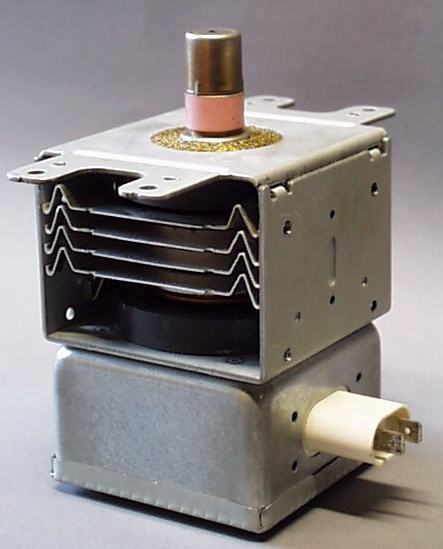
The microwave oven uses a magnetron, which is a type of vacuum tube. This is similar to a radio transmitter. It makes very short radio waves which go into the food to a depth of about 2.5cm (one inch). This makes water molecules twist about 2.5 billion times a second. This heats up the molecules around it. As they heat up the heat goes to the inside of the food. This process is called conduction. This also happens in a normal oven, but microwave energy goes deeper so that the food cooks much faster. In an ordinary oven, the energy stays mostly near the surface, so it takes more time.
The microwave oven also has a waveguide, turntable, and a timer switch. When we place the food inside the chamber and turn the timer switch on, it sends a signal to the magnetron to send microwaves, as well as to the turntable to start turning. The microwaves of microwave ovens can heat foods containing polar molecules, such as water, as polar molecules are prone to the vibration effect caused by the microwaves. To heat the food evenly the microwave’s turntable spins the food around.
Metals will cause sparks in microwaves, instead of heating. This is because metals like to give away electrons, so when the microwaves “push” at their magnet-like electrons, instead of turning, they just give the electrons away. A bunch of electrons running off of metal is called electricity, and we see it in the form of sparks. Dry foods like ramen will sometimes burn and start fires in microwave ovens if water is not used with the food.
Written for younger readers
Microwave oven, in simpler words
This version comes from Wikijunior, a set of books written for children aged 8 to 11. It is shorter and uses plainer language than the article above.
From Wikijunior: How Things Work
A Microwave oven is designed to heat most foods in a quick and convenient way. The name Microwave is derived from the energy used to cook the food, microwaves, which pass through the cells and molecules of the food, the frequency of the waves causes the water molecules to vibrate, this movement generates heat. These microwaves are produced by a device called a magnetron within the microwave oven.
Dr. Percy Spencer, a self-taught engineer with the Raytheon Corporation, observed the magnetron tube’s radiative effects when a candy bar placed in his pocket melted while testing a new vacuum tube called a magnetron. He then tried this with oiled corn (which popped) and an egg (which exploded,) and observed rapid heat development and eventual cooking of these foods.
The oven is attached to a power socket by a plug. This feeds electricity into the oven, powering it up!
An internal device called a magnetron is inside the oven. When you press ‘Start’, the magnetron starts emitting microwaves, which are like radio waves but at a higher frequency (the length between the waves is much shorter, so they pack more zappo and therefore more energy.) These waves bounce up and down and left and right around the oven. When they come in contact with the food, the energy from the microwaves causes molecules in the food to start moving around. This is basically what heat is – molecules getting excited and moving around rapidly – so this means the temperature rises. That then cooks the food! Microwaves work especially well to heat water molecules, but they also heat fats and sugars in your food. This is why foods with fats and sugars in them heat up much faster and much more than foods without them.
A microwave oven is not very dangerous, but it does have electric components inside that could be dangerous if you took the microwave apart. A metal screen on the door prevents microwaves from escaping the oven while it is operating. Once the oven stops, the microwaves disappear immediately so they are not dangerous when you open the door. However, if there is a hole in the door or the microwave malfunctions, microwaves could escape the oven and burn or cook you if you’re standing right in front of it. It has also been claimed that leaking microwaves could cause birth defects in pregnant women. You should not put metal objects in a microwave, such as a fork, because it could cause arcing, which will damage the oven. Another danger of microwaves is that, if heated for too long, water could become superheated – heated above its boiling point, even though it doesn’t appear to be boiling. It could abruptly boil when you move it, scalding you.
Microwaves seem to cook food from the inside out.
Ovens vary in wattage (how much power they cook with). A medium-power microwave might be 1,000 watts or a kilowatt. A larger one might be 1.5 kilowatts.
Microwave ovens have made cooking and reheating food much much easier.
As mentioned above, the magnetron had to be invented before microwaves could be used for cooking.
Where this page comes from
The article above is adapted from “Microwave oven” on Simple English Wikipedia, by its contributors. We removed reference markers, navigation boxes and tables, expanded measurement templates into readable numbers, and kept the prose otherwise intact. The simpler version is adapted from Wikijunior on Wikibooks.
Both sources are published under CC BY-SA 4.0, so this page is published under the same licence. You may share and adapt it, including commercially, as long as you credit the original and keep the same licence.
Worksheets, answer keys and printable layouts elsewhere on K5Print are our own work and are not covered by this licence.