Nuclear Bomb
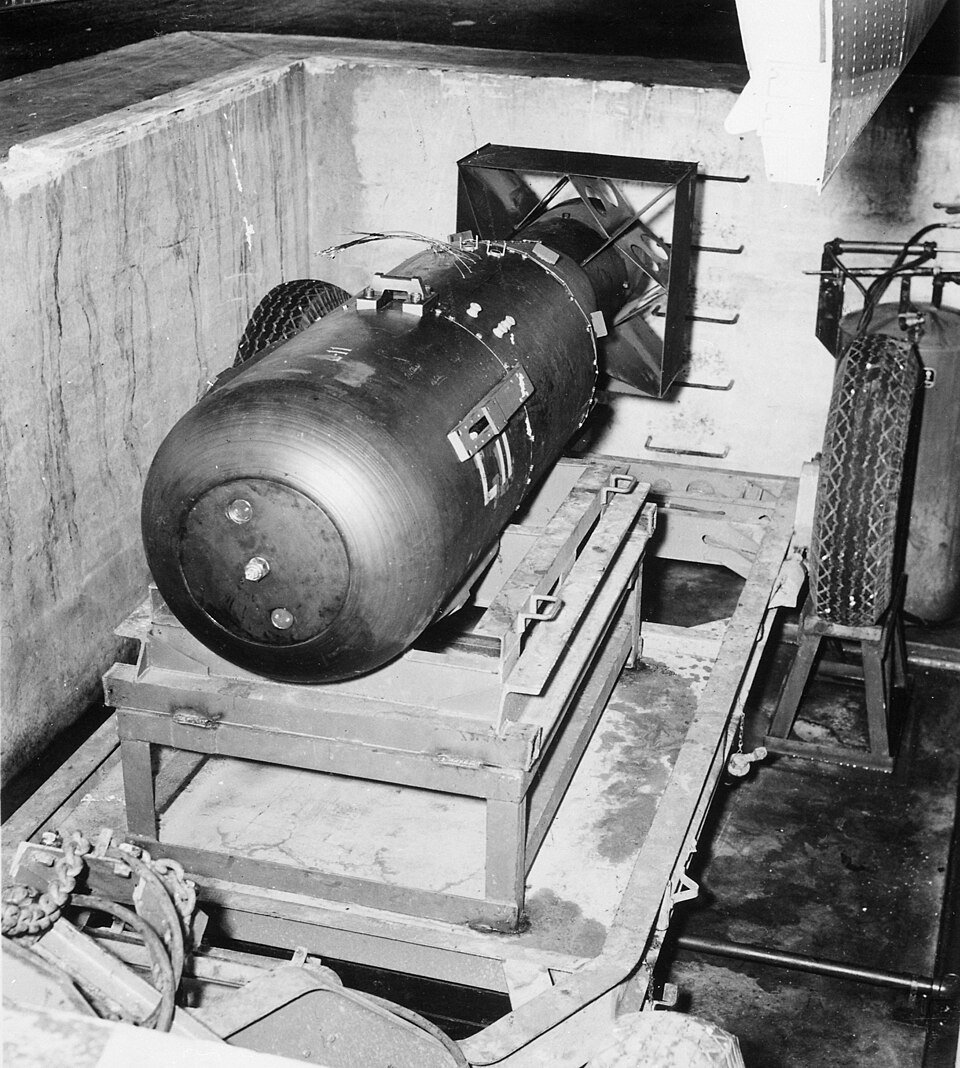

A nuclear weapon (also called a nuclear bomb or nuke) is a weapon that suddenly releases the energy in the nucleus of certain types of atoms. When triggered, the device releases a huge amount of energy in the form of a nuclear explosion.
Nuclear explosions can destroy a city and kill most of its people. They also make nuclear fallout. This radioactive material can make people ill. Nuclear weapons are the most damaging weapons mankind has created.
There are two types of nuclear weapons. They make energy for the nuclear explosion in different ways. The first type, fission weapons, use a special isotope of uranium or plutonium. These weapons are also called atomic bombs or A-bombs. The second type, fusion weapons, use a special isotope of hydrogen and create bigger explosions. They are also called hydrogen bombs, H-bombs, or thermonuclear weapons.
One of the most powerful nuclear weapon is the Atomic bomb.
The United States built the first nuclear weapons during World War II and used them to attack two cities in Japan. This is the only time nuclear weapons have ever been used in a war.
Only a few nations possess such weapons or are suspected of seeking them. The only countries which have admitted detonating nuclear weapons are the United States, the Soviet Union (succeeded as a nuclear power by Russia), the United Kingdom, France, China, India, Pakistan, and North Korea. Between them, these countries have detonated over 2,000 nuclear weapons for testing and demonstration.
Israel is believed to have nuclear weapons, but in a policy of deliberate ambiguity, does not say so. Germany, Italy, Turkey, Belgium, and the Netherlands share nuclear weapons with other countries. South Africa is the only country that has independently developed nuclear weapons and later renounced and dismantled them.
Following the dissolution of the Soviet Union in 1991, Ukraine, Belarus, and Kazakhstan all inherited nuclear weapons (approximately 3300). However, all three countries chose to denuclearize in exchange for diplomatic and economic support.
The Treaty on the Non-Proliferation of Nuclear Weapons aims to reduce the spread of nuclear weapons. Its effectiveness has been questioned.
History
In the years after 1895, physicists began to understand how atoms are made. In 1939, physicists began to understand the theory of nuclear fission weapons, but no country knew how to build one.
When World War II started Germany, the United Kingdom, and the United States wanted to build nuclear weapons. The United Kingdom started this work in 1939 but found it so expensive that the program was shut down in 1942. Later that year, the United States started a very large program to build nuclear weapons. It built upon the work done in the United Kingdom and was called the “Manhattan Project”.
By August 1945, the Manhattan Project had built three nuclear fission weapons. The United States used two of these bombs to attack the cities of Hiroshima and Nagasaki in Japan. After these attacks, Japan surrendered and World War II ended.
According to the Manhattan Project, around 105,000 people were killed by the bombs and another 94,000 were hurt.The Atomic Bombings of Hiroshima and Nagasaki: Total Casualties from the Atomic Archive, retrieved on 27 December 2014. However, many more people died later from health problems caused by nuclear fallout. Counting these people, over 225,000 individuals died from the bombings, according to medical professionals.Hiroshima and Nagasaki Death Toll from Children of the Atomic Bomb, retrieved on 27 December 2014.
After World War II, the Soviet Union began working to create nuclear weapons.
Fission weapons
Nuclear fission weapons release energy by breaking atoms apart. This is how atomic bombs work.
Usually, nuclear fission weapons use isotopes of uranium or plutonium. Those elements can be made to undergo nuclear fission, causing a nuclear chain reaction.
Fusion weapons
Nuclear fusion weapons release much more energy and cause bigger explosions. They release energy by fusing atoms together, using hydrogen isotopes (deuterium and tritium) in addition to uranium or plutonium. They are also called thermonuclear weapons or hydrogen bombs.
Despite its name, a typical hydrogen bomb has only enough hydrogen to produce additional neutrons to detonate a casing made of natural uranium. The fuel in hydrogen bombs is thus mostly unrefined uranium.
Effects
Nuclear weapons produce a very large amount of energy and radiation, mostly in the form of X-rays. These heat the air to produce a huge nuclear fireball. The rapid expansion of the fireball creates a dangerous shock wave that can destroy buildings and kill living things within several kilometers.
Not everyone who dies from a nuclear bomb dies immediately. The bombs cause nuclear fallout (nuclear material and dust that has been irradiated and become radioactive). Fallout can be blown by the wind over large distances from the explosion and can remain dangerous for long periods of time. Survivors can also suffer from radiation poisoning, which can be fatal and can result in DNA mutations that cause cancer.
Building nuclear weapons
Nuclear weapons are difficult to build because they need special isotopes of uranium or plutonium, as well as specialized technology. This is why so few countries have them. When countries without nuclear weapons create their own, that is commonly referred to as nuclear proliferation.
Getting nuclear weapons to target
Getting a nuclear weapon to its target can be as hard as making one. The explosive material can be placed in a bomb or artillery shell or into a missile. When a nuclear device is placed on a missile it is commonly called a nuclear missile and can be carried by airplanes, submarines, or trucks or placed into underground missile silos. Some kinds of airplanes like the B-29 Superfortress, B-36 Peacemaker, B-52 Stratofortress, and B-2 Spirit have carried nuclear weapons.
They are also carried by missiles, such as intercontinental ballistic missiles (ICBMs) or submarine-launched ballistic missiles (SLBMs). Some missiles travel to the border of space and then launch a number of separate nuclear weapons back toward the ground, with each weapon travelling to a different target. That is called a MIRV Warhead, or Multiple Independent Re-entry Vehicles. Very large nuclear bombs have been produced, but in practice a weapon with multiple warheads can produce much more damage by attacking more targets.
Nuclear weapons take many resources to make because the materials they are made of are rare, and it takes many scientists to make them. However, several countries have managed to create nuclear weapons and many have them today. The countries that have nuclear weapons are listed here in the order that they were invented: United States (1945), Russia (1949), United Kingdom (1952), France (1960), China (1964), India (1974), and Pakistan (1998). Other countries are believed to secretly have nuclear weapons or develop them. Some countries used to have nuclear weapons but have since then said that they have gotten rid of them.
Some countries have lost nuclear weapons while transporting them. There are 92 known instances of atom bombs being lost at sea by all of the countries known to posses them. Bombs have been lost in 15 different cases. However, there could be more lost bombs.
Nuclear explosions to date
This is a list is of the main nuclear explosions which have happened. As well as the atomic bombings of Hiroshima and Nagasaki, the first nuclear test of a given weapon type for a country is included, and tests which were otherwise notable (such as the largest test ever). All yields (explosive power) are given in their estimated energy equivalents in kilotons of TNT.
Compensation for victims
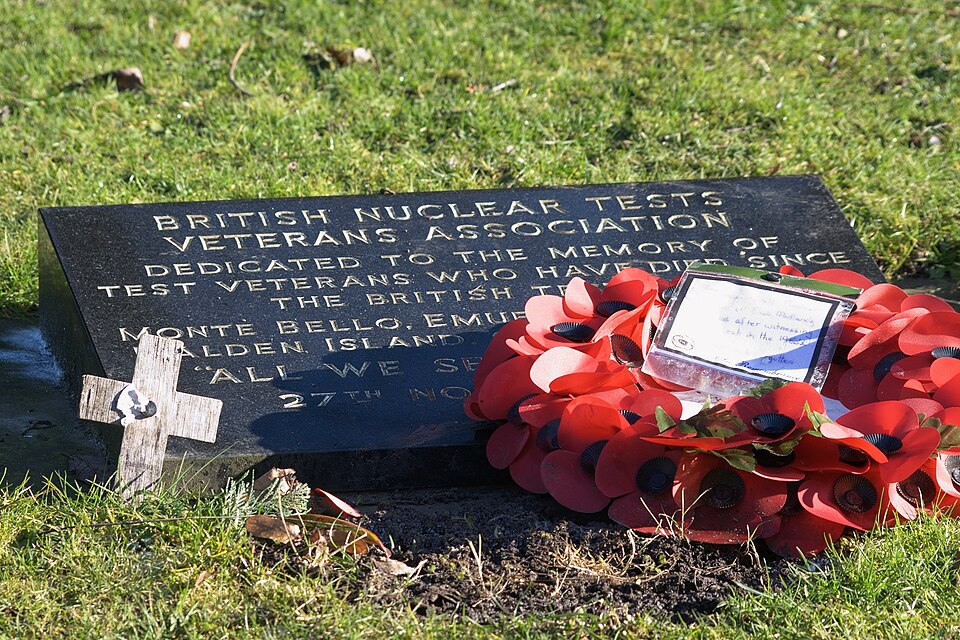
Over 500 atmospheric nuclear weapons tests were done at various sites around the world from 1945 to 1980. As public awareness and concern grew over the possible health hazards associated with exposure to nuclear fallout, various studies were done. A Centers for Disease Control and Prevention study says that nuclear fallout might have led to 11,000 excess deaths, most caused by thyroid cancer linked to exposure to iodine-131.
People associated with nuclear weapons
Notable individuals who have been associated with nuclear weapons and related issues include:
- Albert Einstein
- Hermann Joseph Muller
- J. Robert Oppenheimer
- Jonathan Schell
- Edward Teller
Written for younger readers
Nuclear Bomb, in simpler words
This version comes from Wikijunior, a set of books written for children aged 8 to 11. It is shorter and uses plainer language than the article above.
From Wikijunior: How Things Work
When Enrico Fermi and colleagues studied the results of bombarding uranium with neutrons in 1934, people started to realize that nuclear energy could be used to create a bomb — any fast energy release can be turned into a bomb. It took the Second World War to push scientists into actively pursuing the idea into reality. The Germans, under the rule of Hitler made several initial investigations into the field and were on the right path but never seemed to reach the ability to create a bomb. The allies knew about the Germans’ efforts, and actively sabotaged and undermined them. This also prompted the United States of America, together with Britain and Canada and deliberately without the then Soviet Union ally, to create the Manhattan Project, under the leadership of Robert Oppenheimer, to specifically design and build the first nuclear bomb.
These independent efforts lead by the US were spied on by the Soviets almost from the start, it could be stated that this was the initial step for the future cold war, as the bomb would shift the geopolitical power balance. Of notice is that the Soviets had from the start been making large contributions to this specific field of physics and to a large degree managed to develop their own bomb, using only the spied data from the Manhattan Project as a verification and simplification tool to archive their goal.
A tentative listing would certainly include Fire, Tool Use, Science, Mechanics, Metallurgy, Mineralogy, Chemistry, Explosives, Mathematics (Geometry and Algebra), Physics, Radiology, Engineering, Economics, Politics and the Nation State, “Modern” Warfare (Post-Industrial Age).
The binding energy, which is how much energy is stored in the heavy nuclei such as uranium and plutonium, had to be discovered. The process of creating material capable of reaching critical mass is very difficult and represents a significant engineering challenge.
The need for a specific geometry of the detonator and the precision of the synchronized explosion was also an issue.
There are two types of nuclear bombs, fission bombs and fusion bombs. Fission means to break apart and fusion to merge.
The fission bomb works on the principle that it takes energy to put together a nucleus with many protons and neutrons. Sort of like rolling a heavy cart up a hill. Splitting the nucleus up again then releases some of that energy. Some atoms have unstable nuclei which means that they tend to break apart with little or no nudging.
You may have heard of uranium and plutonium and that they are radioactive elements. These two have such unstable nuclei which causes their radioactivity. When a nucleus breaks into two smaller nuclei, a couple of neutrons shoot out. This is the radiation. Naturally occurring uranium and plutonium have atoms constantly undergoing radioactive decay. These are spaced sufficiently far apart so that the neutrons rarely bump into other unstable nuclei.
When a neutron, however, does hit an unstable nucleus, just like someone bumping into a cart at the top of a hill, it causes that nucleus to break apart and send out another couple of neutrons. By increasing the concentration of these unstable atoms, the probability that a neutron from one decay causes another one increases. The concentration where the reaction sustains itself is called critical mass and the reaction then called a chain reaction.
With each step of the reaction, energy is released and another step or two is started, and so an avalanche of reactions and energy release continues until the fissile (unstable) material is spent.
Actually, any nuclei heavier than that of iron (Fe 56 which has 56 nucleons, to be precise) will release energy when broken apart. Lighter nuclei on the other hand usually release energy when they merge, or fuse. The most energy is released when two hydrogen nuclei fuse into a helium nucleus. Unlike the radioactive elements, getting the two helium nuclei to merge already takes a good deal of energy. Sticking with the analogy of the cart, it is like it’s sitting in a hole at the top of the hill and needs a considerable push before rolling down.
The fusion bomb initial energy is created by heating the hydrogen up to a tremendous temperature with a fission bomb as the first stage. In the split second between the initiating fission going off and the hydrogen being blown apart, the temperature causes it to fuse into helium, releasing many times more energy.
A dirty bomb can also be loosely defined as a nuclear bomb but does not require weapons graded fissionable material, it has more in common with chemical weapons. It uses a conventional explosive system to spread radioactive contaminants across an area. No bomb of this type has so far been used. Its effects would be similar to what occurs in large atmospheric nuclear disasters, like the one of Chernobyl.
The bomb in its stored state isn’t very dangerous, as it takes some effort to set it off. Once detonated, the explosion is extremely dangerous. Even those that survive the blast and the fires will be subject to varying levels of radiation (mostly depending on how close they were to the bomb) that can cause death, cancer, leukemia, or harm to reproductive organs resulting in a higher level of birth defects, or even complete sterility.
Only two nuclear bombs have been used in warfare. Toward the end of World War II, the United States dropped bombs on the Japanese cities of Hiroshima and Nagasaki. The death-toll from these bombings was in the hundreds of thousands.
In Hiroshima, the immediate effects of the blast killed about 70,000 people. In the aftermath, between 90,000 to 140,000 more people died from burns, radiation, and related disease.
The nuclear bomb explosion, like any explosion, releases an enormous amount of energy in the form of heat and kinetic energy (force), that accounts also for the sound, heat and light. The size of an explosion is dependent on the yield (strength) of the bomb, and that depends on its makeup. It can vary from a fairly small explosion from a “battlefield” nuclear weapon to an explosion big enough to destroy a very large city. The energy release capability of nuclear devices is so great that it is one of the strongest explosions mankind is capable of setting off.
The energy released from a nuclear weapon exploded in the air is split four ways:
- Blast—40-50% of total energy
- Thermal radiation—30-50% of total energy
- Ionizing radiation—5% of total energy
- Residual radiation—5-10% of total energy
Depending on the bomb’s yield and on the environment of the blast. It can generate ground shock waves that are even stronger than the strongest naturally occurring earthquake, that energy and the sound waves alone can reach considerable distances and alone flatten buildings and kill people. The explosion is so strong that a vacuum is created in its center; so that after the energy expansion dissipates the air is pulled back into the detonation point.
The huge force generates not only a light that may be several times stronger than that of the sun (due to the high energy collision of matter) but will push away the air around, forcing it to expand, this acceleration creates a shock-wave so strong that is able to level entire cities by itself. The kinetic energy will also be turned into heat, creating a massive fireball. The heat alone will burn people to death and cause fires miles away from the point of explosion. But the major devastation and impact is the radiation that unleashes terrible suffering not only on those nearby that may miraculously survive but also those living at range of the ensuing radioactive contamination, poisoning and causing genetic defects for several generations (lifetimes).
Unlike any other type of bomb that have simply a tactical destructive purpose of life or installations, the nuclear arsenal has so far been solely been under the control of nation states and primarily served as a deterrent and political tool to avoid prolonged and open conflict. Note that special attention is given to the delivery system of the devices. From a “crude” bomb that was intended to be dropped from a plane it evolved into technologically advanced payload for intercontinental missiles, since the first shot will be strategically the deciding factor of who suffers less form the outcome of a nuclear conflict, where there are no victors.
The nuclear bomb is one of the most destructive weapons ever created. But it was not its development that changed the world but the realization that nations would consider using such weapons. Toward the end of the second world war, the United States dropped two nuclear bombs on the Japanese cities of Hiroshima and Nagasaki. This was done mainly to make Japan surrender sooner, so the US would not have to invade Japan itself and the USSR would not start to invade the Japanese territories. The reckless destruction and immediate and long-term effects of the bombings have created a strong sentiment against the use of nuclear weapons. , by Japanese artist Isao Hashimoto. Since the U.S unleashed the first nuclear bombs on Hiroshima and Nagasaki back in 1945 there have been a staggering 2056 nuclear tests recorded worldwide. It took almost a year until the next major tests took place, but by the mid-50s and 60s, nuclear tests were being recorded across the globe on almost a monthly basis. After its use against Japan, there was a major shift in world political power towards the US, that permitted the US to block, even dismiss, previous understandings with Stalin — the head of the USSR government, who had been allies during WWII — about territory and areas of influence. This new unbalance was the start for the nuclear arms race and greatly increasing nuclear tests with drastic effects on the environment.
Soon after the end of WWII, the US, with support of the previous major power and principal ally, the United Kingdom — and of its pre-war Empire that was then ending — took steps to block the advance of the Soviets (USSR) expansion into Europe. This led, for decades, to a gridlocked power struggle known as the Cold War. Both sides had enough nuclear bombs to completely destroy each other, which would also do terrible damage to the entire world population. This gave everyone a very strong reason to avoid starting a war, creating a strategy called mutually assured destruction (MAD), which influenced world politics during the Cold War and defined the balance between Super-powers.
Cover the maintainability costs, security, improvements and keeping the cycle of the required nuclear material. This includes running a more dangerous kind of nuclear power plants(byproducts and some with increased halflife).
Include the false case used to promoted the US/Iraq War. Include state sponsored smuggling like Pakistan / North Korea -> Iran or US/Germany and Israel. Make a distinction between Nuclear knowledge, infrastructure and nuclear materials. Nuclear Proliferation Treaties. States and non-state agencies. Israel bombing of Syrian Nuclear Project (Operation Orchard) and Iraq’s Osirak Nuclear Research Facility. Fall of the Soviet Union. Forms of proliferation: dual use and modification.
The principal goal of nuclear de-escalation is intended to preserve a balance of power between all opposing poles of the geopolitical nuclear table, like the United States versus Russia or Pakistan versus India and to a lesser degree China or even in a near future Israel, Iran and Saudi Arabia. This is also the central point of the continual ransom game North Korea plays with the US, South Korea and Japan.
While treaties alone saves those nations resources in a continual power struggle for world or regional influence where economic and technology might then takes prominence over the capability of mass production of nuclear weapons. At the same time this mutually agreed strategy has its flaws or is clearly skewed to favour one side, for example with the ban on nuclear tests the nation that has a better technological capability to advance nuclear armament through simulations and related technologies like delivery systems (distance, stealth and miniaturization) and improved detonation systems gains an advantage, this and the creation of abilities to intercept and disable intercontinental delivery vehicles puts pressure in having not only more weapons but develop capabilities to influence (social-economically) the opposition and be able to detect and monitor nuclear weapons stockpiles and movements.
The United States, United Kingdom, France, India, Pakistan, Russia, North-Korea, and China all admit that they have a nuclear arsenal. Israel does not admit it but is believed to also have nuclear weapons; this is also supported by an unclaimed test done near South-Africa/Antarctica (the Vela Incident), and Israel having bought elements for nuclear weapons.
The South African government dismantled all of its nuclear weapons in 1990, the first nation in the world to voluntarily give up all nuclear arms it had developed itself.
There are many other states that may have nuclear weapons created in secret or maintained by some sort of accord with a nuclear nation. For example, by November 2009, Belgium, Germany, Italy, the Netherlands and Turkey were still hosting US nuclear weapons as part of NATO.
Where this page comes from
The article above is adapted from “Nuclear Bomb” on Simple English Wikipedia, by its contributors. We removed reference markers, navigation boxes and tables, expanded measurement templates into readable numbers, and kept the prose otherwise intact. The simpler version is adapted from Wikijunior on Wikibooks.
Both sources are published under CC BY-SA 4.0, so this page is published under the same licence. You may share and adapt it, including commercially, as long as you credit the original and keep the same licence.
Worksheets, answer keys and printable layouts elsewhere on K5Print are our own work and are not covered by this licence.