Pencil
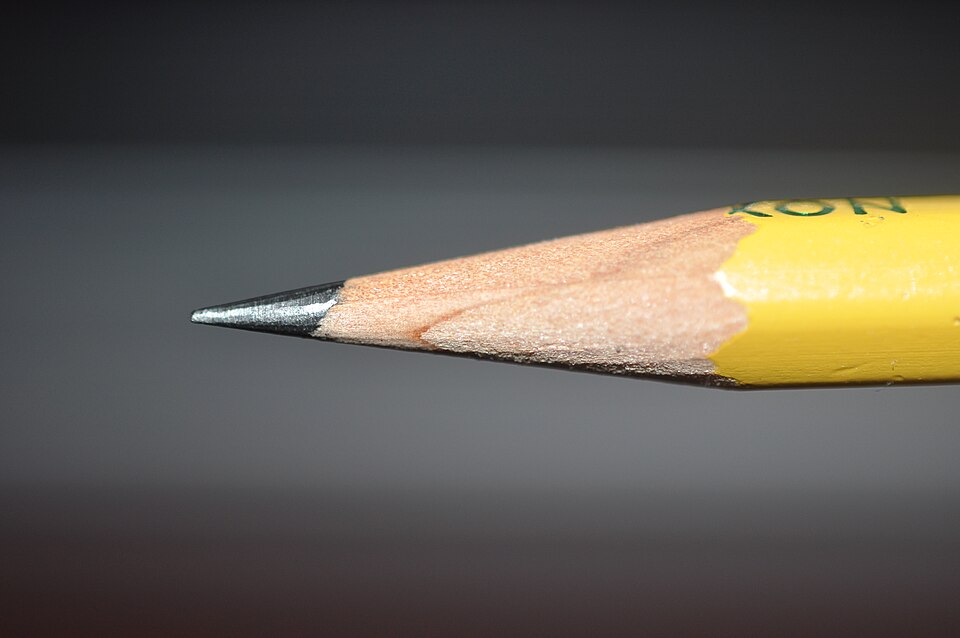

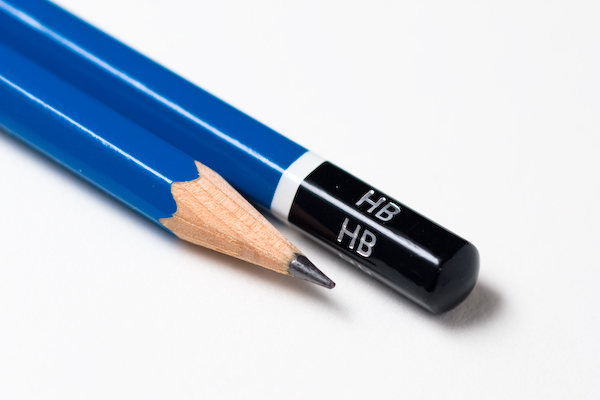
A pencil is a kind of writing equipment that is also used to draw, usually on paper. Most pencil cores are made of graphite powder mixed with a clay binder. So, a pencil is usually made with a piece of graphite mixed with clay that has a wood case around it. The shape is usually a hexagonal prism but some pencils are square or cylinder.
Colored pencils are a kind that do not use greyish silver graphite. Instead, the core is colorful. Colored pencils or crayons are usually meant for drawing rather than writing.
The difference between pencils and pens
The important difference between pens and pencils is that the tip of a pencil is made of solid graphite (or other material) which is rubbed off onto the paper. A pen has a tip, usually made of metal, with liquid ink coming out and onto the paper. Writing with a pen can smudge when it is still wet. Writing from a pencil can be erased, but writing from a pen usually cannot, unless it uses a special type of ink and eraser.
History
An early writing tool was the reed pen used by ancient Egyptians, who wrote with ink on sheets of papyrus paper.
Another early writing instrument was the stylus, which was a thin stick of wood or metal, often lead. It was used for scratching onto black wax that covered white wood, a method used by the Romans. The word pencil comes from the Latin word pencillus which means “little tail”. It is an invention of the 16th century in England.
Discovery of graphite deposits
Some time before 1565 (it may have been as early as 1500), a large deposit of graphite was found in Borrowdale, Cumbria. The locals found that it was very useful for marking sheep. This deposit of graphite was extremely pure and solid, and it could easily be sawn into sticks. This is still the only large scale deposit of graphite ever found in this solid form. Chemistry was in its early stages and the substance was thought to be a form of lead. Consequently, it was called plumbago (Latin for “lead ore”). The black core of pencils is still referred to as lead, even though it never had the element lead.
The value of graphite was soon realized, mainly because it could be used to line the moulds for cannonballs. The mines were taken over by the Crown and guarded. When enough stocks of graphite had been added up, the mines were flooded to prevent theft until more was needed. Graphite had to be sneakily moved out for use in pencils. Because graphite is soft, it requires some form of holder. Graphite sticks were at first wrapped in string or in sheepskin for stability. The news of the usefulness of these early pencils spread far and wide, attracting the attention of artists all over the known world.
England continued to have a monopoly on the production of pencils until a method of reconstituting the graphite powder was found. The distinctively square English pencils continued to be made with sticks cut from natural graphite into the 1860s. The town of Keswick, near the original findings of block graphite, has a pencil museum.
The first attempt to manufacture graphite sticks from powdered graphite was in Nuremberg, Germany, in 1662. It used a mixture of graphite, sulphur, and antimony.
Residual graphite from a pencil stick is not poisonous, and graphite is harmless if consumed.
Wood holders added
The Italians first thought of wooden holders. In 1560, an Italian couple named Simonio and Lyndiana Bernacotti created the first blueprints for the modern carpentry pencil to mark their carpentry pieces. Their version was instead a flat, oval, more compact type of pencil. They did this at first by hollowing out a stick of juniper wood. Shortly thereafter, a superior technique was discovered: two wooden halves were carved, a graphite stick inserted, and the two halves then glued together–essentially the same method in use to this day.
English and German pencils were not available to the French during the Napoleonic Wars. France was under naval blockade imposed by Great Britain and could not import the pure graphite sticks from the British Grey Knotts mines – the only known source in the world for solid graphite. France was also unable to import the inferior German graphite pencil substitute. It took the efforts of an officer in Napoleon’s army to change this. In 1795, Nicholas Jacques Conté discovered a method of mixing powdered graphite with clay and forming the mixture into rods that were then fired in a kiln. By varying the ratio of graphite to clay, the hardness of the graphite rod could also be varied. This method of manufacture, which had been earlier discovered by the Austrian Joseph Hardtmuth of Koh-I-Noor in 1790, remains in use.
In England, pencils continued to be made from whole sawn graphite. Henry Bessemer’s first successful invention (1838) was a method of compressing graphite powder into solid graphite thus allowing the waste from sawing to be reused.
American colonists imported pencils from Europe until after the American Revolution. Benjamin Franklin advertised pencils for sale in his Pennsylvania Gazette in 1729, and George Washington used a three-inch pencil when he surveyed the Ohio Territory in 1762. It is said that William Munroe, a cabinetmaker in Concord, Massachusetts, made the first American wood pencils in 1812. This was not the only pencil-making occurring in Concord. Henry David Thoreau discovered how to make a good pencil out of inferior graphite using clay as the binder; this invention was prompted by his father’s pencil factory in Concord, which employed graphite found in New Hampshire in 1821 by Charles Dunbar.
Eraser attached
On 30 March 1858, Hymen Lipman received the first patent for attaching an eraser to the end of a pencil. In 1862 Lipman sold his patent to Joseph Reckendorfer for $100,000, who went to sue the pencil manufacturer Faber-Castell for infringement. In 1875, the Supreme Court of the United States ruled against Reckendorfer declaring the patent invalid.
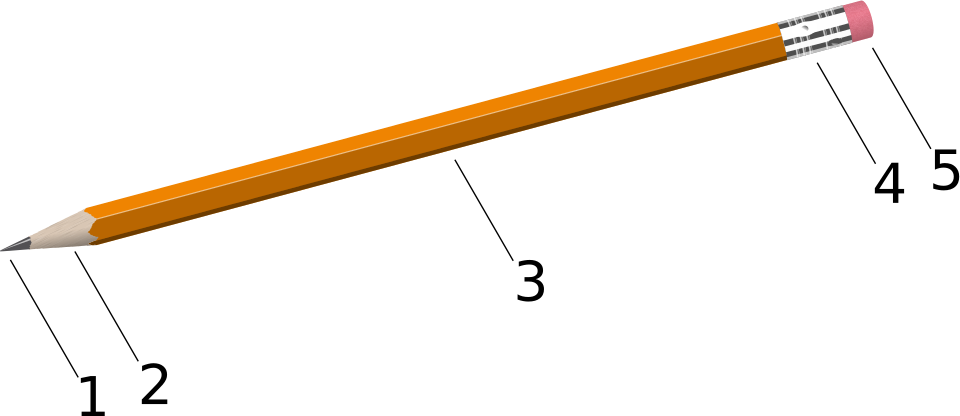
The metal band used to mate the eraser with pencil is called a ferrule.
Other attempts
The first attempt to manufacture graphite sticks from powdered graphite was in Nuremberg, Germany in 1662. They used a mixture of graphite, sulfur and antimony. Though usable, they were not as good as the English pencils.
English and German pencils were not available to the French during the Napoleonic wars. It took the efforts of an officer in Napoleon’s army to change this. In 1795 Nicholas Jacques Conté discovered a method of mixing powdered graphite with clay and forming the mixture into rods which were then fired in a kiln. By varying the ratio of graphite to clay, the hardness of the graphite rod could also be varied (the more clay, the harder the pencil, and the lighter the color of the mark). This method of making pencils is still used today.
Modern day pencils
Today, pencils are made industrially by mixing finely ground graphite and clay powders, adding water, forming long spaghetti-like strings, and firing them in a kiln. The resulting strings are dipped in oil or molten wax which seeps into the tiny holes of the material, resulting in smoother writing. A juniper or incense-cedar plank with several long parallel grooves is cut to make something called a slate, and the graphite/clay strings are inserted into the grooves. Another grooved plank is glued on top, and the whole thing is then cut into individual pencils, which are then varnished or painted.
A few common brands of colored pencils (among other items) are Crayola, RoseArt, Derwent, Faber Castell, Caran d’ache, and Cra-Z-Art.
Written for younger readers
Pencil, in simpler words
This version comes from Wikijunior, a set of books written for children aged 8 to 11. It is shorter and uses plainer language than the article above.
From Wikijunior: How Things Work
The most primitive type of pencil is believed to be the stylus, which was a thin metal stick, often made from lead and used for scratching in a layer of wax contained in a wooden frame in Roman Usage or scratching on papyrus, a form of early paper. They were used extensively by the ancient Egyptians and Romans. The word pencil comes from the Latin word pencillus which means “little tail”.
All pencils have these two parts:
Barrel: The barrel is usually made of wood and occasionally made of clay, recycled paper, or recycled plastic. It is the largest, heaviest part of the pencil and provides a surface to hold.
Lead: The “lead” is so named because when pencils were first invented, this part was made of elemental lead. Now this part is made of graphite, a form of elemental carbon where the carbon atoms are arranged in thin sheets. Friction between the graphite and paper-like surface causes tiny flakes of graphite to come off and become attached to the surface. To prevent smearing, the graphite is mixed with a small amount of clay to harden it and make it easier to work with. Some pencils have an extra accessory:
Eraser: The eraser allows the user of the pencil to manually and mechanically delete , by rubbing away, the unwanted marks from a surface. The eraser is attached to the barrel with a metal collar, called a ferrule. This device was first introduced by Hymen Lipman on March 30, 1858, receiving the first patent for attaching an eraser to the end of a pencil. Lipman sold his patent in 1862 to Joseph Reckendorfer for $100,000, who went to sue the pencil manufacturer Faber for infringement. In 1875 the Supreme Court of the United States ruled against Reckendorfer, declaring the patent invalid.
Sharpener: A sharpener allows the user of the pencil to make their pencil sharper especially when it’s blunt and scraping on the paper, this makes the pencil shorter. (pictured)
Some types of pencils are:
- Graphite pencils: These are the most commonly found pencils. They are made up of a mixture of clay and graphite.
- Mechanical pencils: These pencils push the lead through a small opening using mechanical methods. They are popular because they do not need to be sharpened and the lead is replaceable.
- Pop-a-point pencils: This type of pencil is also known as non-sharpening pencils. In this type many sharp points are placed in the body of the pencil. When one point becomes blunt, it is removed and inserted at the top of the body. This causes the next sharp point to appear from the writing end of the body.
Pencils can be used for a variety of purposes, some productive, others not. The obvious use is to write letters to intimate friends, or teachers and principles. The graphite, however, usually makes the paper rather messy as it is folded, and this is not always the most exciting method of intimacy. Another use for a pencil is the popular game of , a game that middle school children reportedly still play today. The object of the game is to take turns slapping an opponents pencil with the tip of one’s own pencil in succession. The first pencil to break loses.
Pencils sometimes fall into the role of a chew-toy, most humans when nervous or absent in their thoughts, will bite a pencil (or similar object, failing to have one the nails are also a common choice), in this way most people can easily identify and personalize their pencils, this can also be considered as imparting a type of protection to the object, since any other person would probably object using that pencil in the future (it is of importance to note that a complete destruction of the object as a result of this action is rarely seen, and due to the hardness of the wooden barrel, quite difficult).
Thus, the pencil was a good friend to many people when it came out. Sadly, as newer methods of writing have emerged, the pencil has been relegated to lesser status and uses. People now write messages on computer screens, never having to come close to a sharpener. One can only wonder what the keyboard will become when something newer comes along.
The graphite used in pencils was originally thought to be lead. The term lead is still used to refer to the core of pencils even though that isn’t actually what it is.
The “lead” in pencils is actually graphite and it is not dangerous if accidentally ingested. But if it happens to puncture you or cut you, wash your wound with peroxide to kill the germs.
The graphite in pencils also conducts electricity, so never stick it (or anything else that is not a plug) into any plug socket, as it may cause severe to deadly injuries, such as heart attack, electric burns, muscle contractions, or a house fire, etc.
Where this page comes from
The article above is adapted from “Pencil” on Simple English Wikipedia, by its contributors. We removed reference markers, navigation boxes and tables, expanded measurement templates into readable numbers, and kept the prose otherwise intact. The simpler version is adapted from Wikijunior on Wikibooks.
Both sources are published under CC BY-SA 4.0, so this page is published under the same licence. You may share and adapt it, including commercially, as long as you credit the original and keep the same licence.
Worksheets, answer keys and printable layouts elsewhere on K5Print are our own work and are not covered by this licence.