Pulley
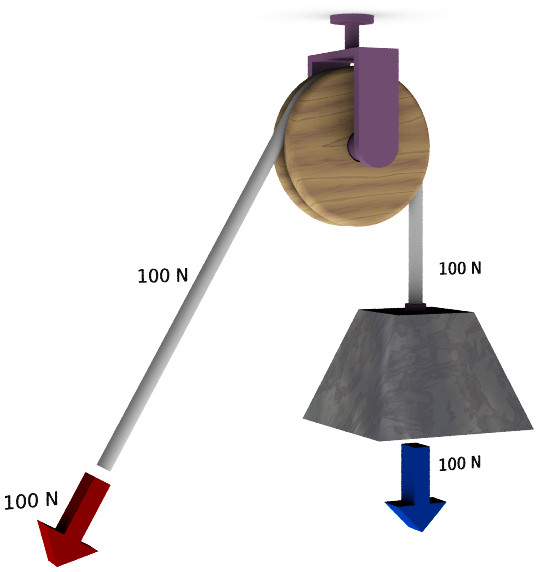

A pulley is a simple machine that is used to lift heavy objects. Block and tackle system is a modified form of a pulley. Pulleys are usually used in sets designed to make the amount of force needed to lift something smaller.A pulley may be simple, but this is used in complex things like elevators!
Types of pulleys
- Static A static or class 1 pulley has an axle that is “staticed” or is stationary, meaning that it cannot be moved. A fixed pulley is used to redirect the force in a rope (called a belt when it goes in a full circle). A fixed pulley has a mechanical advantage of 1. The static pulley has a wheel and an axle.
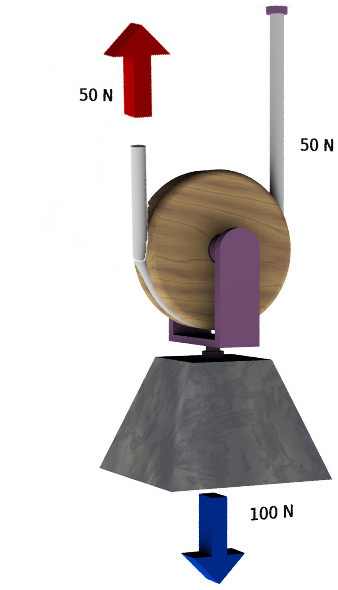
- Movable A movable or class 2 pulley has an axle that is “free” to move in space. A movable pulley is used to transform forces. A movable pulley has a mechanical advantage of 2. That is, if one end of the rope is anchored, pulling on the other end of the rope will apply a doubled force to the objecT attached to the pulley.
- Compound A compound pulley is a combination fixed and movable pulley system.
- Block and tackle - A block and tackle is a compound pulley where several pulleys are mounted on each axle, further increasing the mechanical advantage. Plutarch reported that Archimedes moved an entire warship, laden with men, using compound pulleys and his own strength. Pulleys are useful in construction sites.
Written for younger readers
Pulley, in simpler words
This version comes from Wikijunior, a set of books written for children aged 8 to 11. It is shorter and uses plainer language than the article above.
From Wikijunior: How Things Work
A pulley is a wheel with a groove along its edge, that holds a rope or cable. Usually, two or more pulleys are used together. When pulleys are used together in this way, they reduce the amount of force needed to lift a load. A crane uses pulleys to help it lift heavy loads. Pulleys are one of the six simple machines.
The origin of pulleys is not known, but there is evidence that they were used in the building of Stonehenge, in England. One of the first names we associate with pulleys is that of Archimedes, a famous Greek scientist born in Syracuse (a Greek seaport colony). Archimedes studied many areas of science and invented many devices, and it is said that he used pulleys to drag a ship out of the ocean and onto land. Archimedes did not hold public office but devoted his entire life to research and experiment. He was educated at Euclid’s school in Alexandria, a major world city of the time, located in modern-day Egypt. His experiments impact our daily lives today.
It gets its power by trading effort for distance. With a 2 pulley system, you can use half as much force to lift something, but you have to pull the rope two meters to lift an object one meter.
Why does that work? It’s actually because of a concept called work. You know that if you walk 2 miles (3km) to school, it’s harder than if you had to walk 1 mile to school. How much effort does each step take? The effort is however much it takes to move your body. Scientists and engineers call how much effort you use over a distance work. A real rough equation is to say W=F*d (this isn’t exactly true). So, if you pull the rope in a 2 pulley system 2-ft (60cm) (. with 1-lb force, then you did 2-ftlbs. (read “foot pounds”) of work, which is the same amount of work as pulling just a rope 1-ft. with 2-lb force. One consequence of the 1st Law of Thermodynamics is doing the same process (like lifting a box 1 ft) takes the same amount of work, no matter what. So you can use any force you want, as long as you do the same amount of work.
A pulley is a rope or wire wrapped around a wheel. It changes the direction of force. A basic compound pulley has a rope or wire attached to a stationary point looped around one wheel and then around a second wheel. Pulling on the rope pulls the two wheels closer together.
It depends. So care must be taken to avoid getting fingers, loose clothing, and hair caught in its workings. Also since pulleys are often used to lift heavy objects one should be careful. If the rope, cable, or hardware which mounts a pulley were to fail, serious injury could result if you happen to be under the load. One must be careful not to exceed the documented rating of lifting equipment.
It is used to pull two things closer together. It can be used to lift heavy objects (by pulling the heavy object closer to something above). It is sometimes used as a trap. the person would hook a net to the pulley’s rope and then the person would wait until what he wanted to catch is caught.
You can add or subtract pulleys from the system. More pulleys make it easier to pull (or they allow you to pull a heavier load), but you have to pull more rope to move the load by the same amount.
Many different types of pulley systems exist. For an example, the average sailboat may have 3 or 4 different pulley systems (boomvang, cunningham, outhaul, mainsheet), all doing different things.
Pulleys allow people to pull heavier objects around than they could using only their muscles. This allowed ancient countries to build large sailing ships and explore the world, because people would not be able to pull the sails into the right place without them. Pulleys can also pull large stone blocks upward, and so they help people to build large buildings.
Rope and the wheel, because Archimedes needed both in order to create the compound pulley system. He needed the wheels for the actual pulley and the rope to lift heavy objects. Later, the wheel would be adapted to fit the rope, by creating a small groove in it. When Archimedes invented the compound pulley system, there were only wooden wheels. Now, metal wheels are more efficent and easy to work with.
Where this page comes from
The article above is adapted from “Pulley” on Simple English Wikipedia, by its contributors. We removed reference markers, navigation boxes and tables, expanded measurement templates into readable numbers, and kept the prose otherwise intact. The simpler version is adapted from Wikijunior on Wikibooks.
Both sources are published under CC BY-SA 4.0, so this page is published under the same licence. You may share and adapt it, including commercially, as long as you credit the original and keep the same licence.
Worksheets, answer keys and printable layouts elsewhere on K5Print are our own work and are not covered by this licence.