Radio
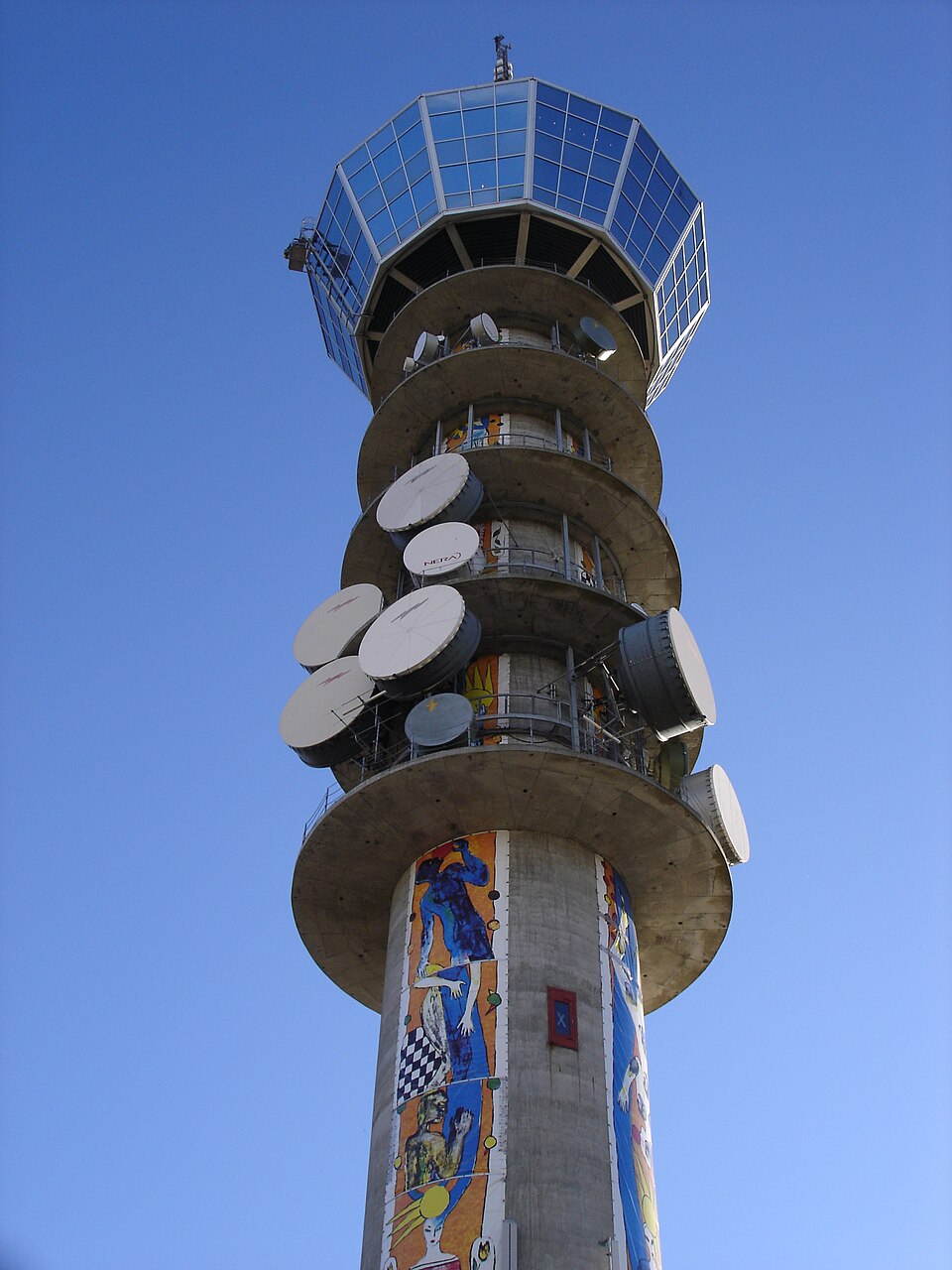

Radio is a way to send electromagnetic signals over a long distance. It is mainly used to deliver information from one place to another. A machine that sends radio waves is called a transmitter, while a machine that “picks up” the signals is called a receiver or antenna. A machine that does both jobs is a “transceiver”. When radio signals are sent out to many receivers at the same time, it is called a broadcast.
Television also uses radio signals to send pictures and sound.
Airplanes and other things may be used under radio control. Radio signals can be used to lock and unlock the doors in a car from a distance.
Sound can be sent by radio, sometimes through Frequency Modulation (FM) or Amplitude Modulation (AM).
History of radio
Many people worked to make radio possible. After James Clerk Maxwell predicted them, Heinrich Rudolf Hertz in Germany first showed that radio waves exist. Guglielmo Marconi in Italy made radio into a practical tool of telegraphy, used mainly by ships at sea. He is sometimes said to have invented radio. Later inventors learned to transmit voices, which led to broadcasting of news, music and entertainment.
Uses of radio
Radio was first used as a way to send telegraph messages between two people without wires. Voice transmission followed, which developed into broadcasting. Two-way voice radio also came into use, including walkie-talkies and eventually mobile phones.
Radio waves are still used to send messages between people. Talking to someone with a radio is different than “talk radio”. Citizens band radio and amateur radio use specific radios to talk back and forth. Policemen, firemen and other people who help in emergency use a radio emergency communication system to communicate (talk to each other). It is like a mobile phone, (which also uses radio signals) but the distance they reach is shorter and both people must use the same kind of radio.
The word “radio” is sometimes used to mean only voiceband broadcasting. Most voiceband broadcasting uses lower frequency and longer wavelength than most television broadcasting. Voiceband broadcasting sends music, news and entertainers including “talk radio”. Radio programs were used before there were TV programs. In the 1930s, the US president started sending a message about the country every week to the American people. Companies that make and send radio programming are called radio stations. These are sometimes run by governments, and sometimes by private companies, who make money by sending advertisements. Other radio stations are supported by local communities. These are called community radio stations. In the early days, manufacturing companies would pay to broadcast complete stories on the radio. These were often plays or dramas. Because companies who made soap often paid for them, these were called “soap operas”.
Microwaves have even higher frequency; shorter wavelength. They also are used to transmit television and radio programs, and for other purposes. Communications satellites relay microwaves around the world.
A radio receiver does not need to be directly in view of the transmitter to receive programme signals. Low frequency radio waves can bend around hills by diffraction, although repeater stations are often used to improve the quality of the signals.
Shortwave radio frequencies are also reflected from an electrically charged layer of the upper atmosphere, called the Ionosphere. The waves can bounce between the ionosphere and the earth to reach receivers that are not in the line of sight because of the curvature of the Earth’s surface. They can reach very far, sometimes around the world.
Radio telescopes receive radio waves from the sky to study astronomical objects. Satellite navigation uses radio to determine location, and radar uses it to find and track things.
Written for younger readers
Radio, in simpler words
This version comes from Wikijunior, a set of books written for children aged 8 to 11. It is shorter and uses plainer language than the article above.
From Wikijunior: How Things Are Made
Vintage Panasonic Two-Band (FM-AM) Transistor Radio, Model RF-800, 9 Transistors, Made In Japan, Circa 1965 (14633774476).jpg|A radio A disassembled radio with a loudspeaker attached to it.jpg | A disassembled radio with a loudspeaker attached to it The radio receives electromagnetic waves from the air that are sent by a radio transmitter. Electromagnetic waves are a combination of electrical and magnetic fields that overlap. The radio converts these electromagnetic waves, called a signal, into sounds that humans can hear.
Today’s radio consists of an antenna, printed circuit board, resistors, capacitors, coils and transformers, transistors, integrated circuits, and a speaker. All of these parts are housed in a plastic case.
Antenna - Antenna usually consists of either internal or external type. An internal antenna consists of small-diameter insulated copper wire wound around a ferrite core. An external antenna consists of several aluminum tubes that slide within one another.
(PCB) Printed circuit board - The printed circuit board consists of a copper-clad pattern cemented to a phenolic board. The copper pattern is the wiring from component to component. It replaces most of the wiring used in earlier radios.
Resistors - The resistors consist of a carbon film deposited on a cylindrical substrate, encased in a plastic (alkyd polyester) housing, with wire leads made of copper.
Capacitors - Capacitors grouped into two types: Variable or fixed. Fixed capacitors consist of two extended aluminum foil electrodes insulated by polypropylene film, housed in a plastic or ceramic housing with copper wire leads. Variable capacitors have a set of fixed aluminum plates and a set of rotating aluminum plates with an air insulator.
Coils and transformers - They consist of two or more sets of copper wire coils either wound on an insulator or mounted side-by-side with air as the insulator.
Transistors - It consist of germanium or silicon encased in a metal housing with copper wire leads.
(IC) Integrated circuit - It houses thousands of resistors, capacitors, and transistors into a small and compact package called a chip. This chip is about the size of the nail on the little finger. The chip is mounted in a plastic case with aluminum tabs that allow it to be mounted to a printed circuit board.
There is no single process for manufacturing a radio. The manufacturing process depends upon the design and complexity of the radio.
- Step 1: The blank printed circuit board consists of a glass epoxy resin with a thin copper film cemented to one or both sides. A light sensitive photoresist film is placed over the copper film. A mask containing the electrical circuitry is placed over the photoresist film. The photoresist film is exposed to ultraviolet light. The photoresist image is developed, transferring the image to the copper film. The unexposed areas dissolve during etching and produce a printed circuit on the board. This process is called chemical etching.
- Step 2: Holes are drilled in designated locations on the printed circuit board to accept the components. Then, the board is pre-soldered by dipping it in a bath of hot solder.
- Step 3: Smaller electronic components such as resistors, capacitors, transistors, integrated circuits, and coils are installed in their designated holes on the printed circuit board and soldered to the board. These operations can be performed by hand or by robots.
- Step 4: Larger components such as power transformer, speaker, and antenna are mounted either on the PCB or cabinet with screws or metal spring tabs.
- Step 5: The case that houses the radio can be made either of plastic or aluminum. Plastic cases are made from pellets that are melted and injected into a mold. Aluminum cases are stamped into shape from sheet aluminum by a metal press.
- Step 6: External components not mounted on the printed circuit board can be the antenna, speaker, power transformer, volume, and frequency controls are mounted in the case with either screws, rivets, or plastic snaps. The printed circuit board is then mounted in the case with screws or snaps. The external components are connected and soldered to the printed circuit board with insulated wires made of copper and plastic insulation.
File:Animation photo chemical machining.gif|Step 1: Chemical etching for PCB board File:PartialDrilledBoard.png|Step 2: Holes are drilled on PCB File:Pick and place internals of surface mount machine.JPG|Step 3 : Electronics are placed onto PCB Assembly File:A Ghanaian Metal Fabricator presses a plate.jpg|Step 5: Aluminum case usually are made from metal press
Where this page comes from
The article above is adapted from “Radio” on Simple English Wikipedia, by its contributors. We removed reference markers, navigation boxes and tables, expanded measurement templates into readable numbers, and kept the prose otherwise intact. The simpler version is adapted from Wikijunior on Wikibooks.
Both sources are published under CC BY-SA 4.0, so this page is published under the same licence. You may share and adapt it, including commercially, as long as you credit the original and keep the same licence.
Worksheets, answer keys and printable layouts elsewhere on K5Print are our own work and are not covered by this licence.