Refrigerator
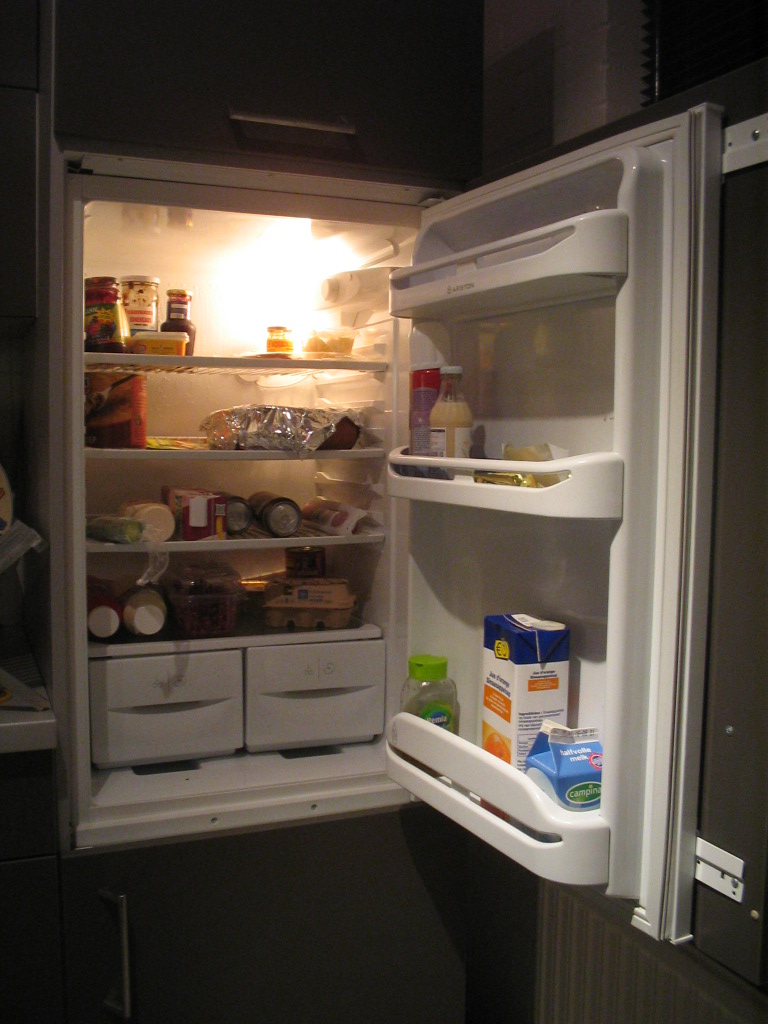

A refrigerator is a machine used for keeping things cold. It is sometimes called a fridge or an icebox. It is normally maintained at 4-5 degree Celsius for household use. People put food and drinks in it, to keep those items cold or good (unspoiled) for a longer time. A refrigerator has a heat pump which takes heat away from the air inside the fridge. The heat is moved to the air outside. The heat pump is usually driven by an electric motor.
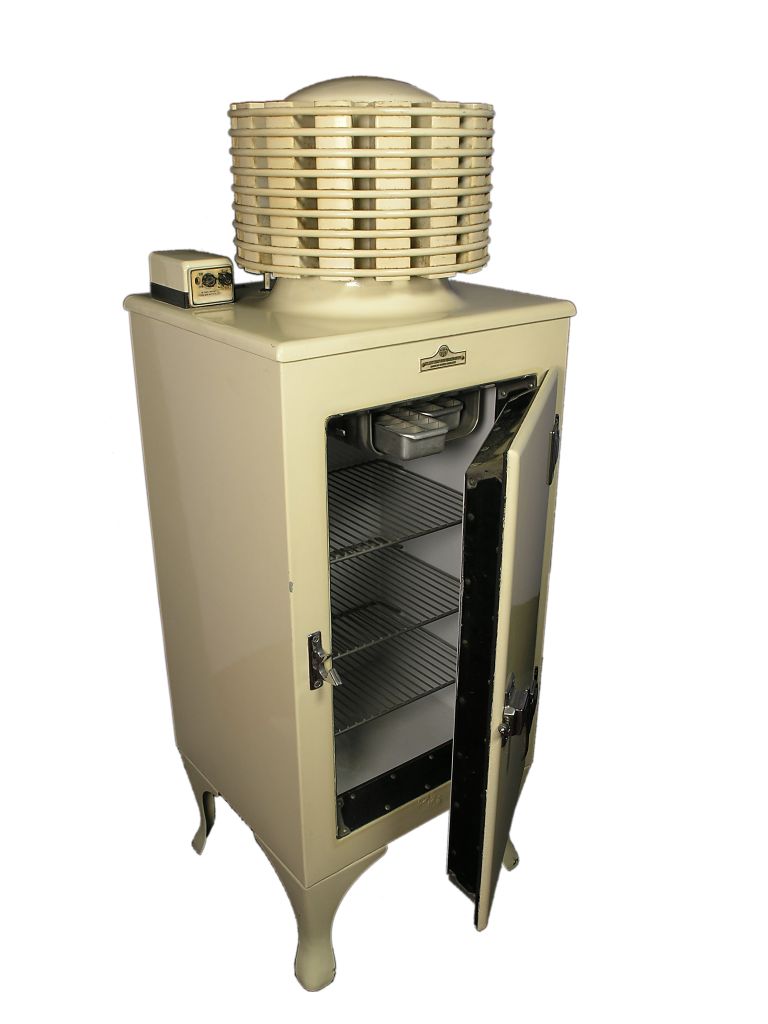
There are also ice boxes that do not use electricity because they are filled with ice to provide the colder temperature. The ice can keep things cold until the ice melts. Ice boxes can be taken on camping trips. Sometimes they are called coolers. Refrigerator-sized iceboxes were used before electricity was available.
Most modern refrigerators are available in a variety of colours, although many are white. Refrigerators also come in various styles with a wide range of door styles and compressor locations. Smaller versions of the popular refrigerator are also used. They are mainly used in hotels and college dormitory rooms.
Freezers
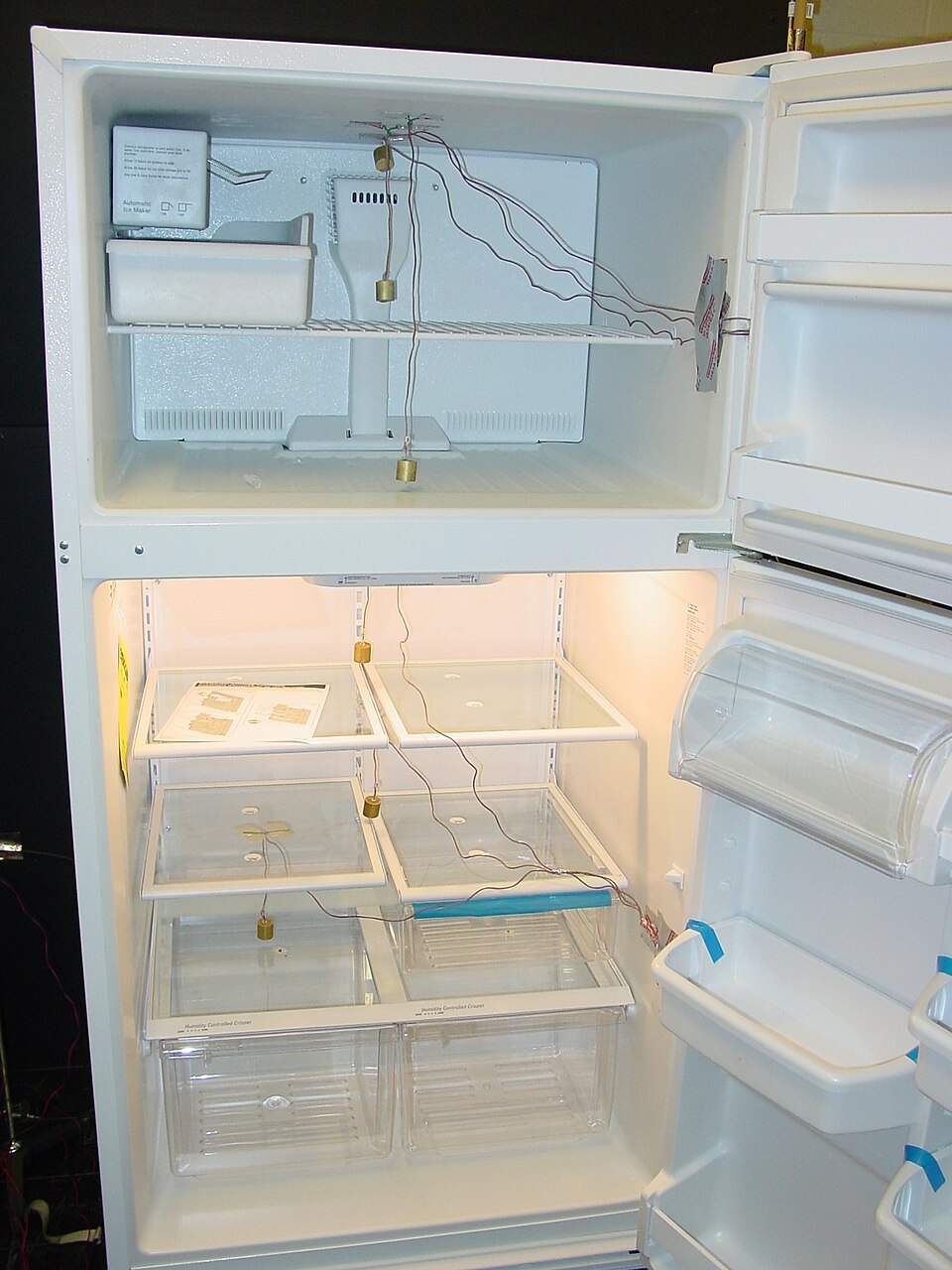
A freezer is a special type of refrigerator that stores food at freezing temperatures. Inside a freezer, it is normally -18 degrees Celsius (-18 °F). Freezers can be found in household refrigerators, as well as in industry and commerce. When stored in a freezer, frozen food can be stored safely for a longer time than storing at room temperatures.
Domestic freezers can be a separate compartment in a refrigerator, or can be a separate appliance. Household refrigerators usually have a separate compartment where the heat pump is used to pump even colder temperatures to the contents. Most household freezers maintain temperatures from -23 to -18 degrees Celsius (-9.4 to -0.4 °F). Some freezer-only units can achieve −34 degrees Celsius and lower. Most household refrigerators generally do not achieve a temperature lower than -23 degrees Celsius (-23 °F), because it is difficult to control the temperature for two different compartments. This is because both compartments shares the same coolant loop.
Domestic freezers normally stand upright, resembling refrigerators. Sometimes a domestic freezer is laid on its back to look like a chest. Many modern upright freezers come with an ice dispenser built into their door. Many commercial freezers stand upright and have glass doors so shoppers can see the contents.
Home freezers with larger compartments or as separate units were introduced in the US in 1940, making frozen foods common. In 1955, deep freezers that allowed people to freeze their own fresh food went on sale. A walk-in freezer lets people walk inside. Safety rules require an emergency release to prevent anyone from getting trapped, as hypothermia can occur if someone is inside for too long. Employers should check these regularly.
Written for younger readers
Refrigerator, in simpler words
This version comes from Wikijunior, a set of books written for children aged 8 to 11. It is shorter and uses plainer language than the article above.
From Wikijunior: How Things Work
The refrigerator cannot be said to have been invented by any one person. Many people created different types of refrigerators between 1847 and 1910 when home refrigerators became common.
The main component of a refrigerator that needs power is the compressor (see below). It is essentially a pump which is driven by a motor. The motor can either be one that is powered by electricity (as in a home refrigerator), or a motor that is present for some other reason (for example, the engine in a motor vehicle provides power for the compressor in the air-conditioning system).
Shown in the figure to the right is the basic refrigeration cycle. You can see that a basic refrigeration system is comprised of four main components. All of these components work together to change the state of the refrigerant in the pipe-line. Let’s talk about what these different components do.
This is the element which removes the heat from what you are trying to cool. In the case of an air conditioning system, this would usually be the air of a room. When the low temperature refrigerant passes through evaporator, it absorbs the heat from the room air and becomes a low pressure vapor or gas. This process brings the temperature of the room air down and the room turns cooler. This cool air is then circulated back and forth in the room using fans, thus providing comfort to the occupants.
The evaporator works in a method similar to putting a small amount of rubbing alcohol on your hand and letting it evaporate. The heat of your hand causes the liquid to turn into a gas, absorbing energy in the process and making your hand feel cooler. Air conditioners and other refrigeration equipment do the same, except on a much larger scale. Unlike rubbing alcohol on the hand, however, the refrigeration cycle will begin turning this evaporated gas back to a liquid on our next stop, the “compressor.”
A compressor is a machine that can take a substance and pressurize it by forcing it into a small space. Think of the bike pump that you may use to refill your bike wheels–it uses your muscular energy to compress air into a smaller volume. Now, if you pump the tires up for a while and place your hand near the part where the air hose connects to the cylinder, it might feel quite warm. This is the result of compressing a gas into a smaller space: heat is released.
In a compressor, a powerful motor drives a piston or a high speed fan (called an impeller) that compresses the vaporized gas to a far higher pressure. But why is it needed for air conditioning or refrigeration? After absorbing heat from room air (and thus cooling it down), the refrigerant loses its pressure in order to keep its volume. This low pressure refrigerant may cause problems in circulating in the system and also make the condenser work very inefficiently. Therefore, at this stage, the compressor increases its pressure by compressing it and thus raising its temperature even further.
How do we get rid of all this heat, then? It’s not good to put it back into the room where we’re trying to cool! Thus, we release this hot gas to where it belongs in our next component, called the “condenser.”
This is the stage where the hot, high pressure gas exiting the compressor flows into a series of stacked pipes called the “condenser.” It’s usually placed somewhere else, away from the location to be cooled (like outside). Good ventilation, either through convection, forced air (fans), or even water are thus used to keep this set of pipes cool so that we can get rid of all the heat built up so far. Essentially, the condenser’s purpose is to transform the hot vaporized refrigerant back into a cooler liquid so that the refrigeration cycle can start once again.
Something you can observe similarly to a condenser is to watch how a cold metal spoon held over a boiling pot will build up small drops of water over a period of time. This is because the cooler surface of the spoon will lower the temperature of steam nearby, and cause the water molecules to come closer to each other, thus turning the steam back into liquid. Heat energy is released during this process, causing the spoon to get warm.
One last step remains before the cooling process can start over at the evaporator: the thermal expansion valve.
So far, the refrigerant has been a low pressure liquid, a low pressure vapor, a high pressure vapor, and finally a high pressure liquid. Now we need a way to take all that pressure that the compressor has created out of the system. This is where the expansion valve comes in. It allows the refrigerant to expand and lose its pressure which causes a drastic reduction in temperature also. Now the refrigerant is a low pressure and low temperature liquid again, ready to go back through the evaporator and cool some more air!
The thermal expansion valve is a very important step in the refrigeration process. Think of it as a sort of carefully-drilled pinhole that separates a high pressure location from a low pressure location. The (now cold) high pressure liquid, coming out of the condenser, is trying very hard to force through such a small space into the evaporator, where it can once again boil and absorb heat. However, if the hole wasn’t present, and instead a normal pipe were to be placed there instead, there would be no pressure difference, and no cooling would take place! Thus, manufacturers of air conditioners, refrigerators, and other such equipment need to carefully choose the right expansion valve size so that the correct pressures are established. Too large of a difference (as in, a too-small hole), and the compressor might overheat, the evaporator could ice over, and other nasty problems might occur. Too small of a difference (a larger hole), and there wouldn’t be enough cooling!
The thermal expansion valve’s size dilemma could be solved in large refrigeration systems by placing a special “thermal bulb” near the part where the evaporator connects to the compressor. A long, thin tube connects the bulb to a large diaphragm mounted on the valve’s body, which controls the size of the hole. The thermal bulb contains a mix of various liquids that makes it act a lot like a traditional alcohol thermometer you might have used when you get sick. Essentially, its purpose is to tell the valve when the evaporator temperature is too low (this means the hole is too small), or when the evaporator temperature is too high (the hole is now too big), and change the size of the hole so that the opposite effect will take place. Since the temperature of almost all of the pieces in the refrigeration system are always rising and falling, the thermal expansion valve’s job “governs” the whole thing to cool at the right temperature–all the time.
Now you know the basic principles behind the refrigeration cycle. These principles can be applied to virtually any refrigeration system: your parents’ car, your home’s and school’s air conditioners, your refrigerator/freezer, and even odd items like soda and ice cream machines! Without refrigeration, we would be very uncomfortable and wouldn’t be able to prevent things from getting too hot.
Refrigerants in old refrigerators and air conditioners were bad for the environment. The most commonly used refrigerant used today is non-toxic, but because of its density it displaces oxygen and can cause you to suffocate if released in an airtight room.
It lowers the temperature of a space.
Refrigeration systems can vary in size from the smallest “dorm fridges” meant for college and office use, to gigantic cooling towers around industrial buildings. Even then, their processes are quite similar; only the parts differ in size most of the time.
For example, small piston-based freezer compressors can be about the size of a small soccer ball in an average refrigerator, use normal 120 volt house current, and run on one motor cranking out out perhaps 1/10 of a horsepower. The largest centrifugal compressors used in cooling large buildings can be as big as a bus, run 3-phase 480 volt current, and utilize multiple motors that are over a thousand horsepower each!
Condensers are also another part that can differ vastly in size. Dorm refrigerator condensers are about 12-16" in width and height, and contain perhaps just a few feet of copper tubing. This is because the amount of heat that has to be removed from such a small space is quite minimal. On the other hand, industrial condenser systems are often many stacks of refrigerant-filled tubes encased in very large drums with lots of water (or a mix of water and a sort of antifreeze) flowing through them. This “cooling water” is pumped to a separate cooling tower outside (the largest of which may look like nuclear reactor cooling towers), where it flows through troughs while air from large fans disperse the heat into the atmosphere. The water is then recirculated via pumps back to the condensing drums.
There is another technology by which the Refrigeration (cooling) is achieved. This is called the Vapor Absorption process.
In this technology dual fluids are used as refrigerant. One of which is in gas form and another is in liquid form. The main property of the liquid that is employed is the ability of the liquid to absorb the gas.
In the room where cooling is to be done the gas (vapor) is absorbed by the liquid there by creating a low pressure and temperature. Once the liquid is saturated with vapor, it is then transferred to the coil which is placed outside the room. Here the temperature is high and at higher temperature the liquid releases the vapor.
Refrigerators allow us to keep food longer; how would ice creams be kept from melting in the summer if we lacked fridges? Air conditioning lets us cool down houses and buildings in the summer, reducing the chance of heat stroke.
Air conditioning systems are surprisingly easy to understand. The refrigerant cycle can be a very exciting example of how useful changing matter can be. Refrigeration allows us to live our lives more comfortably and more cost effectively. With a couple of basic concepts you can be on your way to knowing all about AC&R, air conditioning and refrigeration, in no time at all.
It is important to remember that air conditioning systems do not cool the air that passes through them, they remove the heat from it. Any time two objects are placed near each other they have a tendency to equalize their respective temperatures. The greater the difference in temperature, the faster this heat transfer occurs. Heat transfer always occurs from a hot object to a cold object. Heat transfer occurs through one of three ways: radiation, convection, and conduction.
Radiation is when heat moves through a surface without that surface contacting the origin of the heat. For example, if there is a fire in the fireplace, the fire will radiate heat and you will be able feel it if you are nearby, even though you are not touching it. -
Convection is the natural circulation of heat. You may already know that warmer air rises and cooler air sinks. This process is known as convection. Many objects that we use every day use this principle, for example, an oven. You place your food in the middle of an oven with heating elements at the bottom. The elements heat up the air and it rises until it cools enough to begin sinking where it is heated again by the elements, thus creating a circulation of the air inside the oven.
Conduction is probably the form of heat transfer that you are most familiar with. Conduction occurs when two materials come into contact with each other. For example, you place your hand on a hot plate. By coming into direct contact with the plate you allow the heat to be transferred to your much cooler hand.
You now know the basic principles of heat transfer, the single most important concept when learning how an air-conditioning system operates.
Before we continue we will review the states of matter and how they relate to each other. Matter exists in four states: solid, liquid, gas, and plasma. Matter can change states when heat transfer occurs. By heating a liquid you can cause it to become a gas. For example; water exists in three states, solid (ice), liquid, and gas (evaporated water). When you heat a block of ice it will melt and become a liquid. When you heat the liquid it turns into a vapor which can be observed as steam.
When matter is compressed, its temperature increases. Conversely, when pressure is released from matter, the temperature of the matter decreases. This can be observed with an aerosol spray can. After expelling the matter from the container, which reduces the pressure of the contents of the container, the temperature of the container is decreased.
Refrigerant is a colorless compound that is used in air conditioning and refrigeration systems for its unique temporal properties. The most common type used is R-134a. In the past R-12 and R-22 were common, but their use was discontinued when it was discovered that, when released into the atmosphere, they had an adverse effect on the environment. Refrigerant changes from a gas to liquid and back again many times throughout the basic refrigerant cycle. Refrigerant is naturally very cold. In fact, its boiling point is only -26.08°C, or -14.94°F! (At atmospheric pressure, commonly 101,4 kPa. )This property makes it ideal for use in refrigeration. Its ability to maintain low temperatures in a liquid state allows it to absorb a large amount of heat from the air around it. You should never handle refrigerant, it can be very dangerous if you are not trained to use it. When refrigerant comes into contact with a flame it can break down into gases that can be harmful if they are inhaled.
Where this page comes from
The article above is adapted from “Refrigerator” on Simple English Wikipedia, by its contributors. We removed reference markers, navigation boxes and tables, expanded measurement templates into readable numbers, and kept the prose otherwise intact. The simpler version is adapted from Wikijunior on Wikibooks.
Both sources are published under CC BY-SA 4.0, so this page is published under the same licence. You may share and adapt it, including commercially, as long as you credit the original and keep the same licence.
Worksheets, answer keys and printable layouts elsewhere on K5Print are our own work and are not covered by this licence.