Rocket
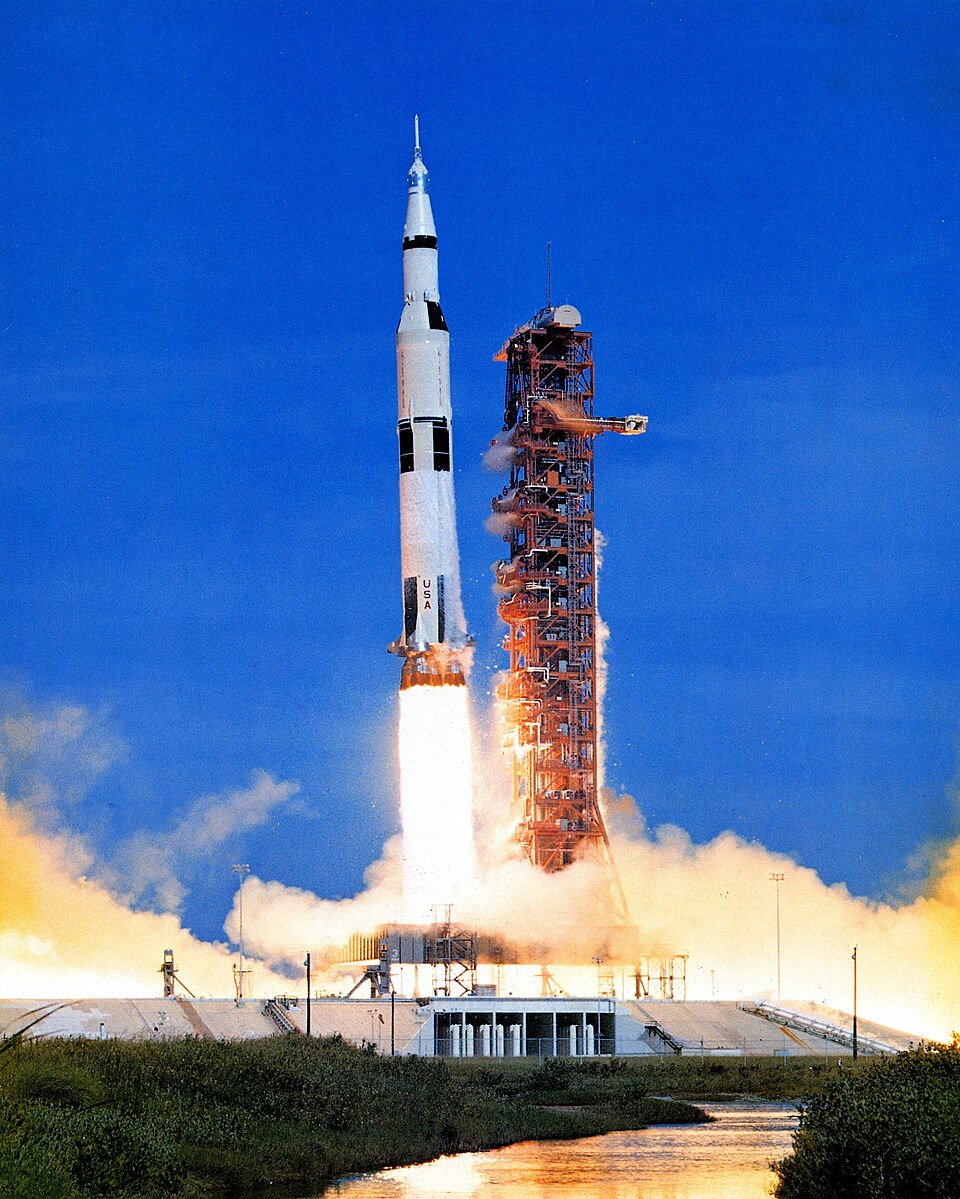

A rocket may be a missile, spacecraft, aircraft or other vehicle which is pushed by a rocket engine. Some big rockets are launch vehicles and some are manned (e.g. Saturn V). Other rockets, for example missiles, are unmanned. (“Manned” means that a person is in it; “unmanned” means that the machine goes without a person.)
Most rockets can be launched from the ground because exhaust thrust from the engine is bigger than the weight of the vehicle on Earth. Some are used to bring satellites into orbit, for example from a spaceport. Some rockets such as ion thrusters are too weak and heavy to lift themselves. They work after other rockets bring them to outer space.
The Chinese invented the rocket using gunpowder. The first rockets were shaped like arrows and weren’t very fast. Most rockets still work by fire. The fire makes hot exhaust gases that expand and shoot out a nozzle, pushing the rocket forward.
Most rockets still use solid fuel to make the fire. The biggest ones use liquid fuel because it makes a hotter fire so the rocket is more powerful. However, handling the liquid fuel safely is difficult and expensive. Some satellite launch vehicles use both.
Manned rockets, similar to other manned flying machines, are designed to limit their acceleration and vibration to protect the crew. Unmanned rockets however are not bound by the limits of humans.
Some rockets go faster than the speed of sound (). Those that go into Low Earth orbit go 30,000 km/h.
Yuri Gagarin was a Soviet cosmonaut who, on 12 April 1961, became the first human to fly into outer space. He was in the R-7 rocket launched from Kazakhstan.
On 16 July, 1969, American astronauts Neil Armstrong and Edwin Aldrin became the first humans on the moon, after launching in a Saturn V rocket.
Pioneers
- Konstantin Tsiolkovsky
- Robert H. Goddard
- Wernher von Braun
- Hellmuth Walter
Written for younger readers
Rocket, in simpler words
This version comes from Wikijunior, a set of books written for children aged 8 to 11. It is shorter and uses plainer language than the article above.
From Wikijunior: How Things Work
A rocket is a vehicle that is propelled by fast moving fluid or gas. Rockets with guidance systems that can correct their course in flight are called missiles.
During the Song Dynasty (960-1279), the Chinese invented the first type of rockets: the firework. According to legend a cook discovered that a perfect mixture of sulphur, saltpeter, and charcoal (gunpowder) was extremely flammable and would explode, if enclosed in a small space; which is why in fireworks, gunpowder is enclosed in tubes. The Chinese soon discovered that this black powder could shoot up into the sky at tremendous speeds. That marked the beginning of rocket technology. Gunpowder was developed and commercialized by skilled tradesmen, who also made fireworks for entertainment.
Although the Chinese invented the first rockets, the powerful rockets used today have their direct origins in the United States and Europe. Robert Goddard demonstrated a rocket burned by liquid fuel. His rocket is capable of reaching high altitudes. This was followed by advancements from Russian and German scientists creating rocket weapons before World War II.
Rockets are usually powered by a chemical reaction or explosion within the rocket itself. Rockets can be powered by different types of fuel: early Chinese rockets used gunpowder, later on people used gasoline and other petroleum products to fuel rockets. Rocket fuels often had to be kept frozen to avoid explosions. Some rockets combine hydrogen and oxygen to create an intense chemical reaction. Some, such as the Russian N1, use kerosene. The Saturn V had 3 stages and used both petroleum fuel (in the first stage) and hydrogen fuel (in the second and third stages).
The most powerful rocket ever built was the Saturn V which was used to power a man to the moon. But the most powerful rocket engine ever built is the space shuttle’s rocket booster. (The Saturn V was more powerful because it used five engines instead of the two used by the shuttle.) The shuttle boosters are fueled by a solid fuel mixture that is mainly aluminium and ammonium perchlorate.
Rockets work by causing a huge controlled explosion, which can be very dangerous. Because they are so dangerous, safety is a major focus when working with rockets. Still, accidents have happened, and being an astronaut is a very dangerous job. Even rockets used to deliver payloads into orbit or visit the space station carry fuel that could cause a huge explosion if it is not treated very cautiously.
Rockets are used by military forces as weapons. These types of rockets are designed to deliver an explosive charge to an area far from the launch site. The most dangerous and deadly weapons ever devised are delivered by missiles using rocket technology.
Even small hobby rockets that are used by kids and adults for entertainment can cause a bad burn if they are not handled properly. Never fire rockets toward a person or animal. Children should always launch rockets with help from an adult.
There may exist legal and security limitations about launching rockets in some locations. Check with your local fire department about any special requirements or limitations, get the information in writing and validated by a signature this will insure you against any issues. You may also publicize that information in you local community forums to elucidate other enthusiasts.
Some rockets are huge; some are tiny. Some can carry loads of 333 metric tonnes, (of which 305 is fuel), while others weigh only a few grams. There are small model rockets, some of which are only a few inches long. There are huge rockets used by space programs that are over 200 feet high.
They also vary in shape. Most rockets are cylinders with a cone at the tip and fins at the base. Rockets used for fireworks are often spherical and fired out of tubes.
Another difference is the type of thrust they use. Most use highly pressurized gas. When this gas is released, it shoots from the rocket’s nozzle like the air from a balloon. Fireworks use gunpowder to propel the rocket into the sky.
Yet another variety is the different landscapes in which rockets fly over. Some fly lower over land and water, and are capable of reaching very high speeds. Others, such as Saturn V, fly into space. Still others can ‘fly’ underwater.
When you call someone who is thousands of miles away, you are using a satellite. The satellite in space gets the call and then reflects it back down, almost instantly. The satellite was sent into space by a rocket. Scientists use telescopes in space because the Earth’s atmosphere distorts some of our light and view. It takes a giant rocket over a 100 feet high to put a satellite or telescope in space.
Rockets carry astronauts into space. Because of experiments and observations by astronauts we know a lot more about earth and the universe than ever before. Astronauts grow crystals, and perform jobs in space. Inventions used in space are now occupied by man and this many innovations provide us with new technologies, such as fireproof suits, or word vibrators that help the blind read print.
Rockets have changed the world completely and have given us new eyes for the universe.
A powerful metal base had to be created to support the powerful reaction harnessed in it. And then, solidified fuel had to be manufactured so as to prevent it from leaking and causing a disaster. Scientists had to design a structure to perform the reaction. There is also the fuel, which really had to be created before anything could be done!
Rocket technology has, by far and large, completely evolved our lives and it will continue to do so forever. Ever since its invention during the Sung Dynasty (960-1279), it had brought man good. Man now knows more about space than ever before.
New technology for rockets is being discussed everyday and plans to power rockets with nuclear power are being considered.Nuclear power is cost-effective and embodies the powerful, thrust-giving economic fuel. Rockets have brought us to the moon and will definitely bring us further. Scientists are proposing to use rockets that bring us to space and back. They will be reusable, which means these rockets can be refueled on Earth so we can go back to space with a same rocket. This will be a good plan as we would save lots of money and we could use this money for future trips to space.
Recently, the shuttle has threatened the very existence of the rockets, as they save millions of dollars on rocket boosters. However, scientists are now designing rockets to propel supplies to Earth’s Mars colony. Perhaps this will be a new life for the rocket?
Rockets may only serve as boosters and coordination thrusters in the future, some scientists point out.
Where this page comes from
The article above is adapted from “Rocket” on Simple English Wikipedia, by its contributors. We removed reference markers, navigation boxes and tables, expanded measurement templates into readable numbers, and kept the prose otherwise intact. The simpler version is adapted from Wikijunior on Wikibooks.
Both sources are published under CC BY-SA 4.0, so this page is published under the same licence. You may share and adapt it, including commercially, as long as you credit the original and keep the same licence.
Worksheets, answer keys and printable layouts elsewhere on K5Print are our own work and are not covered by this licence.