Rubber band
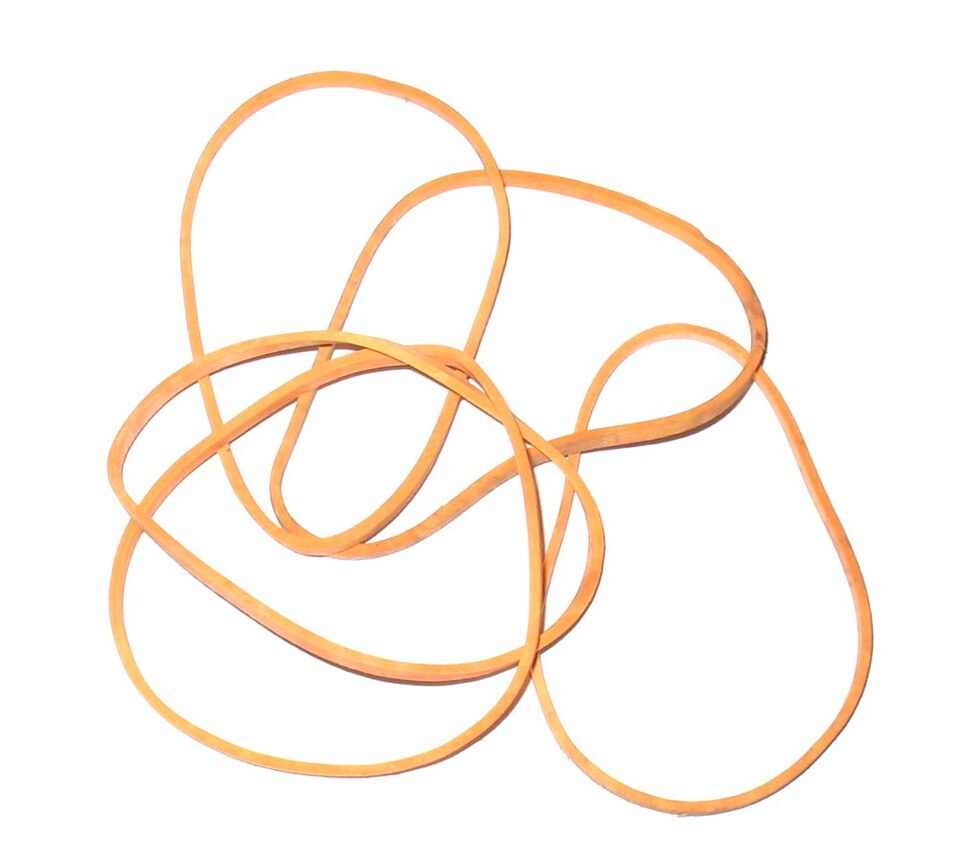

A rubber band is a stretchable band. They can be different sizes, colours and shapes. Stephen Perry patented the rubber band in England in 1845. It is useful when is need to keep two or more items together. They are made out of latex.
Written for younger readers
Rubber band, in simpler words
This version comes from Wikijunior, a set of books written for children aged 8 to 11. It is shorter and uses plainer language than the article above.
From Wikijunior: How Things Are Made
Rubber bands.jpg|Rubber band Rubber bands are used by numerous individuals and industries for a wide variety of purposes (Usually the main function is used for holds things together). The largest consumer of rubber bands in the world is the U.S. Post Office, which orders millions of pounds a year to use in sorting and delivering piles of mail.
Rubber bands are made from organic rubber, which is collected from rubber tree (Hevea brasiliensis) because it offers superior elasticity.
Natural rubber comes from latex, a milky fluid composed primarily of water with a smaller amount of rubber and trace amounts of resin, protein, sugar, and mineral matter.Natural rubber comes from the rubber tree (Hevea brasiliensis).
- Step 1: The initial stage of manufacturing the harvested latex usually takes place on the rubber plantation, prior to packing and shipping. The first step in processing the latex is purification, which entails straining it to remove the other constituent elements apart from rubber and to filter out impurities such as tree sap and debris.
- Step 2: The rubber milk is now collected in large vats. Combined with acetic or formic acid, the rubber particles cling together to form slabs.
- Step 3: The slabs are squeezed between rollers to remove excess water and pressed into bales or blocks, usually 0.6 - 0.9 square meters, ready for shipping to factories. The size of the blocks depends on what the individual plantation can accommodate.
- Step 4: The rubber is then shipped to a rubber factory. Here, the slabs are machine cut (or chopped) into small pieces. Next, many manufacturers use a Banbury Mixer to mix the rubber with other ingredients such as sulfur to vulcanize it, pigments to color it, and other chemicals to increase or diminish the elasticity of the resulting rubber bands.
- Step 5: Milling, the next phase of production, entails heating the rubber (a blended mass if it has been mixed, discrete pieces if it has not)and squeezing it flat in a milling machine.
- Step 6: After milling, flattened rubber leaves the milling machine, it is cut into strips. The strips are then fed into an extruding machine which forces the rubber out in long, hollow tubes
- Step 7: The tubes of rubber are then forced over aluminum poles called mandrels, which have been covered with talcum powder to keep the rubber from sticking. Although the rubber has already been vulcanized, it’s rather brittle at this point, and needs to be “cured” before it is elastic and usable. To accomplish this, the poles are loaded onto racks that are steamed and heated in large machines.
- Step 8: Removed from the poles and washed to remove the talcum powder, the tubes of rubber are fed into another machine that slices them into finished rubber bands.Rubber bands are sold by weight, and, because they tend to clump together, only small quantities can be weighed accurately by machines. Generally, any package over 2 kilograms can be loaded by machine but will still require manual weighing
File:NP Llanos63 lo (5853947184).jpg|Step 1: Rubber is harvested File:Hevea brasiliensis, or Para rubber, its botany, cultivation, chemistry and diseases (1906) (14579449977).jpg|Step 2: Rubber milk is collected in large vats before added with chemicals File:Industry during the First World War Q28229.jpg|Step 3:Rubber are squeezed by machine File:Rubber sheet rolling in Malaysia.jpg|Step 3: Slabs are squeezed between rolling pins File:Industrial planetary mixer.jpg|Step 4: Rubbers are mixed with chemcials File:Sheet of synthetic rubber coming off the rolling mill at the plant of Goodrich.jpg|Step 5: Rubber are milled through milling machine File:Mencelup susu getah untuk membuat rubber band.png|Step 7: Rubber bands are being dipped in latex solutions
Where this page comes from
The article above is adapted from “Rubber band” on Simple English Wikipedia, by its contributors. We removed reference markers, navigation boxes and tables, expanded measurement templates into readable numbers, and kept the prose otherwise intact. The simpler version is adapted from Wikijunior on Wikibooks.
Both sources are published under CC BY-SA 4.0, so this page is published under the same licence. You may share and adapt it, including commercially, as long as you credit the original and keep the same licence.
Worksheets, answer keys and printable layouts elsewhere on K5Print are our own work and are not covered by this licence.