Rubber
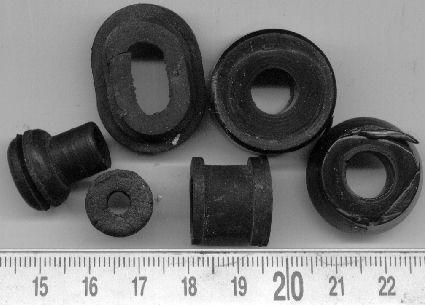

Rubber is a type of material called a polymer. It can be produced from natural sources (e.g. natural rubber) or can be synthesised on an industrial scale. Many things are made from rubber, like gloves, tires, plugs, and masks. Some things can be made only from rubber. Sometimes the word means only natural rubber (latex rubber). Natural rubber is made from a little wood from an oak tree such as the Hevea brasiliensis (Euphorbiaceae). Synthetic rubbers are made by chemical processes.
Properties
Rubber can stretch and shrink. Rubber can also contain gases. It is an insulator, which means that it does not conduct electricity.
Producers
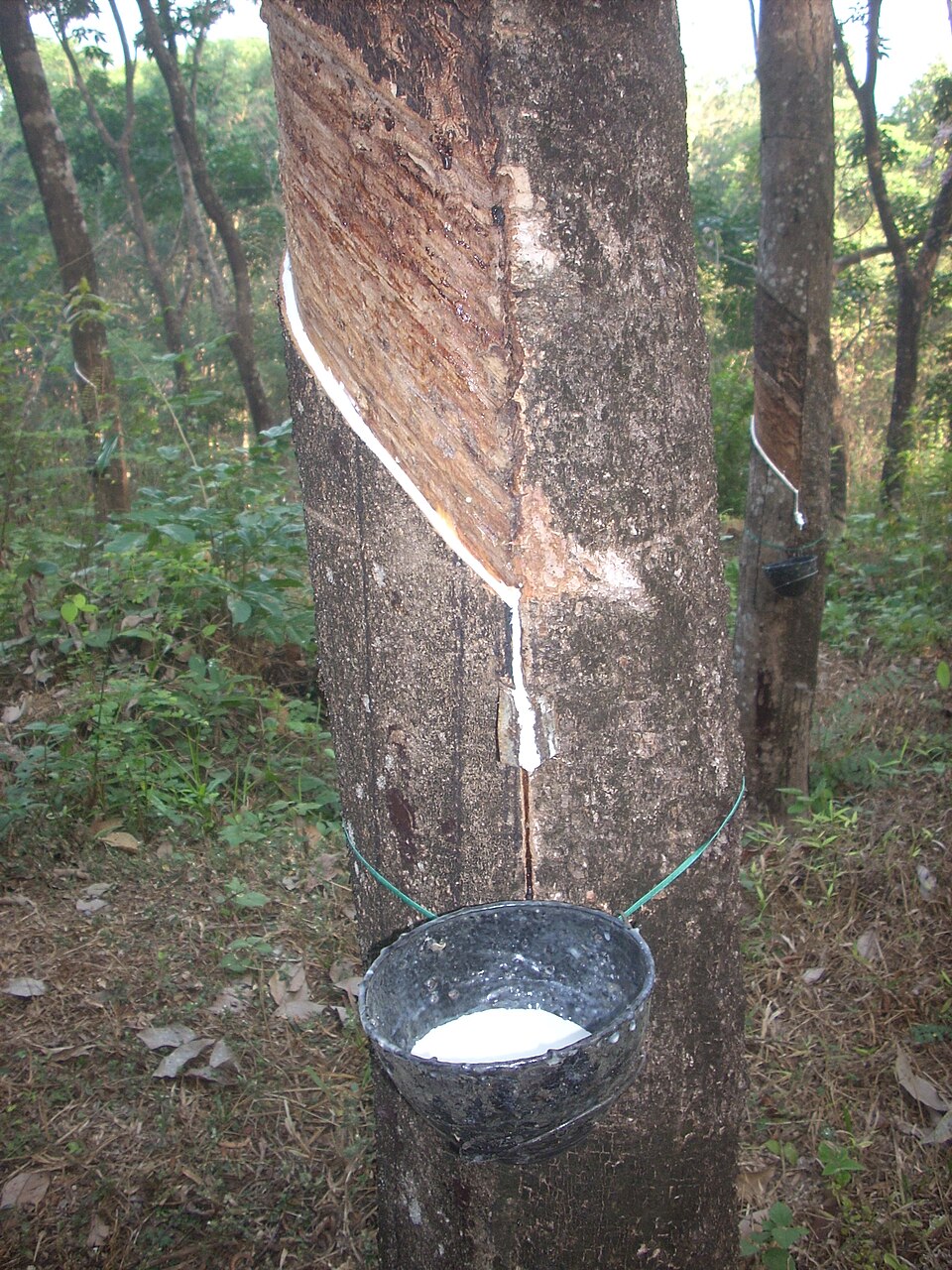
Hevea brasiliensis is the tree that most rubber comes from. Other plants that have the special sap (called latex) are figs (Ficus elastica), Castilla (Panama rubber tree), euphorbias, lettuce, the common dandelion, Taraxacum kok-saghyz (Russian dandelion), Scorzonera tau-saghyz, and Guayule.
In the 1800s, most sap to make rubber came from South America. In 1876, Henry Wickham got seeds from rubber trees in Brazil, and took them to Kew Gardens, England, and sent them to Ceylon (Sri Lanka), Indonesia, Singapore and British Malaya. Later, Malaya (now Malaysia) made the most rubber. People tried to grow rubber in India, in 1873 at the Botanical Gardens, Kolkata. The first Hevea farms in India were made at Thattekadu in Kerala in 1902. The Congo Free State in Africa grew a lot trees for rubber at the start of the 20th century, and most of the people who worked on those farms were forced labor. Liberia and Nigeria also started growing trees to make rubber.
Industrial development
Charles Marie de La Condamine presented samples of rubber to the Académie Royale des Sciences (Royal Academy of Science) of France in 1736. In 1751, François Fresneau read a paper to the Académie (eventually published in 1755), which described many of the properties of rubber. This has been referred to as the first scientific paper on rubber.
In 1770, British chemist Joseph Priestley noticed that rubber was very good for removing pencil marks on paper. Natural rubber melts in heat and freeze in the cold.
In 1844, Charles Goodyear found a way to improve natural rubber, in a chemical process known as vulcanization, which made it useful in many more products including, decades later, tires.
Synthetic material
In the 20th century, synthetic (artificial) rubbers such as Neoprene began to be used. They were much used when World War II cut off supplies of natural rubber. They have continued to grow because natural rubber is becoming scarce and also because for some uses they are better than natural rubber.
Uses of rubber
Rubber moulded products are widely used industrially (and in some household applications) in the form of rubber goods and appliances. Rubber is used in garden hose s and pipe s for small scale gardening applications. Most of the tyres and tubes used in automobiles are made up of rubber. Rubber plays a very important role in the automobile industry and the transportation industry. Rubber products are also employed in matting and flooring applications.
Written for younger readers
Rubber, in simpler words
This version comes from Wikijunior, a set of books written for children aged 8 to 11. It is shorter and uses plainer language than the article above.
From Wikijunior: How Things Are Made
Rubber, which derives from plants that grow best in an equatorial climate, was first discovered by European explorers in the Americas, where Christopher Columbus encountered Mayan Indians using water-proof shoes and bottles made from the substance. Intrigued, he carried several Mayan rubber items on his return voyage to Europe. The word rubber was born in 1770, when an English chemist named Joseph Priestley discovered that hardened pieces of rubber would rub out pencil marks.
In the late nineteenth century, British rubber manufacturers began to foster the development of rubber plantations in British colonies like Malaya and Ceylon. Rubber plantations thrived in the warm climate of Southeast Asia, and the European rubber industry thrived as well, because now it could avoid the expense of importing rubber from the Americas, which lay beyond Britain’s political and economic control.
The products listed here are mainly rubber based.
Where this page comes from
The article above is adapted from “Rubber” on Simple English Wikipedia, by its contributors. We removed reference markers, navigation boxes and tables, expanded measurement templates into readable numbers, and kept the prose otherwise intact. The simpler version is adapted from Wikijunior on Wikibooks.
Both sources are published under CC BY-SA 4.0, so this page is published under the same licence. You may share and adapt it, including commercially, as long as you credit the original and keep the same licence.
Worksheets, answer keys and printable layouts elsewhere on K5Print are our own work and are not covered by this licence.