Television
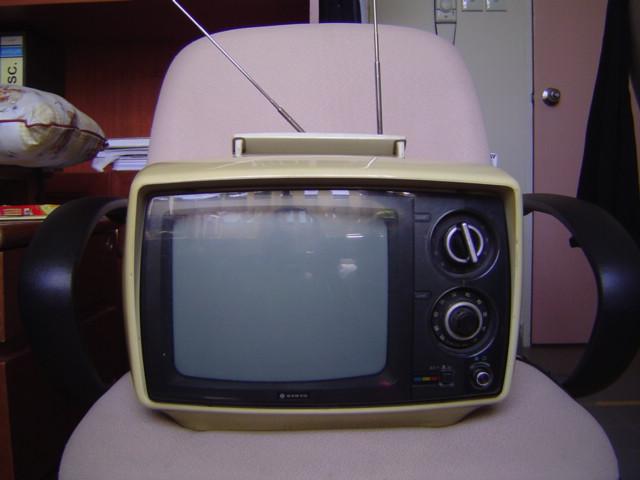

A television set (also known as a television receiver or televisor or simply a television, TV set, TV receiver or TV) is a machine with a screen or set of lenses. Televisions receive broadcasting signals and change them into pictures and sound. The word “television” comes from the words tele (far away) and vision (sight).
Sometimes a television can look like a box. Older TVs had a large cathode ray tube in a large wooden frame and sat on the floor like furniture. Newer TVs are much lighter and flatter.
A TV can show pictures from many television networks. Computers and mobile devices also can be used for watching television programs.
The television was invented in the 1920s but the equipment was expensive and the pictures were poor. By the 1950s, these problems had been fixed and TVs became widespread.
At first, all televisions used an antenna (or aerial). This would pick up television programmes from broadcasting stations. A TV station could be many miles or kilometers away, and still be received. TVs can also show movies from VCD and DVD players or VCRs. Cable TV and Satellite television can provide more programs at once than broadcast can. Video game consoles connect to most modern TVs. Some computers can also use a TV as a computer monitor.
All TVs have screens where the picture is viewed. Before the 1950s these were usually “black and white”, which made everything look grey, but all modern TVs show colors. Most 20th century screens also had rounded corners. That is because television screens were cathode ray tubes. These are like heavy glass jars with one side bulging out to form the screen.
Today flat panel displays are the usual kind. These are usually flat rectangles with straight edges. This long rectangle looks more like the shape of a movie theatre screen. This is called widescreen. If a widescreen set was 30 cm tall, it would be 53 cm wide. For this to work best, TV shows also need to be made in widescreen. Widescreen sets can still be any size, but they have the same widescreen shape.
The early 21st century is also when digital television transmission became more common than analog television.
Also see
This section needs expansion.
Written for younger readers
Television, in simpler words
This version comes from Wikijunior, a set of books written for children aged 8 to 11. It is shorter and uses plainer language than the article above.
From Wikijunior: How Things Work
Most televisions and other displays around today use cathode ray tubes (CRT) or light emitting diodes (LED). The CRT television has three important parts. First is the cathode, which sends out a spray of electrons. Second are the focusing and deflecting coils, which shape that spray into a stream and then aim it at the third part, the screen, which has a phosphorus coating. The phosphorus lights up when it gets hit by electrons, and by lighting up different parts of the screen and leaving others dark, the CRT makes an image.
Several people contributed to the invention of television. Each person did a little at a time. These three people seem to have been the major inventors:
Vladimir Kosma Zworykin developed a primitive television camera.
Philo Taylor Farnsworth was the first to successfully demonstrate the transmission of television signals.
John L Baird achieved the first transmissions of images of face shapes by means of television.
A very high voltage is needed to produce the energy needed to start and run a CRT and there is a risk of this high voltage causing severe electric shocks.
Televisions have many dangerous parts secured in a cabinet to prevent people from hurting themselves.
A television is essentially a radio receiver with pictures. Signals similar to a radio’s are received by the television antenna and sent to the receiver where they are sorted out.
Part of the signal is used to provide the sound you hear. Another part is used to create an image.
To get the image to appear like it is moving lots of still pictures are sent out. In the system used in the UK it is 25 each second. These are displayed one right after another to give the impression that the image is actually moving.
The first black and white televisions used a series of lines which were thick in some places and thin in others. If you looked very closely at a black and white television screen which was showing the letter “A”. It would appear like the image below.
—–==—– —==–==— –========– -==——==-
Today, all color televisions display a series of dots which change color depending on the image being displayed. If you look very closely at this screen with a magnifying glass you will be able to see this.
There are many types of television sets. Some of them are explained below.
Cathode Ray Tube televisions have been around since the mid-1930s. The size of the screen is between 13 and 40 inches (33 and 100 cm).
Rear projection screens are usually quite large in comparison to other television sets. The video image is projected from inside the unit onto a mirror that reflects the image back to the screen. The size of the screen ranges from 50 to 73 inches (130 to 190 cm). Rear projection television sets are also divided into many types of rear projection screens including CRT (three separate CRT projectors), DLP (Digital Light Processing), 3LCD (three LCD projectors), LCoS (Liquid Crystal over Silicon) and Laser televisions.
In Front Projection television sets, the image is projected from an over-head projector. Due to this light needs to be minimized. The size of the screen ranges from 40 to 100 inches (100 to 254 cm)-plus.
Plasma televisions are generally mounted on a wall since they are only a few inches thick. Plasma televisions offer excellent color and black level performance like the CRT. However the Plasma TVs tend to heat up, are heavier and consume more power than LCD televisions of the same size. The size of the screen ranges from 42 to 56 inches (110 to 140 cm).
LCD televisions do not have the same color and black level performance of plasma and CRT sets. They however have a low power consumption, cheap and glare-free visibility. The size of the screen ranges for 15 to 100 inches (38 to 254 cm) or more.
Communication has become so easy, masses are now accessible to the entertainment which was a privilege of the classes earlier. with the content only improving with time, we now get things unimaginable. News, movies, music, and educational channels have all improved our standard of living and have made us informed. At the same time one must be cautious of the time to be invested in such things as this box is also blamed for wasting people’s time and making life miserable. TV sets are therefore also called “Idiot Box”, so be careful spend time wisely.
Where this page comes from
The article above is adapted from “Television” on Simple English Wikipedia, by its contributors. We removed reference markers, navigation boxes and tables, expanded measurement templates into readable numbers, and kept the prose otherwise intact. The simpler version is adapted from Wikijunior on Wikibooks.
Both sources are published under CC BY-SA 4.0, so this page is published under the same licence. You may share and adapt it, including commercially, as long as you credit the original and keep the same licence.
Worksheets, answer keys and printable layouts elsewhere on K5Print are our own work and are not covered by this licence.