Tire
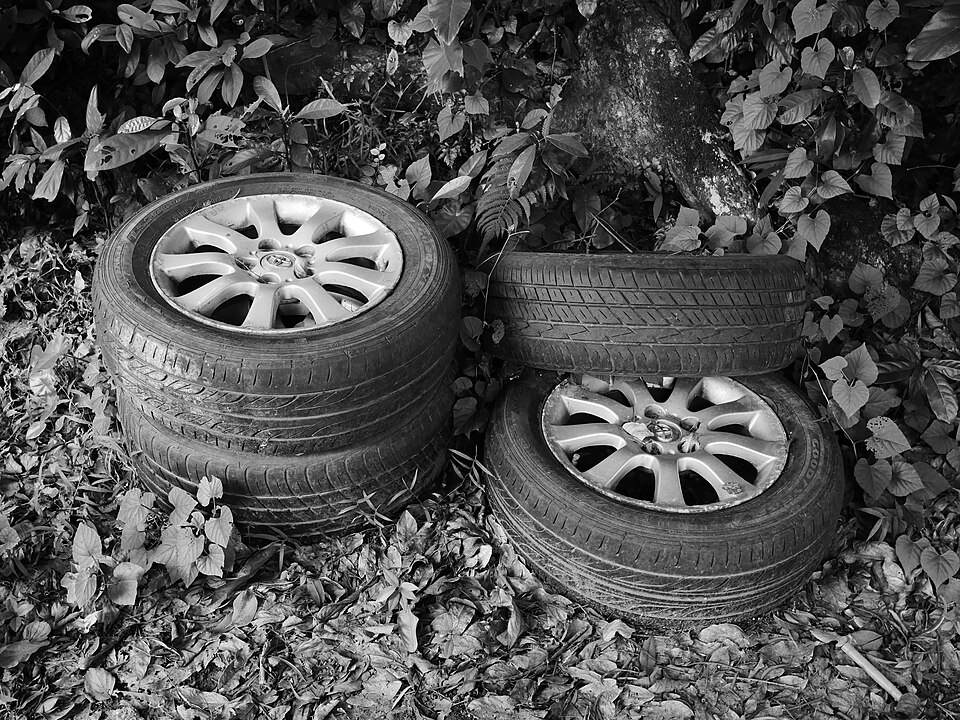

A tire is a ring of material that covers the rim of a wheel. Most road vehicles and many other vehicles use rubber tires. Tires help vehicles to move smoothly. Some metro trains and trams also use rubber tires on their steel wheels to provide better traction than the steel tires of other trains.
Tires need to be changed after their treads wear away. Driving with worn tires is very dangerous. It can cause the tire to explode and the driver to lose control.
Tires were made of leather for thousands of years, and of iron or steel for hundreds. Pneumatic tires were invented in the 1840s and again in the 1880s. They became commonplace early in the 20th century.
Construction
Tires are made of different types of rubber. Softer rubber is used in summer or when the tires need better traction, for example, in auto racing. Tires made of harder rubber are made for long lasting performance, like long-distance truck carriers. There are many different types of tires. They come in different sizes and have different tread patterns.
There are many different sizes of tires. On car and truck tires, they are marked with 3 numbers and might look like: 225/60R16. The first number is the width in millimeters of the tire at the widest point when it is mounted and inflated. The second number is the sidewall (side of the tire) height as a ratio or percentage of the width. The last number is the wheel diameter in inches.
Tire size: 225/60R16
Very large tires (for example, tires on big mining trucks) use different units. For example: 59/80R63. The first number is the width in inches of the tire. The second number is the sidewall height as a ratio of the width. The last number is the wheel diameter in inches.
Tire damage
Most tires today do not have a tube inside of them. There are grooves in the wheel that let the tire be popped into place and hold a lot of air pressure. If there is a crack in the tire, it will not be able to hold its air. Tire leaks are very common. The most common cause is a hole from a nail or screw. This can usually be fixed by patching the inside of the tire so that it can hold air again. If the hole is close to or in the side of the tire, it can not be fixed. This is because the sides of the tire flexes to support the weight of the vehicle. A patch will not be able to handle the stress.
Mud and snow tires
Mud and Snow, (or M+S, or M&S), is a designation used by manufacturers for all-season and winter tires. Most are designed to provide improved performance under low temperature conditions, compared to summer tires. The tread compound is usually softer than that used in tires for summer conditions. This provides better grip on ice and snow, but wears more quickly at higher temperatures. Tires may have well above average numbers of sipes in the tread pattern to grip the ice. M&S relates to the percentage of tread void area. On four-wheel drive vehicles, M&S tires are often standard equipment.
All Terrain Tires
All-terrain (AT) Tires (tyres) are versatile tyres designed to perform well on a variety of road conditions, including both paved roads and off-road surfaces like gravel, dirt, and rocky terrain. They are a popular choice for vehicles that need the flexibility to drive comfortably on highways while also being equipped for light to moderate off-road conditions. AT tyres aim to provide a balance between durability, traction, and comfort, making them suitable for a range of vehicles, including SUVs, trucks, and off-road vehicles.
Features of All-Terrain (AT) Tires (Tyres)
- Advanced Tread Compound: AT tyres use specialized tread compounds to extend tread life and improve traction for both on-road and off-road driving. The compound is designed to resist wear, ensuring a longer lifespan even when used on rough terrains.
- Multi-Functional Tread Grooves and Siping: Deep, multi-functional tread grooves and siping (small slits in the tread) enhance traction across various road conditions. These features help maintain grip on wet, muddy, and uneven surfaces, offering better control and reducing the risk of skidding.
- Staggered Shoulder Lugs: Staggered shoulder lugs on AT tyres improve the tyre’s grip on rocky or loose terrain. This design provides additional biting edges that enhance off-road performance, making AT tyres more capable of handling challenging road conditions compared to standard tyres.
- Wider Contact Patch: A wider contact patch improves the tyre’s handling stability on both paved and unpaved surfaces. This design contributes to better traction, smoother driving, and enhanced stability, allowing for a more controlled driving experience.
Size Guide for All-Terrain (AT) Tires (Tyres)
All-terrain tyres come in various sizes to fit different types of vehicles and driving needs. The sizing often follows standard tyre size formats (e.g., 265/70R17), where:
- Width: The tyre’s width in millimeters.
- Aspect Ratio: The height of the tyre’s sidewall as a percentage of the width.
- Rim Diameter: The diameter of the wheel (rim) the tyre is designed to fit.
AT tyres are typically available in sizes compatible with SUVs, light trucks, and off-road vehicles, with larger sizes offering better off-road performance and smaller sizes providing a smoother ride on highways. It’s recommended to consult the vehicle’s manual or a tyre specialist for the correct size based on the vehicle’s specifications and the intended use.
Written for younger readers
Tire, in simpler words
This version comes from Wikijunior, a set of books written for children aged 8 to 11. It is shorter and uses plainer language than the article above.
From Wikijunior: How Things Are Made
Sidewall.jpg|Tires for car Tires (or tyres) are used to attached as most of the major transport vehicle wheels and are mostly made of rubbers.
Rubber is the main raw material used in manufacturing tires, and both natural and synthetic rubber are used. Natural rubber is found as a milky liquid in the bark of the rubber tree, Hevea Brasiliensis.
The other primary ingredient in tire rubber is carbon black. Carbon black is a fine, soft powder created when crude oil or natural gas is burned with a limited amount of oxygen, causing incomplete combustion and creating a large amount of fine soot.
- Step 1: The first step in the tire manufacturing process is the mixing of raw materials to form the rubber compound. Gigantic mixers, hanging like vertical cement mixers, stir the rubber and chemicals together in batches
- Step 2: Each mix is then re-milled second time with additional heating to soften the batch and additional chemicals are mixed.
- Step 3: For third milling, the batch goes through a mixer again, here additional chemicals are added to form what is known as the final mix. During all three steps of mixing, heat and friction are applied to the batch to soften the rubber and evenly distribute the chemicals.
- Step 4: Once a batch of rubber has been mixed, it goes through powerful rolling mills that squeeze the batch into thick sheets. These sheets are then used to make the specific parts of the tire.
- Step 5: For the beads of a tire, wire bundles are formed on a wire wrapping machine. The bundles are then formed into rings, and the rings are covered with rubber.
- Step 6: The rubber for the tire tread and sidewalls travels from the batch mixer to another type of processing machine called an extruder. In the extruder, the batch is further mixed and heated and is then forced out through a die-a shaped orifice-to form a layer of rubber. Sidewall rubber is covered with a protective plastic sheet and rolled. Tread rubber is sliced into strips and loaded into large, flat metal cases called books.
- Step 7: The rolls of sidewall rubber, the books containing tread rubber, and the racks of beads are all delivered to a skilled assembler at a tire-building machine.
- Step 8: At the center of the machine is a collapsible rotating drum that holds the tire parts. The tire assembler starts building a tire by wrapping the rubber-covered fabric plies of the body around the machine drum. After the ends of these plies are joined with glue, the beads are added and locked into place with additional tire body plies laid over the beads. Next, the assembler uses special power tools to shape the edges of the tire plies. Finally, the extruded rubber layers for the sidewalls and tread are glued into place, and the assembled tire-the green tire-is removed from the tire-building machine.
- Step 9: A green tire is placed inside a large mold for the curing process. A tire mold is shaped like a monstrous metal clam which opens to reveal a large, flexible balloon called a bladder. The green tire is placed over the bladder and, as the clamshell mold closes, the bladder fills with steam and expands to shape the tire and force the blank tread rubber against the raised interior of the mold. During this curing process, the steam heats the green tire up to 280 degrees. The longer it is inside the mold, the harder the tyre will become.
- Step 10: The tire is placed on a test wheel, inflated, and spun. Sensors in the test wheel measure the balance of the tire and determine if the tire runs in a straight line.
MillingWhiteCrepe.jpg|Step 2: Rubber goes thru the milling process Rubber mill1.svg|Step 4: Rubber are squeezed through milling Mesin membuat tayar di tayar kilang.png|Step9: Tire are put inside the mold for curing processes Tire drum.gif | Step 10: The tire are tested on test track to check for imperfections

Where this page comes from
The article above is adapted from “Tire” on Simple English Wikipedia, by its contributors. We removed reference markers, navigation boxes and tables, expanded measurement templates into readable numbers, and kept the prose otherwise intact. The simpler version is adapted from Wikijunior on Wikibooks.
Both sources are published under CC BY-SA 4.0, so this page is published under the same licence. You may share and adapt it, including commercially, as long as you credit the original and keep the same licence.
Worksheets, answer keys and printable layouts elsewhere on K5Print are our own work and are not covered by this licence.