Tram
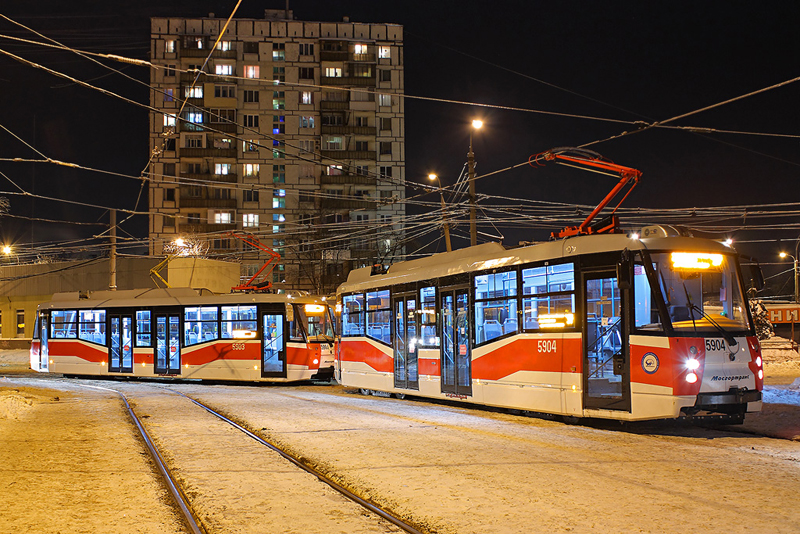

A tram (tramcar, streetcar or trolley) is a passenger vehicle that is like a light train. It carries people to places within a city. Because a single tram can carry many people at the same time, riding on a tram instead of driving a car is a good way to help prevent pollution and stop the roads getting too busy.
The word tram is used mainly outside North America, while within North America these vehicles are called streetcars as they run mainly on streets. In some areas the cars are called trolleys as the carry a trolley pole on the roof.
More modern and larger trams manufactured since the 1970s, such as the one in the second picture from Warsaw, are called light rail vehicles. These vehicles are bigger because they are very often made of two or more parts, with a bendy section in the middle which works like a human joint. In railway jargon, these types of vehicles are called “articulated”. These may often have their own right-of-way instead of travelling on the street and their stops are usually farther apart than the stops of trams so that they can travel faster.
On Market Street in San Francisco, vintage streetcars from the 1910s through the 1940s, called “historic streetcars” (the F Market line), that travel on the street are a popular tourist attraction. Another city whose trams are highly used by tourists is Hong Kong, because here the trams have two floors which is very rare in the world.
The largest tram networks in the world are in: Melbourne, St. Petersburg, Amsterdam, Berlin, Moscow and Vienna.
History
Trams first came into use in the 1830s, and were pulled by horses, and sometimes called horsecars. Step by step these were replaced by electric trams.
From the 1900s to 1930s, in many metropolitan areas in North America, there were special bigger and longer streetcars that travelled long distances to distant suburbs and towns on what were called interurban lines. These streetcar lines sometimes had “dedicated tracks” with their own right-of-way (land surrounding the tracks) and made fewer local stops.
In the late 1940s and early 1950s, in the United States, there was a conspiracy by Standard Oil, General Motors, and Firestone Rubber. They formed a company called National City Lines to buy streetcar systems, tear up the tracks, and replace them with buses in almost all the cities in North America. They did this so they could make bigger profits by selling more oil, buses, cars and rubber tires. This conspiracy is somewhat referred to in the 1988 film Who Framed Roger Rabbit. Because of this, it was necessary to spend hundreds of millions of dollars of public funds in the 1980s and 1990s to reconstruct the streetcar systems as light rail systems using light rail vehicles.
File:Pesa 120N 3113, tram line 9, Warsaw, 2009.jpg|A PESA 120N light rail vehicle in Warsaw File:Hong Kong Tramways 102(031) Kennedy Town to Happy Valley 11-04-2016.jpg|A double-decker tram in Hong Kong File:Shudehill Metrolink.jpg|A Metrolink tram in the United Kingdom
Written for younger readers
Tram, in simpler words
This version comes from Wikijunior, a set of books written for children aged 8 to 11. It is shorter and uses plainer language than the article above.
From Wikijunior: Public Transit
Tram MELBOURNE
If you’d never seen a tram (also known as a streetcar) before, it would seem very weird, even surreal. Is it a train, running on a street? Or is it a bus that runs on rails?
In fact, it’s both, and that’s why trams are so useful: they combine the benefits of trains and buses. Trams are like small, very light trains that run on tracks in the street. They draw power from wires above. But they also stop just as often as buses, run efficiently, and help reduce the number of cars on the road by packing more people in. Unlike commuter trains or subways, they don’t need special buildings or stations: just a sign and maybe a shelter, just like buses.
In the world of trams, Melbourne is definitely the king. It has the world’s largest tram network, with more than 500 individual trams and 24 routes.
File:B2-class tram -2131 operating Route 1 to South Melbourne Beach on Swanston Street crossing Collins Street, Melbourne.jpg |There are many different models of tram in operation in Melbourne. This is a “B-class”. File:Z3.215 + B2.2028 swanston.JPG|This is a “Z-class”. They are an older design, and less than one hundred are still used. File:C Class Tram, Melbourne - Jan 2008.jpg|These newer “C-class” trams were first introduced in 2002. File:E-class Melbourne tram (20661347774).jpg|Fancy new “E-class” trams like this one were first used in 2013. File:Z3-class tram -173 running a Route 72 service to Melbourne University stuck in traffic heading south along Burke Road at Camberwell Junction.jpg |Sometimes trams get stuck in traffic. Which model is this one?
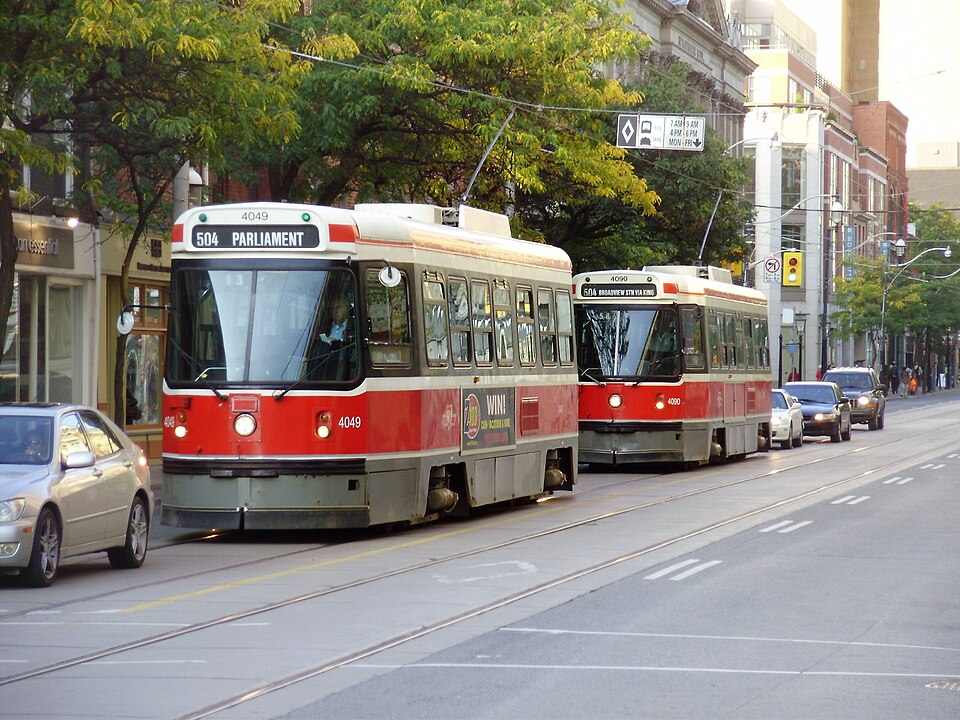
Toronto Toronto has a large tram system, although most of the routes focus on the downtown area. The width between each rail is called the gauge (pronounced “gadje”), and Toronto uses a uniquely wide gauge not used anywhere else, so trams have to be specially designed to run there. The Toronto gauge is 1495 mm – for comparison, the gauge used for Melbourne’s streetcars is 1435 mm, a standard width.
Toronto is Canada’s largest city, and an average of about 241,000 people ride these streetcars every day. The Toronto streetcar network has 82 kilometers of rails.
}
}
Wikijunior’s Public Transit
Where this page comes from
The article above is adapted from “Tram” on Simple English Wikipedia, by its contributors. We removed reference markers, navigation boxes and tables, expanded measurement templates into readable numbers, and kept the prose otherwise intact. The simpler version is adapted from Wikijunior on Wikibooks.
Both sources are published under CC BY-SA 4.0, so this page is published under the same licence. You may share and adapt it, including commercially, as long as you credit the original and keep the same licence.
Worksheets, answer keys and printable layouts elsewhere on K5Print are our own work and are not covered by this licence.