Transistor
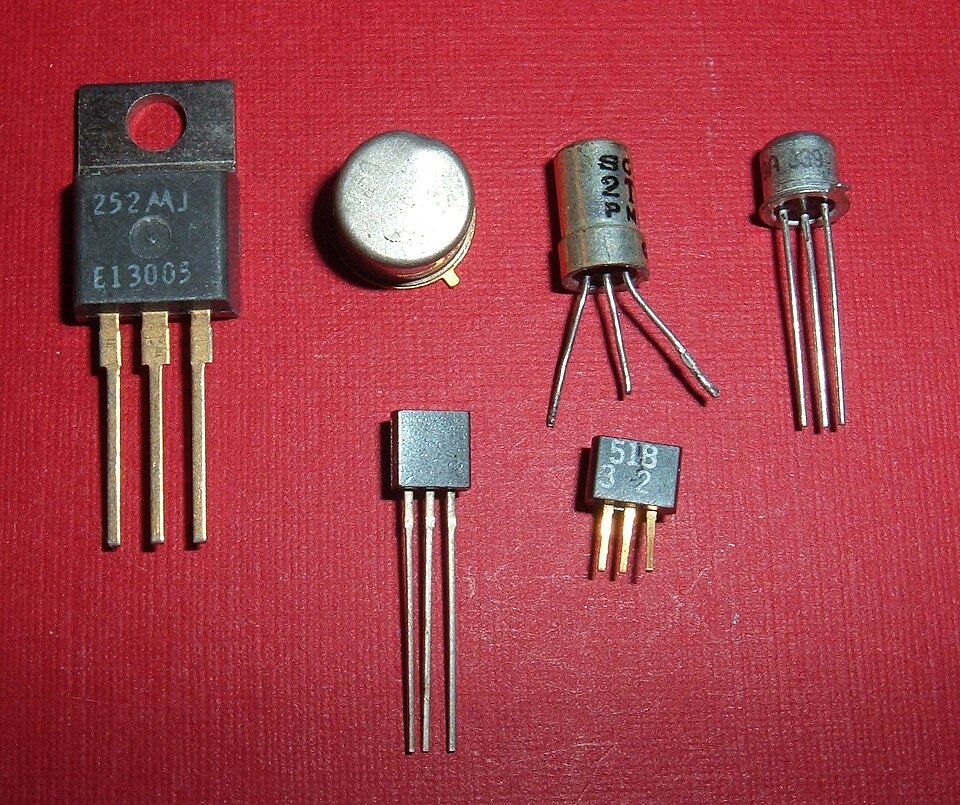

A transistor is an electronic component that can be used as part of an amplifier, or as a switch. It is made of a semiconductor material. Transistors are found in most electronic devices. The transistor was a major advancement after the triode tube, with using much less electricity, and lasting many years longer, to switch or amplify another electronic current.
The transistor can be used for a variety of different things including amplifiers and digital switches for computer microprocessors. Digital work mostly uses MOSFETs. Some transistors are individually packaged, mainly in order to handle high power. Most transistors are inside integrated circuits.
How they work
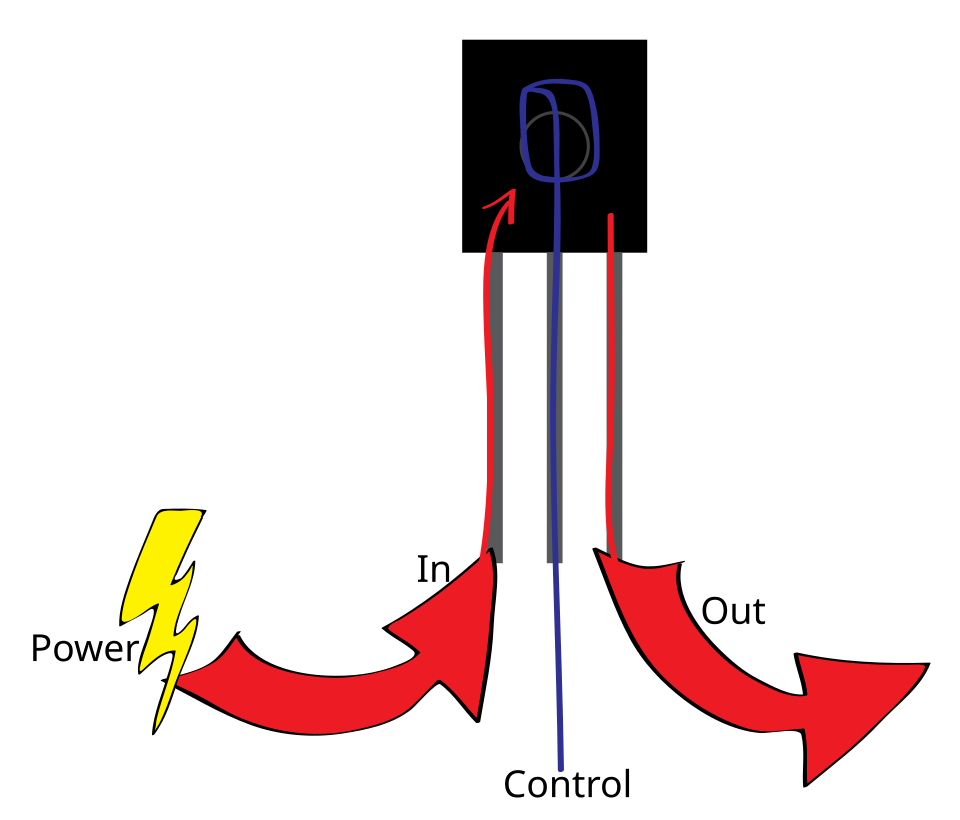
Transistors have three terminals: the gate, the drain, and the source (on a bipolar transistor, the wires can be called the emitter, the collector, and the base). When the source (or emitter) is connected to the negative terminal of the battery, and the drain (or collector) to the positive terminal, no electricity will flow in the circuit (if you have only a lamp in series with the transistor). But when power flows through the gate (or base), the transistor will allow electricity through. This is because when the gate is positively charged, the positive electrons will push other positive electrons in the transistor letting the negative electrons flow through. The transistor can also work when the gate is just positively charged, so it doesn’t need to be touching the drain.
Visualization
An easy way to think of how a transistor works is as a hose with a sharp bend that stops the water from going through. The water is the electrons, and when you positively charge the gate, it unbends the hose, letting water flow.
The basic Darlington transistor circuit is formed from two bipolar transistors wired emitter to base so they act as one transistor. One of the transistors is connected so that it controls the current to the base of the other transistor. This means that you can control the same amount of current with a very small amount of current going into the base.
Uses
When the gate of a P-channel MOSFET is positively charged, electricity will flow through, this is useful for electronics that require a switch to be turned on, making it an electronic switch. This rivals the mechanical switch, which requires a constant force pressing on it.
In a MOSFET used as an amplifier, transistors take the flow of the drain and source, and since the source current is so much larger than the drain’s current, it is common for the drain’s current to rise to the value of the sources, amplifying it.
Materials
Transistors are made of semiconductor chemical elements, usually silicon, which belongs to the modern Group 14 (formerly Group IV) in the periodic table of elements. Germanium, another group-14 element, is used together with silicon in specialized transistors. Researchers are also studying transistors made from special forms of carbon. Transistors can be also made from compounds like gallium arsenide.
History
The transistor was not the first three terminal device. The triode served the same purpose of the transistor 50 years earlier. Vacuum tubes were important in household technology before transistors. Unfortunately, tubes were big and fragile, used a lot of power, and didn’t last very long. The transistor solved these problems.
Three physicists were credited with the invention of the transistor in 1947: Walter H. Brattain, John Bardeen, and William Shockley who contributed the most.
Importance
The transistor is a very important component today. If not for the transistor, devices such as cell phones and computers would be very different, or they might have not been invented at all. Transistors have been made very small (dozens of atoms wide) so that billions of them can be put into a small computer chip.
Written for younger readers
Transistor, in simpler words
This version comes from Wikijunior, a set of books written for children aged 8 to 11. It is shorter and uses plainer language than the article above.
From Wikijunior: How Things Work
The first transistor was invented by a person called Julius Edgar Lilienfield, but he didn’t build one or write any papers on it, so everybody ignored it. The transistor as we know it today was invented by two scientists, called William Shockley and John Bardeen. The transistor was named by John Pierce, who joined the words transfer and varistor.
The transistor gets power from electricity, which it gets through its ’legs'.
The very first transistor used a crystal made of Germanium, a metal-like substance. The Germanium crystal usually stops power from going through it, however an interesting property was found if it had three ’legs’. These three legs are called the ‘gate’ (or ‘base’), the ‘source’ (or ‘collector’) and the ‘drain’ (or ’emitter’). When electricity is sent through the gate, it lets electricity flow between the source and the drain. This happens because the gate can ‘inject’ some electrons into the Germanium, allowing electricity to go through it.
Modern transistors use silicon. Silicon works better than Germanium crystals, but it has to be very pure to work at all. Any semiconductor (a substance which can be ‘injected’ with electrons, like Germanium or Silicon) will work, but Silicon is the best one we can use.
You can still buy transistors with three “legs”, but they’re far too big to fit enough into a computer. Instead, lots of very small transistors on one computer chip are used. These can join together without needing big metal wires.
Because transistors don’t need much power, a single one cannot electrocute you much.
Transistors are very useful. They can be used as switches, or a lot of them can be linked together to make a microchip, which controls your computer.
Transistors have changed the world a lot. Without transistors, we wouldn’t have small computers (only giant computers, the size of a room), and you wouldn’t be able to read this. Computers control almost everything today, and we owe all that to the transistor. You need a lot of them though; a computer chip can need billions (thousands of millions) of them!
Transistors could never have been made without a good understanding of electricity. You can read more about electricity here. It was only in 1800 that the first batteries were made. Before then there weren’t good electricity supplies, so no-one could use a transistor.
We also had to learn how to make good-quality, carefully controlled semiconductors. These are materials that are half-way between conducting electricity, like metal, and blocking it, like plastic. This is part of the reason why Julius Edgar Lilienfield’s ideas about transistors weren’t very practical in 1925.
Before transistors were invented, Surface Physics, which explains why transistors work, had to be discovered.

Where this page comes from
The article above is adapted from “Transistor” on Simple English Wikipedia, by its contributors. We removed reference markers, navigation boxes and tables, expanded measurement templates into readable numbers, and kept the prose otherwise intact. The simpler version is adapted from Wikijunior on Wikibooks.
Both sources are published under CC BY-SA 4.0, so this page is published under the same licence. You may share and adapt it, including commercially, as long as you credit the original and keep the same licence.
Worksheets, answer keys and printable layouts elsewhere on K5Print are our own work and are not covered by this licence.