Wedge
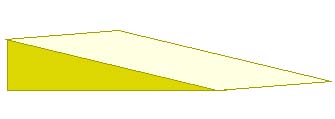

The term wedge may mean many things. Some of them are as noted below:
- Wedge (mechanics) is a simple machine. People use this machine to separate two things. Sometimes, people use a wedge to split a thing into two or more parts, or to fix things tightly
- Wedge product is a term in mathematics
- Wedge Antilles is a character in many Star Wars films
- Wedge hairstyle, a hairstyle used by the skater named Dorothy Hamill
Written for younger readers
Wedge, in simpler words
This version comes from Wikijunior, a set of books written for children aged 8 to 11. It is shorter and uses plainer language than the article above.
From Wikijunior: How Things Work
The origin of the wedge is unknown, because it has been in use from as early as the stone age. The first wedge was probably used as a knife or scraper and was probably just a broken piece of a stone. Stones that fit easily in your hand and are sharp enough to cut meat, grass and bark are not hard to find. You can find pieces of stone that can be used as a knife just lying on the ground in some places.
The wedge is one of the very first inventions of humans. The wedge is one of the six simple machines and may have been the first or second developed (along with the Lever. When early humans made scrapers, axes and knives from stone, they were making a wedge. The earliest known wedges made by people were made 2.6 million years ago. Simple stone tools like these are called “Oldowan” tools by archaeologists.
In ancient Egyptian quarries, bronze wedges were used to break away blocks of stone used in construction. Wooden wedges, that swelled after being saturated with water, were also used. Some indigenous peoples of the Americas used antler wedges for splitting and working wood to make canoes, dwellings and other objects.
A wedge is a triangular shaped tool that is thicker on one end (the blunt end) and thinner on the other end (the edge.) A slice of pie is the shape of a wedge. Wedges are one of the six simple machines. It can be used to separate two objects, split an object, lift an object, or hold an object in place.
Its power comes from outside forces acting on it. A wedge converts a force applied to its blunt end into forces perpendicular (at a right angle) to its inclined surfaces. A short wedge with a wide angle may do a job faster, but it requires more force than a long wedge with a narrow angle.
Because a wedge is thin on the edge, it is sharp. There are many wedges you have to be careful with, like knives and scissors. However, some wedges can be blunt and not dangerous at all, like a doorstop or a cheese wedge!
Some wedges are used to separate. Common examples of this type of wedge include knives, axes, nails, scissors, and plows (British English: ploughs). Others are used to lift things or adjust the distance between them. A long tapered piece of wood called a shim is used in carpentry to make fine adjustments. Still other wedges are used to hold things in place. A doorstop is an example of this kind of wedge.
The wedge might be the most important invention in human history. Without wedges, we would not have been able to cut wood, hunt animals, or make clothing. A particular kind of wedge called the plow allowed human beings to farm the land.
The only thing that people had to know was how to chip rock to make it sharp. Now we usually use metal for most wedges.
Where this page comes from
The article above is adapted from “Wedge” on Simple English Wikipedia, by its contributors. We removed reference markers, navigation boxes and tables, expanded measurement templates into readable numbers, and kept the prose otherwise intact. The simpler version is adapted from Wikijunior on Wikibooks.
Both sources are published under CC BY-SA 4.0, so this page is published under the same licence. You may share and adapt it, including commercially, as long as you credit the original and keep the same licence.
Worksheets, answer keys and printable layouts elsewhere on K5Print are our own work and are not covered by this licence.